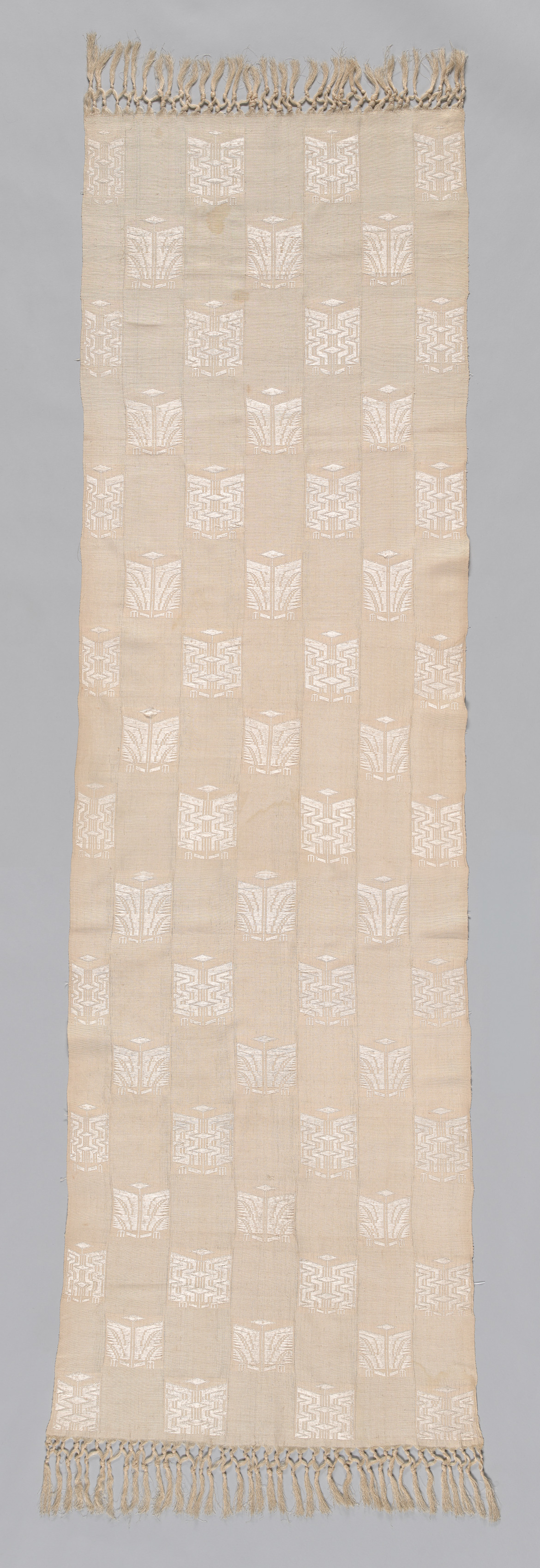
Fabric Deconstruction Analysis: Lamba Landy Fotsy Shawl (Single Specimen)
Specimen Identification and Provenance
Origin: Madagascar, East Africa, circa 16th–17th century.
Material Composition: Silk from Bombyx mori (domestic mulberry silkworm) and Borocera cajani (wild indigenous silkworm, known locally as “landibe”).
Object Type: One half of a pair of ceremonial shawls (Lamba Landy Fotsy), traditionally worn by Merina royalty and high-status individuals.
Archive Resonance: In the long river of human civilization, artifacts and paintings are not only crystallizations of the era’s craftsmanship but also silent witnesses to cultural collision and aesthetic fusion. The 16th–17th centuries marked a period of intensified trade routes across the Indian Ocean, where Malagasy silk textiles became prized commodities, exchanged for gold, ivory, and European goods. This particular shawl fragment embodies a syncretic moment: indigenous weaving techniques meeting imported materials and motifs.
Technical Fiber Analysis
Bombyx mori Silk: The dominant fiber in this specimen is domesticated silk, characterized by its smooth, continuous filament, high tensile strength, and lustrous sheen. Under microscopic examination, these threads exhibit a triangular cross-section and a fine, even diameter, indicative of controlled sericulture. The presence of Bombyx mori silk in 16th–17th century Madagascar is significant. It suggests active trade with either the Ottoman Empire, India, or China, where mulberry silk was mass-produced. This imported material was likely prized for its uniformity and brilliant white color—a stark contrast to the coarser, more irregular wild silk.
Borocera cajani Silk: Interspersed within the weave are fibers from the endemic Borocera cajani moth, whose caterpillars feed on the tafimena tree. This wild silk, known as “landibe,” is shorter, more brittle, and has a natural golden-beige hue. Its surface is rougher, with a higher coefficient of friction, giving the textile a subtle textural irregularity. The inclusion of Borocera cajani silk is a deliberate design choice—not a compromise. It introduces a matte, organic counterpoint to the glossy Bombyx mori, creating a visual and tactile dialogue between the exotic and the indigenous.
Structural Integrity: The warp threads are predominantly Bombyx mori, providing tensile strength and a smooth foundation. The weft alternates between both silks, with Borocera cajani used in patterning bands. This hybrid construction reveals a sophisticated understanding of material properties: the stronger, imported silk supports the structure, while the local wild silk adds decorative depth and cultural resonance.
Weave and Construction Analysis
Plain Weave with Supplementary Weft Float: The ground weave is a balanced plain weave (1/1), typical of Malagasy lamba textiles. However, this specimen is distinguished by its supplementary weft float patterns, where Borocera cajani threads are floated over multiple warp ends to create geometric motifs—diamonds, zigzags, and stepped pyramids. These motifs are not merely decorative; they encode clan affiliations, status hierarchies, and spiritual beliefs. The float length varies from 3 to 7 warp threads, indicating a high degree of manual control and intentional asymmetry.
Selvedge and Edge Finishing: The surviving selvedge is intact on one side, showing a reinforced edge with a 2/2 twill structure. This edge is composed entirely of Bombyx mori silk, suggesting a desire for durability at the borders. The opposite edge is frayed, revealing the original warp fringe was cut or worn away. The absence of a hemmed finish is typical for ritual shawls, where the raw edge was considered symbolically “open” to receive blessings or energy.
Dye Analysis: The “fotsy” (white) designation is somewhat misleading. While the base is undyed Bombyx mori silk, the Borocera cajani threads retain their natural tan. Traces of a red pigment—likely tomentos (Cochineal scale insect) or mokotra (native madder root)—are visible in a narrow band near the center. This red band, now faded to a rust tone, was historically associated with royalty and sacrifice. The absence of indigo or other dark dyes aligns with the shawl’s use in daylight ceremonies, where the interplay of white and gold would catch the sun.
Cultural and Symbolic Deconstruction
Duality and Asymmetry: As one half of a pair, this shawl was originally matched with an identical counterpart, likely worn by a spouse or ritual partner. The pair symbolizes cosmic balance—male/female, sky/earth, ancestor/descendant. Yet this single specimen challenges that symmetry. Its frayed edge, faded dye, and missing mate speak to the fragmentary nature of historical memory. In an avant-garde context, we can reinterpret this incompleteness as a deliberate aesthetic: the beauty of the partial, the power of the vestige.
Material as Metaphor: The juxtaposition of Bombyx mori (imported, uniform, colonial) and Borocera cajani (native, irregular, resistant) mirrors the cultural hybridity of 17th-century Madagascar. The shawl is not a pure “traditional” artifact; it is a negotiation between global trade and local identity. For Zoey Fashion Lab, this material dialogue offers a blueprint for avant-garde design: combine the hyper-refined with the raw, the global with the indigenous, and let the tension generate meaning.
Avant-Garde Design Implications
Textile as Archive: This shawl is not merely a garment; it is a woven document of trade routes, ecological exchange, and social stratification. For an avant-garde collection, we propose a “Deconstructed Archive” series where historical textiles are dissected and reassembled. The Lamba Landy Fotsy could be laser-cut into modular panels, then rewoven with conductive threads or recycled plastics—creating a dialogue between ancestral craftsmanship and futuristic materiality.
Asymmetry as Principle: The missing pair of this shawl inspires a design philosophy of “intentional incompleteness.” Garments would feature one meticulously finished side and one deliberately raw edge, echoing the shawl’s frayed border. Pairs of garments (coats, gloves, sleeves) would be intentionally mismatched in texture or color, referencing the original pair’s separation.
Hybrid Fiber Innovation: The combination of Bombyx mori and Borocera cajani suggests a new material strategy: “domesticated + wild” blends. Zoey Fashion Lab could develop modern equivalents—such as combining machine-spun silk with hand-reeled tussah or even integrating lab-grown spider silk with recycled polyester. The result would be textiles that are both structurally innovative and narratively rich.
Color as Code: The faded red band, once a symbol of power, can be reinterpreted as a “hidden code” in garments. Use thermochromic dyes that reveal red only at body temperature, or embed micro-LEDs that pulse red when the wearer’s heart rate rises. This transforms the shawl’s original ritual function into a biometric, interactive experience.
Conclusion: A Fragment for the Future
This single Lamba Landy Fotsy shawl is more than a historical textile; it is a manifesto for material storytelling. Its hybrid fibers, asymmetrical construction, and faded symbolism offer a rich lexicon for avant-garde fashion. By deconstructing its technical and cultural layers, Zoey Fashion Lab can create garments that are not merely worn but read—as archives, as dialogues, as fragments of a larger, unfinished narrative. The shawl’s missing pair is not a loss; it is an invitation to complete the story through design.