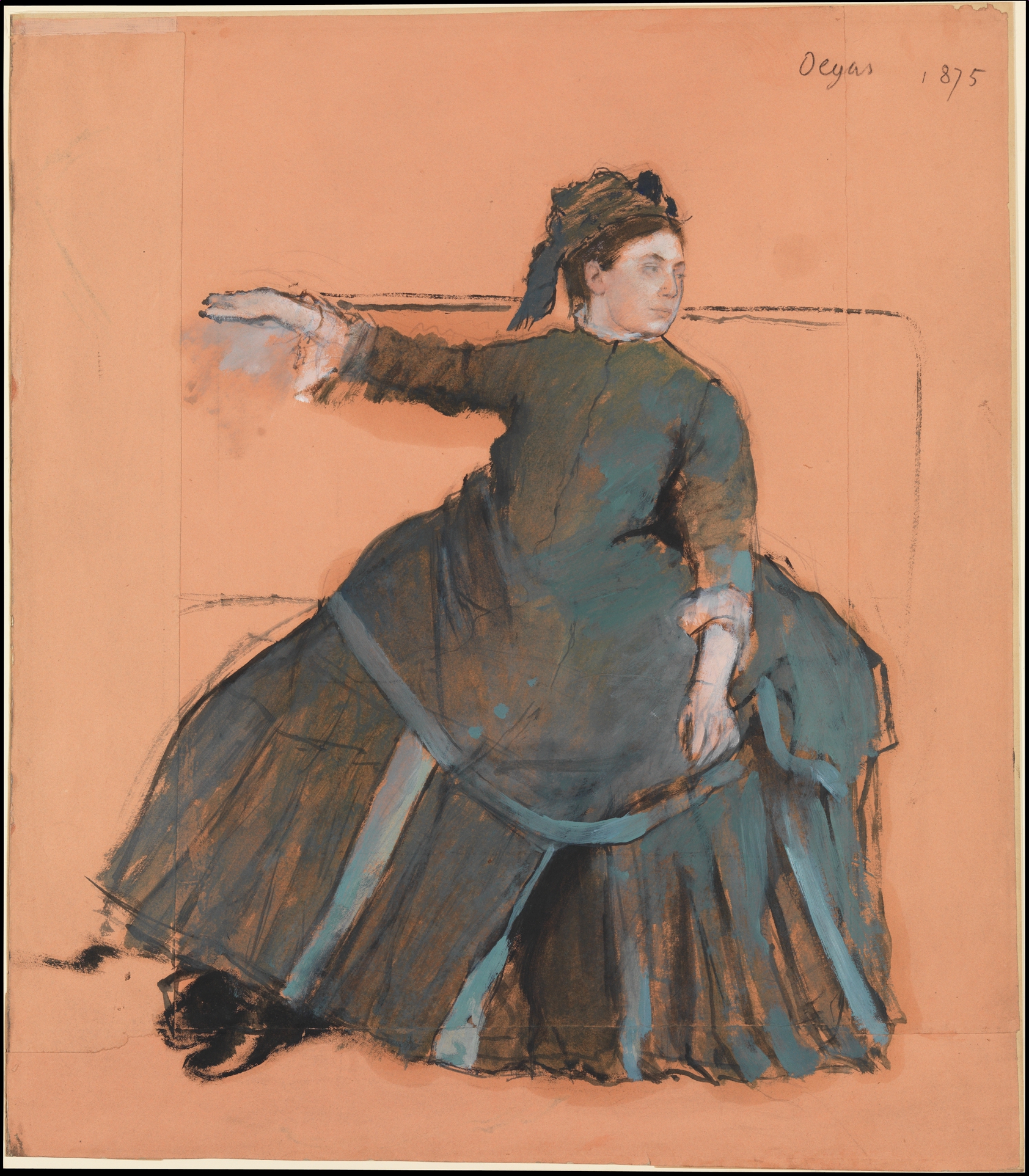
Deconstructing the Domestic: From "Woman on a Sofa" to Architectural Silhouette
The archetype of the "Woman on a Sofa" is a cornerstone of art historical discourse, a motif laden with connotations of leisure, interiority, and often, passive objectification. For Zoey Fashion Laboratory's SS26 collection, this is not a subject to be draped but a structural proposition to be deconstructed. The provided origin point—a global frontier—demands we abandon geographic and cultural specificity in favor of a psychic and architectural terrain. The medium itself, oil freely mixed with turpentine on pink paper, is our first clue: this is about instability married to a foundational blush, a dissolution of rigid form over a substrate of intimate flesh. Our couture analysis begins not with fabric, but with the principles of this study: liquidity, underpinning, and the bold intrusion of the pastel touch as a disruptive, future-signaling agent.
The Silhouette as Dissolved Architecture
The traditional sofa implies support, a defined perimeter for the body. Our avant-garde translation for SS26 rejects this implied containment. The futuristic silhouette emerges from the interaction between the body and the negative space once occupied by domestic furniture. Imagine garments where rigid boning, not unlike the graphite underdrawing, creates an armature that extends beyond the physical form, suggesting the ghost of a chaise lounge or the cantilevered line of a settee. This is wearable architecture that carries its own context. The "woman" does not recline; she integrates the geometry of repose into her stance. Voluminous trousers may balloon from a hip, stabilized by internal tensile wires, creating a silhouette that is both grounded and buoyant—a direct analogy to oil pigment suspended in turpentine. The pink paper base translates to foundational garments in shades of raw silk or tech-mesh in blush, nude, and cellular pink, upon which all structural experimentation is built.
Material Alchemy: Translucing Turpentine and the Pastel Intrusion
The material specification is a precise recipe for innovation. "Oil colors freely mixed with turpentine" dictates a philosophy of controlled dissolution and transparency. For SS26, this manifests in the development of proprietary technical fabrics. We propose laminates where rigid, oil-like vinyls are fused to evaporating, turpentine-inspired mesh, creating unpredictable windows to the skin beneath. Seams are not concealed but treated as graphic lines of underdrawing, emphasized with graphite-hued piping or exposed technical stitching that maps the garment's construction onto its surface.
Critically, the "touches of pastel" are not mere color accents but conceptual disruptions. In a palette derived from the muted, dissolved oils, a sudden bolt of electric pastel—acid mint, hyper-cyan, digital lavender—functions as a data stream across the form. This could be a sleeve in iridescent foil suddenly spliced into a wool felt bustier, or a subdermal glow of LED-embedded pastel organza peeking through a dissolvable lace. These touches are the future breaking into the fluid, traditional medium; they are the SS26 signature, representing quantum jumps in both aesthetic and material science.
Structural Innovation: The Underdrawing as Exoskeleton
The graphite underdrawing is the most crucial technical directive. It represents the hidden logic, the armature beneath the expressive, fluid surface. Zoey Fashion Laboratory will manifest this as wearable exoskeletons. Lightweight carbon-fiber rods, sheathed in blush leather, may trace the spine from nape to coccyx, flaring out to support a skirt's asymmetrical hem. Dress forms will be built upon corsetry that is externalized, its boning channels becoming decorative topographical lines on the garment's exterior. This philosophy extends to closures: zippers follow exaggerated anatomical curves, their tracks highlighted like drawn lines, while magnetic closures and pneumatic hinges allow for garments that change shape—a collar that rises like a sofa's wingback, a skirt that expands into a seated silhouette at the wearer's command.
SS26: The Global Frontier Body
The "Global Frontier" context liberates this study from nostalgia. This is not a revival but a projection. The resulting collection is for a nomadic intellect, a body that carries its own environmental and architectural context. Garments are multi-functional, modular systems. A coat's interior may unfurl into a textile shelter, referencing the sofa's function as a site of security. The pastel intrusions serve as biometric or communicative displays, integrating soft technology. The overall aesthetic is one of calculated disintegration and recombinant form—a body in continuous dialogue with the space it occupies and creates.
Ultimately, Zoey Fashion Laboratory's SS26, inspired by "Woman on a Sofa," moves beyond garment-making into the realm of portable psycho-architecture. We dismantle the domestic trope and use its components—support, contour, intimacy, display—to engineer a future where fashion is not worn but inhabited. The fluidity of the medium becomes the fluidity of function; the underdrawing becomes a visible blueprint for a new kind of corporeal experience. The woman is no longer on the sofa; she has synthesized it, becoming an autonomous entity of rest, power, and radical, frontier-defining beauty.