Deconstructing the Lattice: A Technical and Artistic Analysis of 15th-Century Florentine Velvet
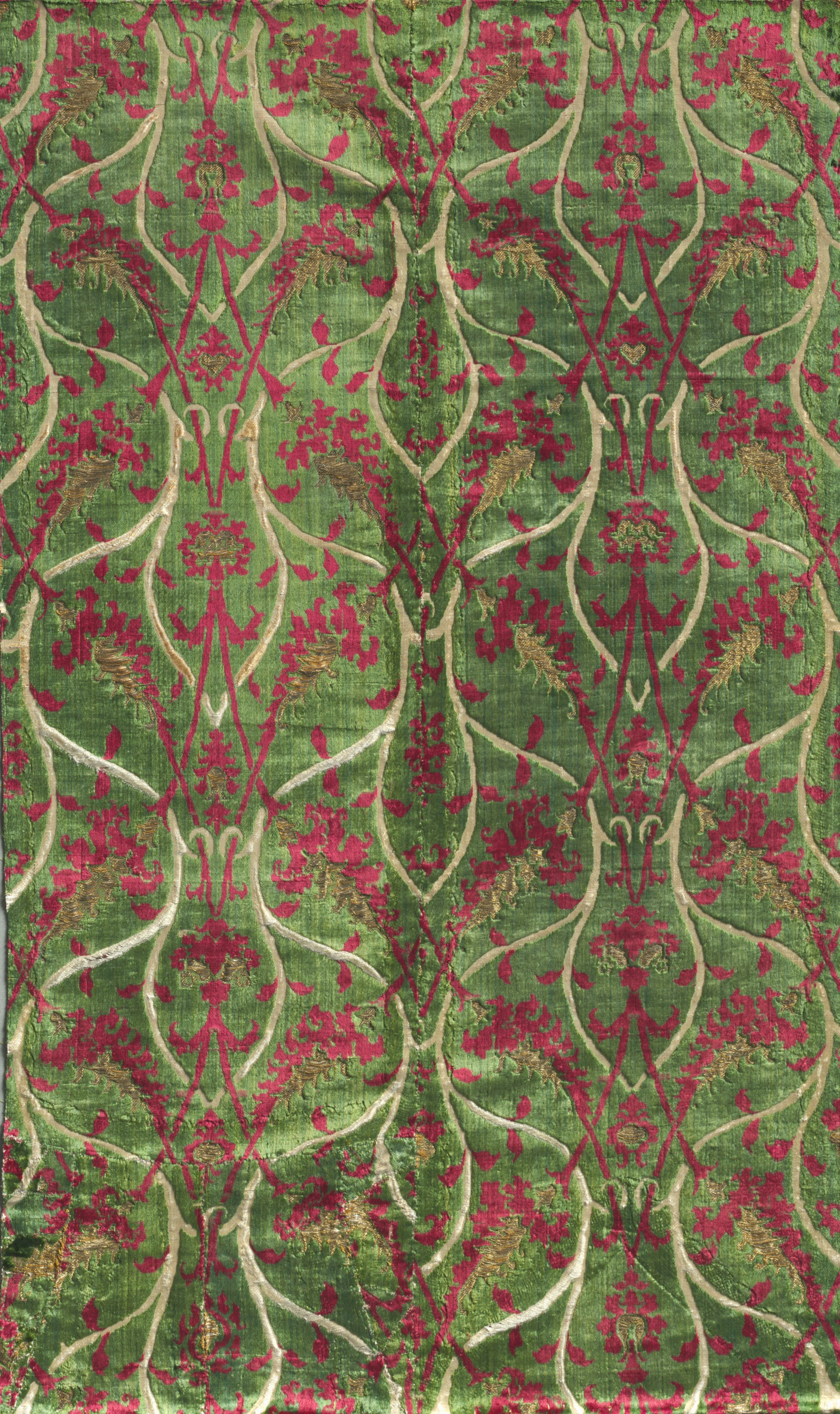
At Zoey Fashion Lab, our mandate is not merely to preserve historical textiles, but to deconstruct their DNA—to extract the radical, avant-garde principles embedded within their construction. The subject of this analysis, a fragment of two-color velvet with gold, originating from 15th-century Italy (likely Florence), presents a paradox: a fabric of supreme aristocratic luxury that encodes a startlingly modern, almost architectural, sensibility. This is not a relic; it is a blueprint for subversive design. The piece, a polychrome velvet employing cut pile, brocading, and voiding techniques, features a double curved lattice pattern interlaced with gold thread. Our deconstruction will focus on three disruptive elements: the structural tension of the lattice, the material dialectic of void and volume, and the anachronistic resonance with contemporary avant-garde aesthetics.
I. The Lattice as a Structural Disruption: From Ornament to Armature
The dominant motif—a double curved lattice—is the fabric’s most radical feature. In conventional Renaissance velvets, such patterns often served as a decorative frame for floral or heraldic motifs. Here, the lattice is not a background; it is the protagonist. The double curvature, achieved through the interplay of cut pile and voided ground, creates a visual field of continuous, intersecting arcs. This is not a static grid. It is a dynamic, almost kinetic, structure that suggests movement and spatial depth.
From an avant-garde perspective, this lattice functions as a structural armature, prefiguring the modernist fascination with exposed frameworks. Think of the skeletal steel of a Jean Prouvé building or the woven wire of a Harry Bertoia sculpture. The velvet’s pile rises from the voided ground, creating a literal three-dimensional topography. The gold thread, brocaded into the intersections of the lattice, acts as a series of luminous nodes, anchoring the eye and creating a rhythm that is both mathematical and organic. This is not mere decoration; it is a tectonic statement. The fabric becomes a miniature architecture, a landscape of peaks (pile) and valleys (voids) where light and shadow perform a continuous, silent choreography.
The choice of a double curve is particularly significant. It rejects the static, hierarchical order of a single grid or a repeating floral. Instead, it introduces a topological complexity. The curves overlap, interlock, and create optical illusions of depth and rotation. This is a fabric that refuses to be flat. It demands to be seen from multiple angles, its pattern shifting with every movement of the wearer. For the contemporary designer, this offers a direct challenge: how to create garments that are not simply surfaces, but complex, interactive environments. The lattice is a manifesto for dynamic, non-linear design.
II. The Dialectic of Material: Void, Pile, and the Alchemy of Gold
The technical execution of this velvet is a masterclass in material dialectic. The term "polychrome" here is misleading; the palette is deliberately restrained—typically a deep, saturated color (crimson, sapphire, or emerald) against a voided ground of the same hue but with a contrasting texture, and the brilliant, unyielding gold. The drama is not in chromatic variety, but in the tension between presence and absence.
The voided areas are not empty. They are negative space made positive. By cutting away the pile, the weaver exposed the foundation weave, creating a flat, matte surface that absorbs light. This is the "cold stone" of the archive reference—a ground of stillness and silence. In contrast, the cut pile rises in dense, plush loops, absorbing and reflecting light with a soft, velvety glow. This is the "warm flesh" of the fabric, its tactile and visual sensuality. The gold thread, brocaded onto the surface, introduces a third term: absolute, reflective brilliance. It does not blend; it asserts itself as a foreign, metallic element.
This triad—void, pile, gold—creates a radical material dialogue. The void represents the conceptual, the structural, the intellectual. The pile represents the sensory, the physical, the emotional. The gold represents the transcendent, the symbolic, the aspirational. In a single square inch of fabric, the 15th-century weaver staged a philosophical debate between the material and the immaterial, the earthly and the divine. For Zoey Fashion Lab, this is the essence of avant-garde design: the use of material to provoke thought, to create tension, to refuse easy resolution. The fabric is not just beautiful; it is argumentative.
Furthermore, the use of gold thread is not merely decorative. It is a structural element. The gold is brocaded—woven in as a supplementary weft—which means it sits on the surface, creating a raised, rigid line. This introduces a second order of texture: the soft, yielding pile versus the hard, unyielding metal. The fabric becomes a hybrid, a chimera of soft and hard, organic and inorganic. This prefigures contemporary experiments with smart textiles and material hybrids, where fabric is no longer a single substance but a composite system.
III. Anachronistic Resonance: The Avant-Garde in the Archive
The archive reference, "一面是光洁银镜上以黄金镶嵌的纷繁棕叶纹,另一面是冰冷石棺板上以浮雕诉说的生命叙事," evokes a duality that is central to our deconstruction. One side is the polished silver mirror, inlaid with gold—a surface of perfect, reflective beauty. The other is the cold stone sarcophagus, a surface of narrative depth and mortal weight. This velvet embodies both. The gold lattice is the mirror, the dazzling surface of courtly display. The voided ground is the stone, the silent, enduring substrate of history.
This duality is the hallmark of the avant-garde. It is the tension between the spectacular and the subterranean. A contemporary designer might translate this by creating a garment that appears, from a distance, to be a simple, luxurious surface. Up close, however, the lattice reveals itself as a complex, almost brutalist structure. The gold catches the light, but the voids create deep shadows that suggest hidden depths. The fabric becomes a palimpsest, a layered text that demands to be read slowly, critically.
The double curved lattice, in particular, resonates with the work of avant-garde architects and fashion designers who reject straight lines and orthogonal grids. Think of Zaha Hadid’s fluid, parametric forms or Iris van Herpen’s 3D-printed, lattice-like structures. This 15th-century velvet is a proto-parametric design, a manual for creating complexity through repetition and variation. The lattice is not a pattern; it is a system. It is a set of rules that generate infinite visual outcomes. This is the same logic that drives generative design and algorithmic fashion.
Finally, the fabric’s origin in Florence—the crucible of the Renaissance and a center of early capitalism—adds another layer. This velvet was a product of immense wealth, technical skill, and global trade (the gold thread likely came from the East). It was a symbol of power, but also of technological ambition. The avant-garde is always, at its core, a technological project. It is about pushing the limits of what a material can do. This velvet does exactly that. It uses the loom to create a three-dimensional, multi-textural, light-responsive surface that defies the flatness of its woven origin. It is a triumph of engineering disguised as ornament.
Conclusion: The Fabric as a Manifesto
For Zoey Fashion Lab, this 15th-century Florentine velvet is not a historical curiosity. It is a manifesto in thread. It teaches us that the avant-garde is not a style, but a strategy: the strategy of using material and structure to create tension, provoke thought, and refuse easy consumption. The double curved lattice is a structural disruption. The interplay of void, pile, and gold is a material dialectic. The anachronistic resonance with contemporary design is a call to action.
Our deconstruction reveals that the most radical future often lies hidden in the most refined past. The task of the Chief Fabric Deconstructionist is not to replicate this velvet, but to extract its principles: the use of negative space as a positive design element, the integration of metal as a structural component, the creation of dynamic, non-repeating patterns through systematic variation. These are the tools for a new avant-garde, forged in the archives of Florence, ready to be weaponized for the future of fashion.