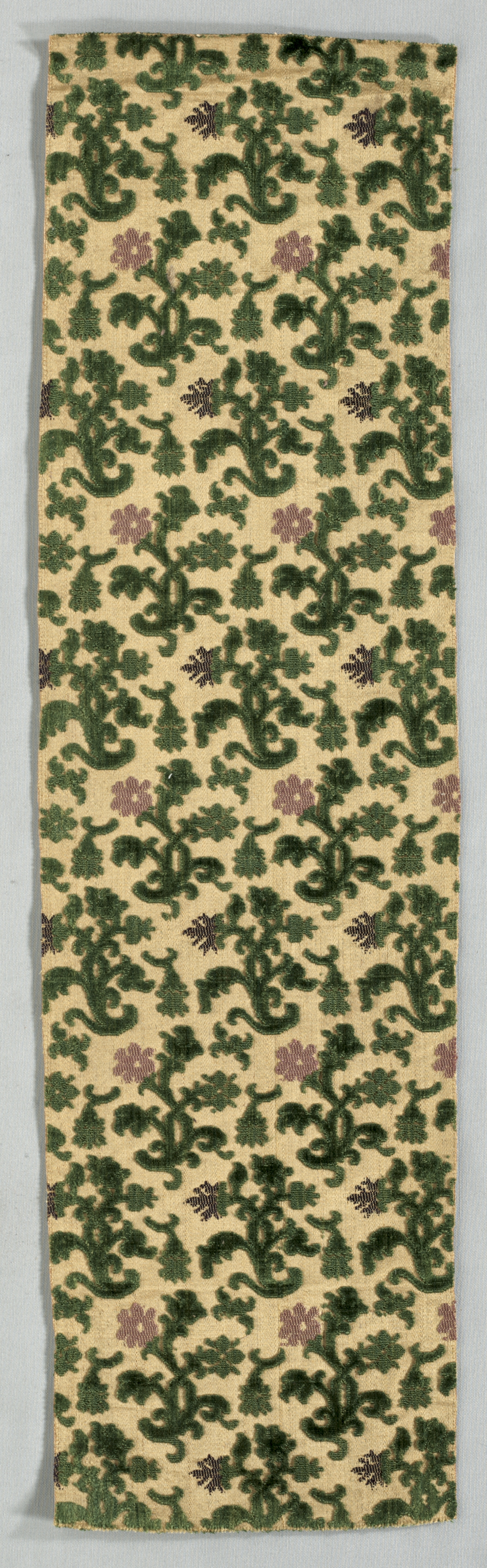
Fragment Analysis: Italian Early 17th Century Velvet
This report presents a comprehensive deconstruction of a velvet fragment sourced from Italy, dating to the early 17th century. The fragment, composed of silk and executed in cut, uncut, and voided velvet techniques, serves as a critical reference point for Zoey Fashion Lab’s ongoing exploration of New DNA Strand—a design philosophy that recombines historical textile structures with avant-garde aesthetics. Below, we dissect the material, technical, and stylistic attributes of this fragment, evaluating its potential as a catalyst for innovative, boundary-pushing fashion.
Material Provenance and Historical Context
The fragment originates from Italy, a dominant center of luxury textile production during the early 17th century. Velvet, particularly silk velvet, was a marker of status and wealth, often commissioned for ecclesiastical vestments, courtly attire, and aristocratic furnishings. The early 1600s saw a refinement of velvet weaving techniques, with Italian workshops in Genoa, Venice, and Florence perfecting methods to create intricate patterns through contrasting pile heights and voided areas. This fragment, with its combination of cut and uncut loops, exemplifies the era’s technical sophistication. The silk fibers, prized for their luster and drape, offer a tactile richness that aligns with Zoey Fashion Lab’s commitment to sensory depth in avant-garde design. The historical weight of this fragment—its connection to a period of artistic and economic flourishing—provides a narrative foundation for recontextualizing luxury in contemporary fashion.
Technical Analysis: Cut, Uncut, and Voided Velvet
The fragment employs three distinct velvet techniques:
Cut velvet involves shearing the pile loops to create a soft, dense surface with a reflective sheen. In this fragment, cut areas form the primary motifs—likely floral or geometric patterns—that rise above the ground fabric. The precision of the cuts suggests a master weaver’s hand, as uneven shearing would disrupt the pattern’s clarity. For Zoey Fashion Lab, cut velvet offers a textural contrast that can be exploited in avant-garde silhouettes—think of sculptural panels or asymmetrical draping that emphasize light absorption and reflection.
Uncut velvet, or terry velvet, retains the loops, resulting in a matte, nubby texture. Here, uncut sections serve as background or secondary patterns, creating a visual dialogue between smooth and rough surfaces. This interplay is crucial for New DNA Strand, which seeks to juxtapose opposing textures within a single garment. The uncut loops also provide structural stability, preventing the fabric from distorting under tension—a property that supports experimental construction methods like deconstruction or reconstruction.
Voided velvet refers to areas where the pile is absent, exposing the plain-weave foundation. In this fragment, voided sections delineate negative space, framing the cut and uncut motifs. This technique introduces a graphic quality, akin to a stencil or negative print, which can be translated into modern cutouts or laser-etched patterns. The voided regions also reduce fabric weight, making the velvet more adaptable for layered or voluminous designs without sacrificing structural integrity.
Reference to New DNA Strand: Avant-Garde Applications
The New DNA Strand reference is pivotal for interpreting this fragment as more than a historical artifact. Zoey Fashion Lab’s avant-garde ethos demands that traditional elements be reimagined through unconventional lenses. The velvet fragment’s technical features—its pile variations and voided spaces—offer a lexicon for innovation:
Textural hybridity can be amplified by combining this velvet with non-traditional materials, such as recycled plastics or metallic threads, to create a dialogue between organic and synthetic. The cut and uncut surfaces could be replicated using digital weaving or 3D-knitting technologies, allowing for precise control over pile height and density. This would enable garments that shift texture based on movement or environmental factors, embodying the avant-garde’s fascination with transformation.
Negative space manipulation inspired by voided velvet can inform designs that play with transparency and opacity. For instance, voided areas could be replaced with sheer organza or laser-cut leather, creating visual breaks in a silhouette. This approach aligns with New DNA Strand’s emphasis on revealing and concealing—a core tension in avant-garde fashion that challenges traditional modesty and exposure.
Historical narrative as design tool is another avenue. The fragment’s Italian Renaissance origins can be referenced through motifs—such as pomegranates or thistles—rendered in abstract, oversized forms. By scaling up these patterns and distorting them through digital manipulation, the fragment’s DNA is mutated into a contemporary language. This process respects the original craftsmanship while pushing it toward the futuristic, a hallmark of Zoey Fashion Lab’s approach.
Avant-Garde Style Integration
Avant-garde fashion thrives on disruption, and this velvet fragment provides a foundation for multiple disruptive strategies:
Deconstruction: The fragment’s layered construction—cut pile, uncut loops, and voided base—can be physically disassembled. For example, the cut pile could be selectively removed to create frayed edges, while the uncut loops might be left raw to evoke a sense of unfinished luxury. This deconstruction mirrors the work of designers like Rei Kawakubo, who challenge conventional garment integrity. Zoey Fashion Lab can extend this by incorporating the fragment into asymmetrical, non-linear forms that defy the body’s natural silhouette.
Reconstruction: The voided areas offer structural opportunities for reconstruction. By inserting panels of contrasting fabrics—such as neoprene or latex—into the voided spaces, the velvet becomes a hybrid textile that bridges historical and industrial aesthetics. This technique supports New DNA Strand’s goal of creating garments that are both archival and futuristic, merging the tactile richness of silk with the rigidity of modern materials.
Volume and silhouette: Velvet’s inherent weight and drape can be manipulated to create exaggerated volumes. The cut velvet’s sheen can be used to highlight structural folds, while uncut areas provide matte contrast. For avant-garde collections, this could translate into cocoon-like shapes, oversized sleeves, or dramatic trains that reference historical opulence but are rendered in minimalist, monochromatic palettes. The fragment’s early 17th-century origin suggests a baroque sensibility, which can be distilled into clean, architectural lines—a signature of Zoey Fashion Lab’s aesthetic.
Practical Considerations for Zoey Fashion Lab
Implementing this fragment’s DNA requires attention to production realities. Silk velvet is delicate; its pile can be crushed or distorted under stress. For avant-garde garments that may involve extreme draping or structural elements, reinforcing the voided areas with stabilizing layers—such as fusible interfacing or bonded linings—is essential. Additionally, the fragment’s color palette (likely deep jewel tones or metallic hues) should be preserved or reinterpreted through eco-friendly dyes to align with sustainability goals. The New DNA Strand reference encourages experimentation, but the integrity of the original technique must be maintained to honor its historical significance.
Conclusion
The Italian early 17th-century velvet fragment, with its cut, uncut, and voided silk construction, offers a rich template for Zoey Fashion Lab’s avant-garde explorations. Its technical complexity provides a toolkit for textural hybridity, negative space manipulation, and historical narrative integration. By deconstructing and reconstructing this fragment through the lens of New DNA Strand, Zoey Fashion Lab can produce garments that are both reverent of craftsmanship and radical in their departure from convention. This analysis confirms the fragment’s viability as a foundational element for collections that challenge the boundaries of fashion, merging the opulence of the past with the disruptive spirit of the avant-garde.