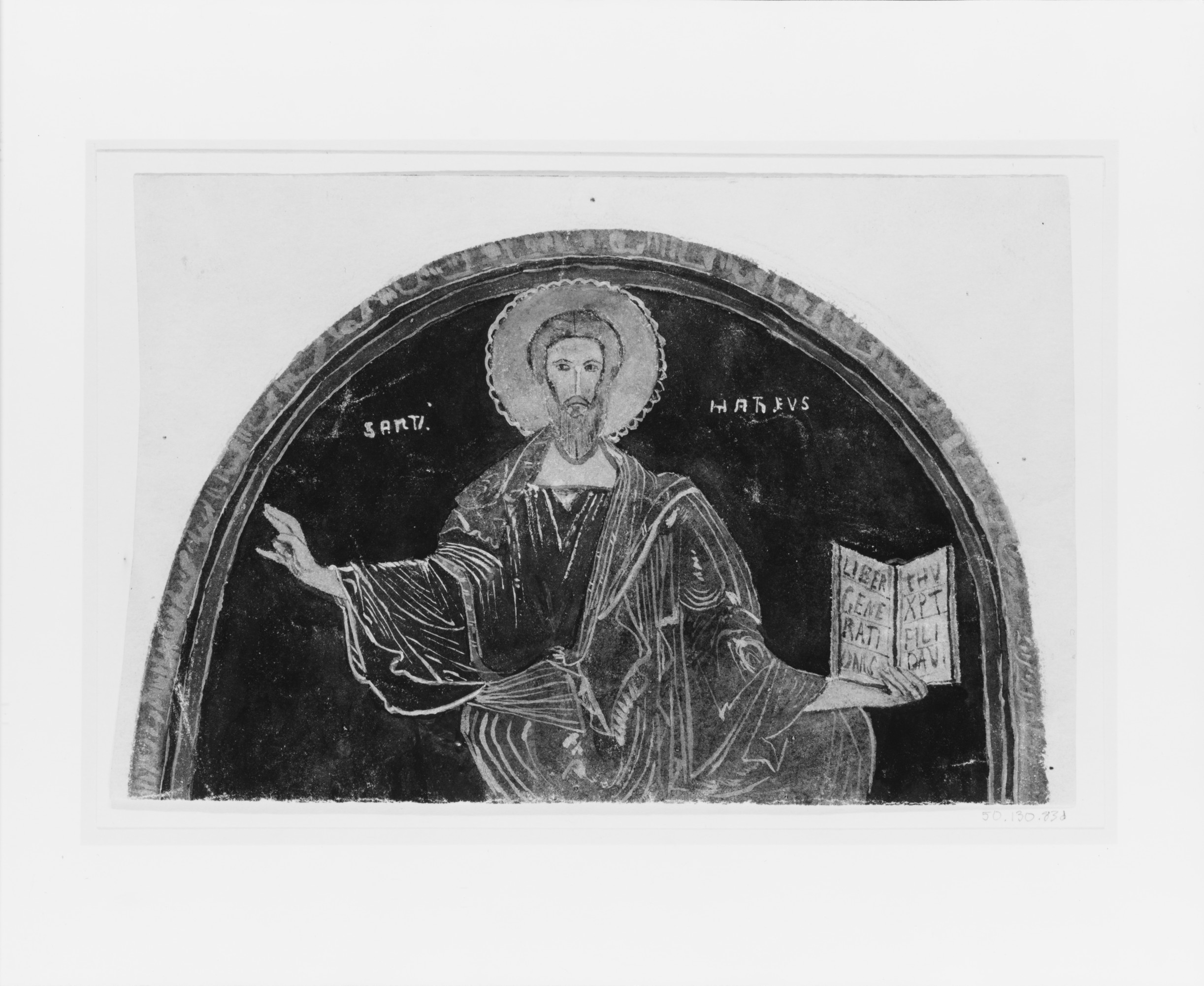
The Sacred Geometry of Dissolution: Deconstructing the Salerno Saint Matthew for SS26
The cathedral of Salerno, a palimpsest of Norman, Byzantine, and Romanesque influences, houses a mosaic of Saint Matthew that has, for centuries, served as a static icon of divine order. To approach this artifact as a blueprint for SS26 avant-garde couture is to engage in a radical act of temporal and material dislocation. The original mosaic, rendered in watercolor, gold paint, gouache, and graphite on off-white wove paper, is not a reproduction; it is a forensic reconstruction of light and shadow, a study in the entropy of sacred form. For the Zoey Fashion Laboratory, this piece becomes a manifesto for a new structural vocabulary—one that marries the fragility of hand-painted textiles with the rigor of architectural engineering.
Deconstructing the Divine: From Mosaic Tesserae to Fractured Silhouettes
The mosaic’s defining characteristic is its tessellation—the deliberate segmentation of form into discrete, luminous units. In the original work, each tessera is a particle of faith, a fragment of narrative. For SS26, we translate this into a silhouette of controlled fragmentation. The garment is no longer a continuous fabric envelope; it is a constellation of panels, each acting as an independent structural element. Consider a coat constructed from overlapping, irregularly shaped pauldrons and cuirass sections, reminiscent of Byzantine armor, but rendered in biomimetic, laser-cut polymer composites. These panels are not sewn together but articulated via micro-hinges and magnetic closures, allowing the wearer’s movement to shift the “tesserae,” creating a dynamic, ever-changing surface. The off-white wove paper of the source material informs a base palette of unbleached, raw linen and milk-white bio-ceramic leather, providing a neutral ground for the gold paint’s explosive luminosity.
The gold paint itself is not a decorative afterthought; it is a structural principle. In the study, it is applied in thick, gestural strokes, suggesting both the gilded halos of saints and the molten, volatile nature of alchemical transformation. For the collection, we employ a technique of liquid metal embroidery, where threads of fine gold-plated copper are woven into the fabric matrix, not as embellishment, but as load-bearing seams. These seams glow with an internal heat, creating a visual tension between the sacred and the industrial. The graphite, meanwhile, provides the dark, grounding shadows. It becomes a carbon-fiber understructure, visible through strategic cutouts in the fabric, a skeleton of the garment that speaks to the engineering beneath the surface.
Structural Innovation: The Cathedral Buttress as a Wearable Scaffold
The architecture of the Salerno Cathedral is not merely a backdrop; it is a load-bearing system. The flying buttresses, the ribbed vaults, the massive columns—these are not decorative but functional, channeling immense forces downward. For SS26, we reinterpret this as exoskeletal couture. The garment’s form is not draped but erected. A long, columnar dress, inspired by the cathedral’s nave, is constructed from a honeycomb lattice of 3D-printed, recycled polycarbonate, mimicking the structural logic of a Gothic vault. This lattice is then infilled with panels of hand-painted silk organza, the watercolor washes bleeding into one another, evoking the faded frescoes of the cathedral walls. The lattice is not hidden; it is celebrated, painted in the same graphite and gold tones, creating a dialogue between the ephemeral (the painted silk) and the permanent (the structural frame).
The mosaic’s depiction of Saint Matthew, often shown with a winged man or angel, introduces a further dimension: the asymmetrical, biomorphic silhouette. One shoulder is built up into a dramatic, wing-like projection, constructed from layered, carbon-fiber “feathers” that are individually articulated. This wing is not symmetrical; it is a deconstructive gesture, a remnant of the sacred icon that has been broken and reassembled in a futuristic idiom. The opposite side of the garment is minimal, almost monastic, with a clean, floor-length line. This dichotomy—the sacred versus the profane, the complex versus the austere—becomes the collection’s core tension.
Material Alchemy: The Alchemy of Paper, Paint, and Precious Metal
The choice of materials in the original study—watercolor, gouache, gold paint, graphite—is not arbitrary. Each medium has a specific behavior: watercolor bleeds, gouache is opaque, gold paint reflects, graphite smudges. For the couture pieces, we replicate this material conflict through layered, reactive textiles. A base layer of thermochromic silk changes color with body heat, mimicking the wash of watercolor. Over this, we apply a gouache-like, matte finish using a spray-on cellulose compound that can be peeled or distressed, revealing the luminous silk beneath. The gold is not just thread; it is a liquid gold leaf that is screen-printed onto the fabric in geometric patterns, then partially abraded, creating a worn, liturgical quality. The graphite becomes a carbon nanotube coating applied to the seams, creating a subtle, shimmering darkness that absorbs light, contrasting with the gold’s reflection.
The off-white wove paper is perhaps the most radical material influence. We translate its texture into a new fabric: a paper-like, non-woven textile made from recycled cotton and abaca fibers, treated with a biodegradable resin. This material is lightweight, sculptural, and can be pleated, crumpled, or laser-cut into intricate patterns. It is the canvas for the watercolor and gouache, but it is also the garment itself—a wearable sketch, a testament to the process of creation. The paper is not a substitute for fabric; it is a provocation, a challenge to the conventions of couture.
The Futuristic Silhouette: A Standalone Avant-Garde Manifesto
The final silhouette for SS26 is not a dress, a coat, or a suit. It is a wearable architectural fragment. Imagine a garment that is part cloak, part exoskeleton, part sculpture. It begins at the nape of the neck with a rigid, gold-leafed collar that fans out like a halo, then descends into a series of overlapping, graphite-stained panels that are held away from the body by a hidden, articulated armature. The front is open, revealing a second, inner garment—a simple, watercolor-stained shift that is the “ghost” of the saint. The overall effect is one of sacred geometry in a state of flux, of a divine icon that has been shattered by time and reassembled by a futuristic archaeologist. This is not fashion as adornment; it is fashion as a critical inquiry into the nature of structure, material, and meaning. For the Zoey Fashion Laboratory, the Saint Matthew mosaic is not a relic; it is a blueprint for the future of couture.