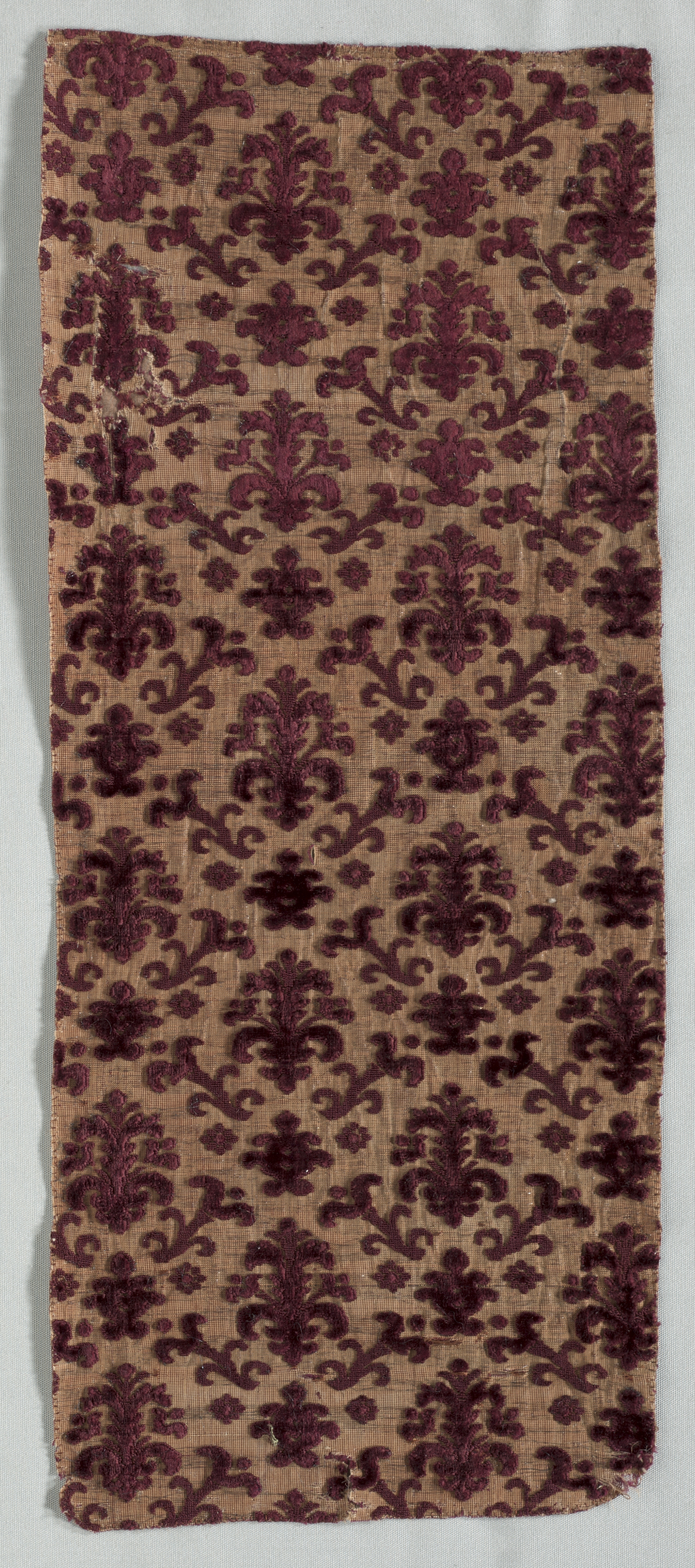
Technical Deconstruction: The Velvet Fragment
The provided fragment is a masterclass in late Renaissance textile engineering, representing the pinnacle of Italian silk weaving during the Baroque period's dawn. Our analysis begins at the structural level. The foundation is a silk satin ground, providing a lustrous, smooth background. Upon this, the velvet pile is created using supplementary warp threads, lifted over wires during weaving. The critical technical achievement here is the combination of cut and uncut pile within the same textile. The uncut loops create a subdued, textured light reflection, while the cut pile stands erect, offering a deep, light-absorbing plushness. This binary texture is not random; it is meticulously deployed to define the pattern's contours and create internal shading, a tactile chiaroscuro effect.
The material palette—silk and silver filé—elevates this from a luxurious fabric to a status-defining artifact. The silk, likely from premium Italian or imported sources, provides the core luxury. The silver filé, a slender strip of silver wound around a silk core, is integrated into the weft. This metallic element would have originally imparted a scintillating, almost liquid light effect, catching candlelight with every movement. Its presence signals immense value and aligns the fragment with ecclesiastical, royal, or aristocratic patronage. The degradation of the silver over centuries (likely now oxidized to a dull black or grey) must be considered in our reinterpretation; we are working with the ghost of its original brilliance.
Pattern Analysis & The "New DNA Strand" Reference
The pattern, though fragmentary, suggests a large-scale, symmetrical design typical of the era—possibly a pomegranate, palmette, or acanthus motif, symbols of abundance and eternity. The true innovation for Zoey Fashion Lab lies not in replicating this pattern, but in interpreting the "New DNA Strand" reference as our core creative directive.
We propose deconstructing the pattern's "genetic code." Its DNA consists of: Binary Texture (cut/uncut pile), Organic Form, Metallic Luster, and Dimensional Depth. Our avant-garde mission is to splice this historical DNA with contemporary genomic sequences. Imagine mapping the pattern's repeat structure onto a double-helix formation. The velvet's textural binary becomes a code—cut pile representing one nucleotide base, uncut another. The sinuous Baroque scrollwork transforms into the twisting backbone of a macromolecule. The silver filé is no longer mere decoration; it becomes a conductive element, a literal thread of energy and data within the textile's structure.
Avant-Garde Reinterpretation: From Baroque Relic to Future Artifact
Moving from analysis to application, Zoey Fashion Lab's avant-garde approach must honor the fragment's complexity while propelling it into a future context. This is not vintage revival; it is techno-archaeological reconstruction.
Material & Technical Innovation
We preserve the textural philosophy but update the materials. The silk ground could be replaced with a biologically engineered silk protein, lab-grown to specific tensile and luminous properties, or fused with a translucent technical polymer for structural hybridity. The pile could be rendered not just in textile, but through laser-etched acrylic, 3D-printed bioplastic filaments, or even magnetic shavings suspended in a resin matrix, creating a mutable, responsive surface. The silver filé's function is reinterpreted as integrated, photo-luminescent wiring or a thin-film electronic circuit, allowing the fabric to emit light, change color, or respond to touch and biometric data.
Form & Silhouette
The 17th-century context implied flat patterning on a tailored, structured garment. Our avant-garde silhouette must reflect a new bodily architecture. Imagine the "DNA strand" pattern growing organically across the body, not printed but constructed as dimensional, topographical ridges and valleys. A garment could feature protruding, cushioned forms (the cut pile zones) adjacent to smooth, recessed channels (the uncut/satin zones), creating a wearable landscape. Silhouettes become non-linear, perhaps modular or asymmetrical, with the pattern flowing across seams as if the garment is grown, not sewn.
Conceptual Narrative: The Neo-Baroque Cyborg
The final output should tell a story. This fragment, once adorning a powerful figure in a court defined by rigid hierarchy and opulent display, now speaks to a future of biotechnical integration and fluid identity. The wearer becomes a Neo-Baroque entity, where organic history (the velvet's lushness) merges with the digital present (the integrated circuitry). The garment is not passive; it is an interface. The "silver" now carries a charge. The velvet's depth becomes housing for technology.
We propose a final collection piece: a monolithic coat or architectural dress. From a distance, it presents a striking, abstract pattern of deep shadow and sharp light. On closer inspection, the textured areas reveal their technical composition—some are soft, some are rigid. Within the lines of the pattern, a soft glow pulses rhythmically, mirroring a heartbeat or external data stream. It is heavy with history yet speaks of a speculative future. It embodies the paradox of the avant-garde: a profound respect for the craft of the past, violently and beautifully re-engineered for a consciousness yet to come.
The 17th-century Italian velvet fragment is our primer. Its technical brilliance is our inspiration. The "New DNA Strand" is our mutation. Zoey Fashion Lab's task is to catalyze this evolution, creating not a costume of the past, but an artifact of a future that remembers its depth.