Deconstructing the Gorget: A Material and Temporal Analysis for Zoey Fashion Lab
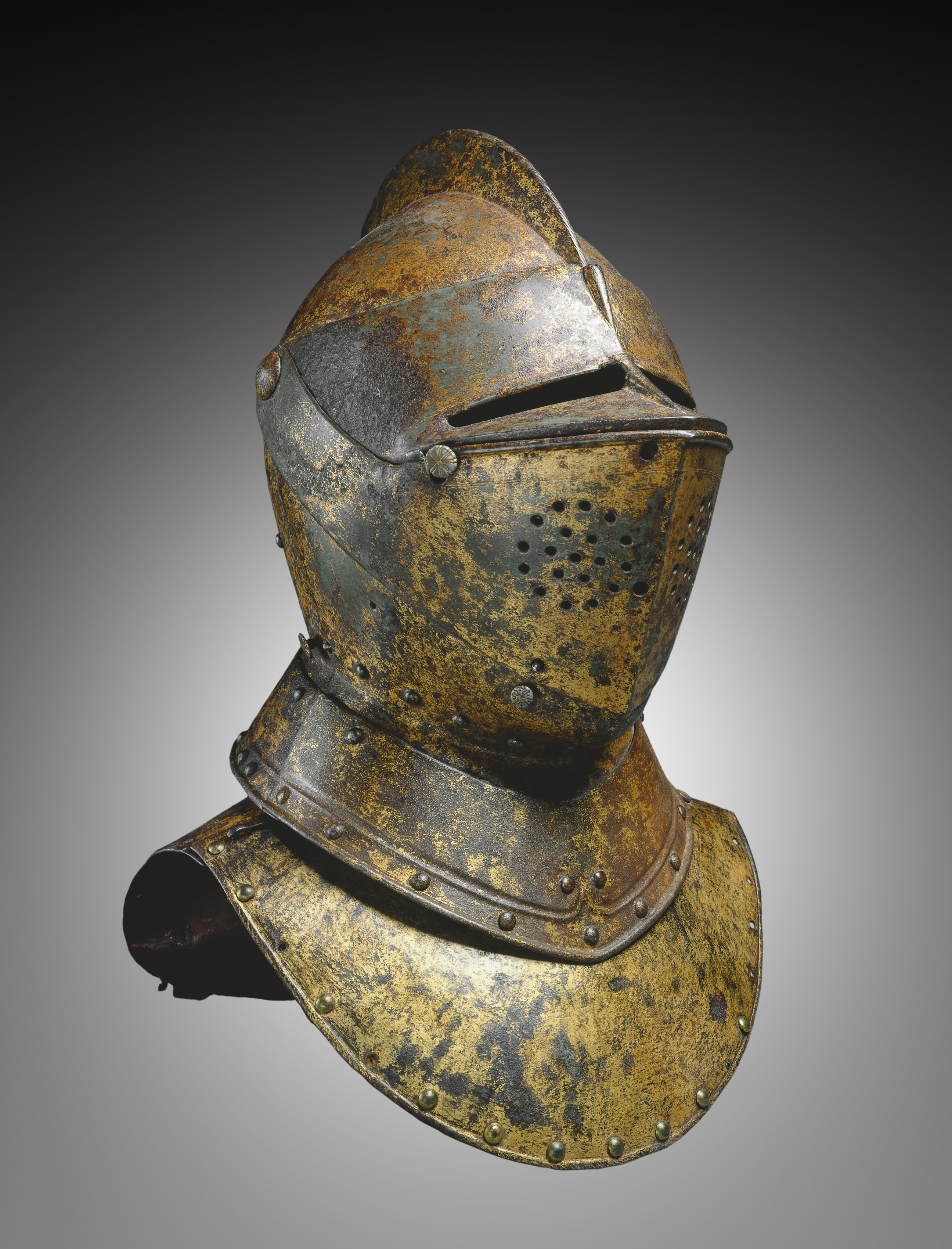
At Zoey Fashion Lab, the artifact under scrutiny—a gilded steel gorget, likely from a funerary achievement, dated to the late 16th to early 17th century, and of probable Netherlandish origin—presents a compelling case study for our New DNA Strand methodology. This approach deconstructs historical objects not merely as relics, but as living archives of material, technique, and cultural narrative. The gorget, a piece of armor designed to protect the throat and upper chest, is here transformed from a functional military object into a potent symbol of status, mortality, and the nascent avant-garde spirit that disrupts linear time. Its current state—invaded with rust, yet retaining gilded glory, lined with red velvet, and fitted with a plume holder—offers a rich, fractured text for deconstruction.
Materiality and Decay: The Gilded Steel
The primary material, gilded steel, immediately establishes a dialogue between permanence and ephemerality. Steel, forged for strength and defense, is now compromised by invasive rust. This is not mere corrosion; it is a biological and chemical process that re-writes the object’s surface. The rust acts as a new stratum, a patina of time that the original armorer could not have anticipated. In the context of Zoey Fashion Lab, we interpret this not as damage, but as a new aesthetic layer. The gilding—once a display of wealth and power, achieved through fire-gilding or mercury amalgam—now peels and flakes, revealing the iron beneath. This juxtaposition of gold (symbol of the divine, the eternal) and rust (symbol of decay, the mortal) is the core of the gorget’s avant-garde potential. The New DNA Strand reads this as a deliberate, albeit natural, act of deconstruction: the armor of life is being reclaimed by the earth, a memento mori made manifest in metal.
The Velvet Lining: Soft Power and Tactile Contrast
The red velvet lining provides a stark, sensuous counterpoint to the cold, corroded steel. Velvet, a fabric of luxury and comfort, was often used in armor to cushion the wearer and absorb sweat. Here, it serves a dual function: it is both a practical buffer and a symbolic interior. The red hue—associated with blood, passion, and martyrdom—deepens the narrative. In a funerary context, this lining becomes the internal shroud, the softness that cradles the neck of the deceased. The velvet’s pile, now likely worn and faded, retains traces of the body that once wore it. For Zoey Fashion Lab, this fabric is a tactile archive. We deconstruct its weave, its color degradation, and its stitching to understand the intimacy of the object. The contrast between the brutal exterior (steel, rust, war) and the tender interior (velvet, red, comfort) creates a dialectical tension that is inherently avant-garde. It challenges the binary of hard/soft, public/private, life/death.
The Plume Holder: A Vestige of Performance
The plume holder, a small fixture on the gorget’s crest, is perhaps the most telling component for our analysis. Originally designed to secure a feather—often from an ostrich or heron—as a marker of rank and theatricality, it now stands empty. This emptiness is a void of potential. The plume was the gorget’s most ephemeral element, a statement of movement and color that would have swayed with the wearer’s gait. In the funerary achievement, the plume would have been a final, silent salute. For the avant-garde, this empty holder is an invitation to re-inscribe. It is a point of intervention where the laboratory can introduce new materials—perhaps a metallic filament, a bio-luminescent fiber, or a preserved organic specimen—to re-animate the object’s performative history. The plume holder becomes a connector between past and future, a literal socket for a new narrative.
Funerary Achievement: The Gorget as Thanatos
The origin of this gorget within a funerary achievement radically recontextualizes its function. A funerary achievement—a display of a deceased knight’s helmet, shield, sword, and gorget—was a temporary monument, often hung above a tomb or in a church. The gorget was thus a symbol of the deceased’s identity, frozen in time. It is no longer a tool of combat, but a relic of a life lived. The rust and decay are not flaws; they are evidence of the passage from life to death. In the New DNA Strand framework, we view this as a primary text: the gorget is a material ghost. Its gilding, now tarnished, reflects the fading glory of the individual. The red velvet lining, now faded, echoes the blood that once flowed. The plume holder, now empty, marks the absence of the spirit. This is a deconstruction of the heroic narrative. The gorget does not celebrate victory; it mourns finitude.
Avant-Garde Implications: A Temporal Collision
For Zoey Fashion Lab, this gorget is not a historical artifact to be preserved, but a catalyst for new creation. Its avant-garde potential lies in its temporal collision: the 16th-century craftsmanship meets 21st-century decay. The rust is not an enemy; it is a collaborator. We propose a deconstruction that does not restore the gorget to its original state, but instead amplifies its current condition. Imagine a garment that incorporates the gorget as a wearable ruin. The steel could be left exposed, the rust stabilized with clear resin, the velvet replaced with a contemporary bio-fabric that mimics its texture but is alive—perhaps a mycelium-based velvet that continues to grow. The plume holder could hold a sensor that emits a low-frequency hum, a ghostly echo of the knight’s breath. The New DNA Strand would trace the gorget’s material history—from iron ore to gilded armor to rust—and project it forward into a future where decay is celebrated as a design principle.
Conclusion: The Gorget as a Threshold Object
In summary, this gorget is a threshold object, situated between life and death, function and symbol, past and future. The gilded steel, invaded with rust, speaks to the inevitable collapse of power. The red velvet lining offers a soft, intimate counter-narrative. The plume holder stands as a silent invitation for reanimation. For Zoey Fashion Lab, this artifact is a blueprint for an avant-garde fashion practice that embraces decay, temporality, and the material memory of the human body. The New DNA Strand does not seek to fossilize history, but to extract its genetic code and splice it with contemporary materials and concepts. This gorget is not a relic; it is a living document, and its rust is the ink of a new story.