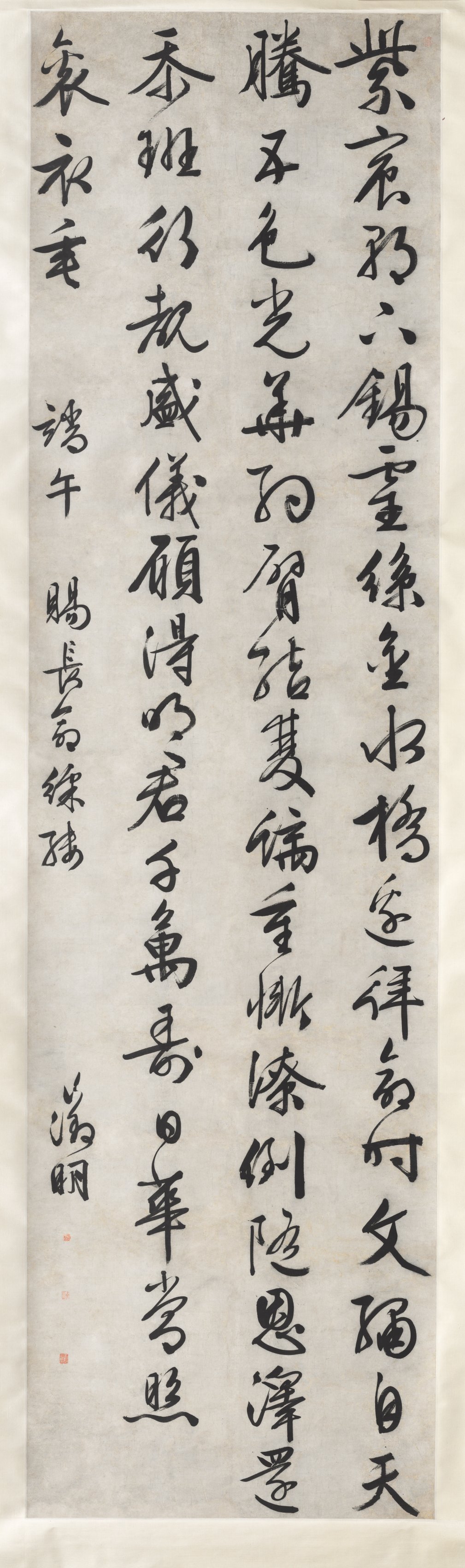
Deconstructing the Imperial Thread: An Avant-Garde Analysis of a Ming Dynasty Silk Poem
At Zoey Fashion Lab, our mission is to unravel the fabric of history, not merely to preserve it, but to re-spin its fibers into the DNA of future design. Today, we turn our Chief Fabric Deconstructionist’s lens to a singular artifact: a hanging scroll from Ming dynasty Suzhou, bearing a poem on the "Imperial Gift of an Embroidered Silk," rendered in the fluid yet disciplined running-standard script (xingkaishu). This is not a relic to be admired from a distance; it is a New DNA Strand—a genetic code for an avant-garde fashion revolution.
The Material as Metaphor: Ink on Paper vs. Silk on Skin
The scroll’s technical specification—ink on paper—immediately establishes a tension. The poem speaks of an embroidered silk, a textile of imperial luxury, yet the medium is humble, absorbent paper. This dichotomy is our first design principle. The avant-garde mind sees not a static object, but a dialogue between materiality and representation. The paper is the skin of the scroll, the ink its blood. In fashion, we must ask: what happens when we translate this dialogue onto a garment? The silk of the poem’s subject is a surface of opulence, while the paper of its execution is a surface of recorded thought. Our New DNA Strand splices these opposites: a garment that is both translucent and opaque, a fabric that absorbs light like paper yet reflects it like silk. Imagine a deconstructed gown where panels of raw, unbleached linen (the paper) are overlaid with laser-cut, metallic-thread embroidery (the silk), the calligraphy itself rendered as a 3D-printed, flexible lattice that moves with the body.
Calligraphy as Code: The Running-Standard Script as Genetic Sequence
The xingkaishu script—a hybrid of running and standard forms—is the scroll’s true structural innovation. It is neither rigidly formal nor chaotically free; it exists in a state of controlled flux. This is the genetic mutation we seek. In an avant-garde context, each brushstroke is not just a character but a directional vector—a line of force that can be translated into a seam, a pleat, or a cut. The standard elements (kaishu) represent the skeleton of the garment: the structured seams, the tailored shoulders, the precise darts. The running elements (xingshu) represent the fluid drape: the cascading folds, the asymmetric hemlines, the fabric’s movement in a breeze. Our deconstruction reveals that the poem’s calligraphy is not merely decorative; it is a choreographic score. Each stroke’s thickness, angle, and speed can be algorithmically mapped to create a parametric pattern. For instance, a heavy, slow stroke becomes a deep, structural fold in a jacket’s shoulder; a swift, light stroke becomes a gossamer-thin slit in a skirt.
Imperial Gift: Power Dynamics in Textile Form
The poem’s title—"Imperial Gift of an Embroidered Silk"—is a loaded signifier. It speaks of hierarchy, patronage, and the economy of luxury. The emperor bestows silk; the poet inscribes gratitude. In our New DNA Strand, we deconstruct this power dynamic by reversing the gaze. The garment is no longer a gift from above but a self-authored manifesto. The embroidered silk, traditionally a symbol of subservience and ornament, is reimagined as a surface of resistance. Using digital embroidery and reactive inks, we can embed the calligraphy into the fabric in a way that changes visibility with temperature or movement. The poem becomes a hidden text—visible only when the wearer is in motion or under specific light conditions. This is avant-garde activism: the imperial gift is now a personal, kinetic secret. The wearer is both the emperor and the poet, the giver and the receiver, the fabric and the script.
Suzhou’s Ghost: The Loom and the Brush
Suzhou, the scroll’s origin, was the epicenter of Ming silk production. The city’s looms wove the very fabric the poem celebrates. Our deconstruction must honor this geographic DNA. The running-standard script, with its balance of precision and flow, mirrors the rhythm of the loom—the warp and weft, the tension and release. For an avant-garde collection, we propose a hybrid textile that physically embodies this rhythm. Imagine a fabric woven with two distinct thread systems: one of stiff, metallic yarn (the standard script, the loom’s structure) and one of soft, silk organza (the running script, the hand’s gesture). The result is a self-deconstructing textile where the metallic threads create rigid, calligraphic lines that the silk organza softens and distorts as the garment is worn. This is not a print of calligraphy; it is the calligraphy itself as a woven structure.
The Avant-Garde Silhouette: From Scroll to Body
The scroll’s vertical format—a hanging scroll—dictates a vertical, elongated silhouette. This is a direct reference to the Ming dynasty’s long robes and the flowing lines of scholar-official attire. In our deconstruction, we fragment this verticality. The scroll is not a single, unbroken surface; it is a sequence of panels, each containing a portion of the poem. Our avant-garde garment might be a modular ensemble: a long, asymmetrical coat with panels that can be detached and reattached, allowing the wearer to recompose the poem on their body. The running-standard script becomes a visual rhythm that guides the eye up and down the silhouette, interrupted by strategic cutouts that reveal the skin (the paper’s blank space). The imperial gift is now a personal, interactive architecture.
Conclusion: The New DNA Strand in Practice
This analysis is not a historical report; it is a design brief. The New DNA Strand we have extracted from this Ming dynasty scroll is a genetic blueprint for a collection that is both reverent and rebellious. We have deconstructed the material (ink on paper vs. embroidered silk), the script (standard vs. running), the power (imperial gift vs. self-authored text), and the silhouette (vertical scroll vs. modular body). The result is a fashion language that speaks of history as a living, mutable code. At Zoey Fashion Lab, we do not copy the past; we rewrite its DNA into garments that are poems in motion, where every thread is a stroke and every seam a verse. The imperial gift is now yours to wear, to deconstruct, and to re-gift to the future.