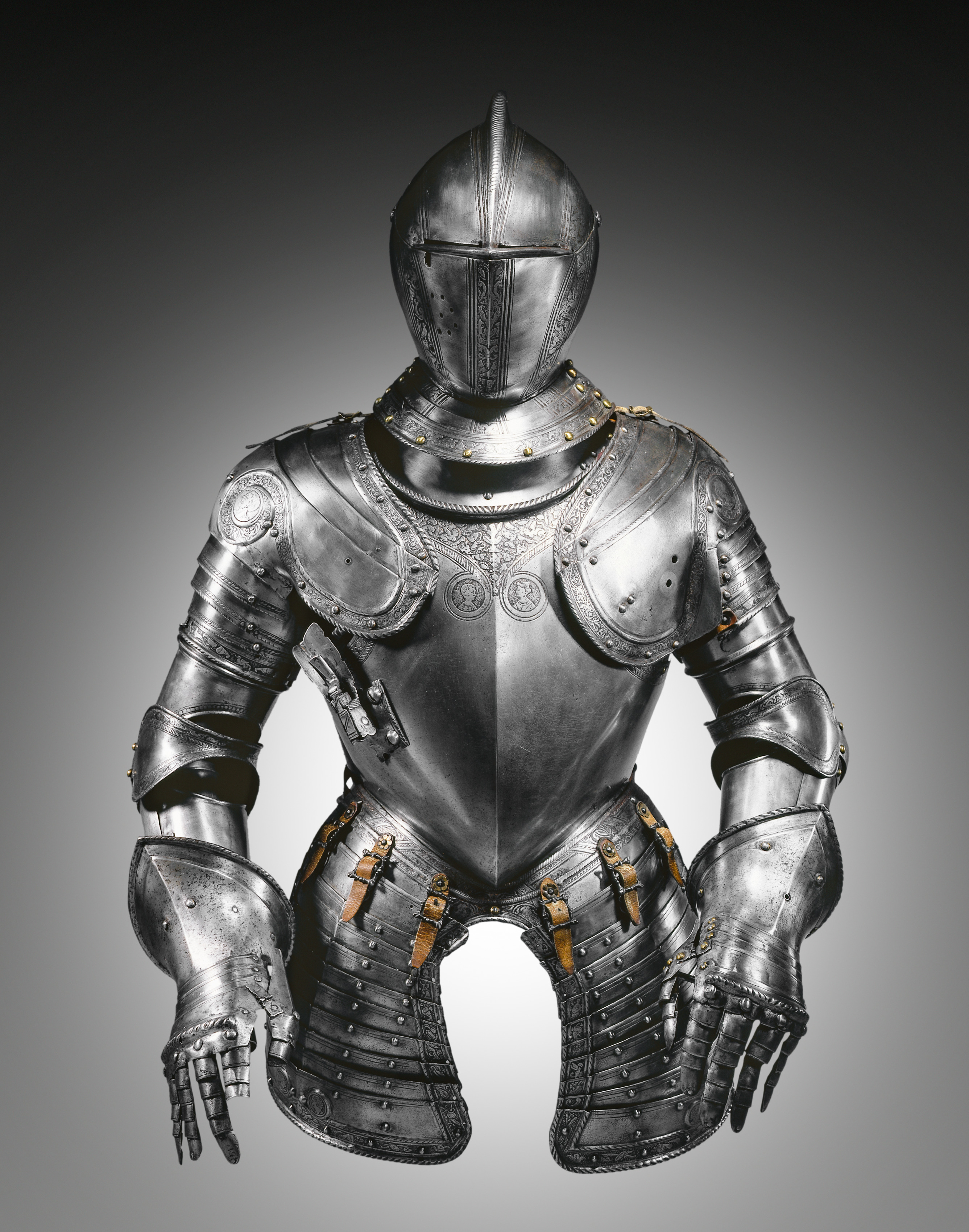
Deconstructing the Brescia Half-Suit: An Avant-Garde Analysis for Zoey Fashion Lab
As the Chief Fabric Deconstructionist for Zoey Fashion Lab, I approach historical artifacts not as static relics, but as living, breathing documents of material culture. The half-suit of armor, attributed to North Italy, possibly Brescia, circa the 16th century, is a masterclass in structural engineering and aesthetic restraint. Its technical composition—steel with etched decorative bands and roundels—offers a rich, textured narrative that transcends its original martial purpose. For our avant-garde lens, this piece is not merely armor; it is a proto-futurist garment, a DNA strand of structural fashion, waiting to be unraveled and re-synthesized into a new, rebellious lexicon.
Materiality and the Etched Narrative: Steel as Fabric
The primary material, steel, is often perceived as rigid, cold, and unforgiving. Yet, in the hands of a 16th-century Brescian armorer, it was manipulated with the precision of a tailor. The etched decorative bands and roundels are not mere ornamentation; they are functional text. Each etched line is a stitch, a seam, a pleat in a metallic garment. The roundels, likely placed at points of high stress (shoulders, elbows, wrists), function as strategic reinforcements, akin to modern bar-tacking or grommeting in high-performance sportswear. For Zoey Fashion Lab, this suggests a radical rethinking of hardware as textile. We can deconstruct the roundel’s circular motif into a modular fastening system—magnetic or interlocking—that replaces traditional zippers or buttons. The etched bands, meanwhile, become a surface pattern language, a code that can be translated into laser-cut leather, bonded neoprene, or even heat-pressed vinyl on technical mesh. The armor’s steel is not a barrier; it is a conductive membrane for narrative and structural innovation.
Structural Silhouette: The Architecture of Mobility
The half-suit’s design—covering the torso, shoulders, and upper arms—is a study in controlled asymmetry. Unlike a full suit, it leaves the lower body and one arm free, suggesting a dynamic, asymmetrical field of action. This is not a passive garment; it is a kinetic sculpture. For our avant-garde collection, we can extract this principle of selective encapsulation. Imagine a jacket that is half-corseted, half-draped; a sleeve that is armored on one side, transparent on the other. The Brescia half-suit’s articulation—its overlapping plates at the shoulder and elbow—is a precursor to modern articulated exoskeletons. Zoey Fashion Lab can reinterpret this through layered, segmented panels of carbon fiber, molded polyurethane, or even 3D-printed nylon. The key is to preserve the illusion of weight while achieving actual lightness. The original armor was designed for mobility; our version must be a second skin that empowers, not encumbers.
Decorative Bands as a Deconstructive Tool: The Etched Line as Seam
The etched decorative bands are the most fertile ground for deconstruction. In traditional tailoring, seams are hidden or reinforced; here, they are celebrated and amplified. The etching creates a visual topography that guides the eye across the steel surface. For Zoey Fashion Lab, this translates into a radical seam strategy. We can expose seams as decorative elements, using contrasting threads, raw edges, or even metallic piping. The roundels, often etched with geometric or floral motifs, become focal points for asymmetrical closures. Imagine a blazer where one side is closed with a single, oversized, etched metal disc, while the other side is left open, revealing a lining of mirrored acrylic or iridescent silk. The etching itself can be reverse-engineered into a digital print on stretch jersey, creating a trompe-l’œil effect of armor that moves with the body. The roundels might be reimagined as interchangeable patches, attached via magnets or snaps, allowing the wearer to customize the garment’s narrative.
The Avant-Garde Synthesis: From Field to Future
To synthesize this analysis into a coherent collection, Zoey Fashion Lab must embrace the half-suit’s core paradox: protection as expression. The original armor was a tool of war; our version is a tool of identity. Consider a half-suit of armor for the digital field—a jacket with built-in LED panels that mimic the etched bands, pulsing with data streams. The roundels become haptic feedback nodes, vibrating in response to social media interactions. The steel is replaced by liquid metal-coated fabric, offering the visual weight of armor with the drape of silk. The asymmetrical silhouette is amplified: one sleeve is a structural, sculpted piece of molded foam, the other a sheer, ethereal mesh. The etched bands are laser-cut into leather, creating a lattice that reveals a second layer of neon-bright spandex.
Technical Recommendations for Zoey Fashion Lab
Based on this deconstruction, I propose the following technical directions:
- Material Innovation: Develop a hybrid textile that combines laser-cut stainless steel mesh with a flexible, breathable base (e.g., Coolmax or Tencel). The steel mesh should be etched with a custom pattern derived from the Brescia roundels, creating a see-through armor effect.
- Structural Seaming: Use exposed, reinforced seams with metallic thread (silver or copper) to echo the etched bands. Introduce modular roundels—circular, etched metal or resin pieces that can be snapped onto the garment at stress points (shoulders, elbows, hip bones).
- Silhouette Strategy: Create a half-suit jacket with a single, articulated sleeve (using segmented panels of molded EVA foam or carbon fiber) and a free, draped sleeve. The torso should be asymmetrically structured—one side rigid, the other soft—to mirror the original’s field-ready asymmetry.
- Surface Treatment: Apply a patina finish to the metal elements, using chemical oxidation or heat to create a weathered, aged look that contrasts with the pristine, high-tech base fabric. This honors the 16th-century origin while asserting a futuristic identity.
In conclusion, the Brescia half-suit is not a museum piece; it is a blueprint for rebellion. Its etched bands and roundels are a language of power, precision, and protection. For Zoey Fashion Lab, this language must be re-coded into a dialect of avant-garde expression—where steel becomes skin, seams become stories, and armor becomes identity. The half-suit’s DNA is now part of our lab’s genetic code; let us splice it with the future.