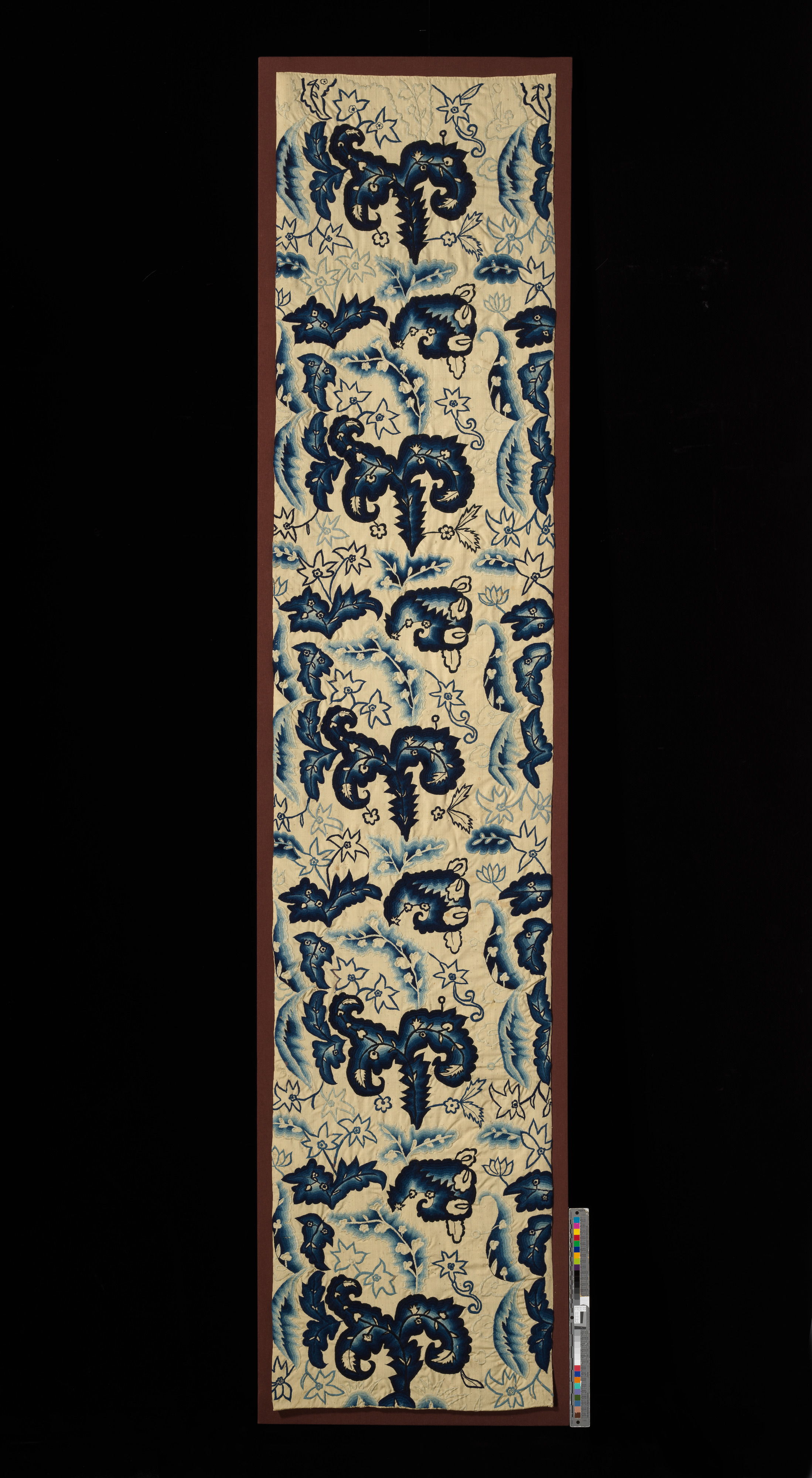
The Draped Frontier: Deconstructing the Bed Curtain as Avant-Garde Armature for SS26
In the hallowed halls of Zoey Fashion Laboratory, the mundane is perpetually dissected to reveal the extraordinary. For the SS26 season, we turn our gaze to a seemingly domestic relic: a pair of bed curtains, sourced from the Global Frontier. This is not a nostalgic exercise in historical revival. Rather, it is a radical recontextualization of volume, weight, and narrative. Constructed from crewel wool embroidery on a plain weave wool foundation fabric, these curtains are not merely fabric; they are architectural membranes, bearing the encoded memory of domestic privacy and nomadic resilience. Our analysis confronts their potential as the foundation for a new avant-garde silhouette—one that marries the structural integrity of historical textile craftsmanship with the speculative, deconstructed forms of a futuristic wardrobe.
Deconstructing the Textile: Crewel Wool as Structural Code
The materiality of the bed curtain is its first manifesto. The crewel wool embroidery, with its dense, raised loops and intricate floral or geometric motifs, is not a decorative afterthought but a structural reinforcement. Each stitch acts as a microscopic cantilever, adding tensile strength to the plain weave wool foundation. In the context of SS26, we reject the notion of embroidery as mere embellishment. Instead, we recognize it as a form of functional ornamentation—a pre-industrial algorithm for creating three-dimensional relief on a two-dimensional plane. The wool foundation, a plain weave of moderate weight, provides a supple yet sturdy base, capable of holding dramatic folds without collapsing. This is a textile built for endurance, not for the passive display of a bedroom. It whispers of frontier life, where curtains served as mobile walls, thermal barriers, and symbolic thresholds.
For the avant-garde designer, this fabric becomes a material for metamorphosis. The crewel work’s raised patterns can be strategically placed to create exoskeletal ridges along a garment’s seams, mimicking the structural ribbing of futuristic armor. Alternatively, the plain weave can be left intact to form fluid, gravity-defying drapes, while the embroidery acts as a stabilizing corset. The Global Frontier origin imbues the textile with a narrative of travel and adaptation—a perfect allegory for the nomadic, shape-shifting silhouettes of SS26.
Futuristic Silhouettes: From Domestic Volume to Architectural Sheath
The bed curtain’s inherent volume—its generous width, its ability to pool on the floor, its vertical drop—is the raw material for a new silhouette. We propose three distinct architectural forms for SS26, each leveraging the curtain’s structural potential.
1. The Inverted Canopy Silhouette: Here, the curtain is suspended from the shoulders, not the ceiling. The top edge is gathered into a rigid, asymmetrical yoke, while the lower half cascades into a train that folds back upon itself, creating a negative space—a void between the wearer’s body and the fabric. The crewel embroidery is concentrated along the yoke and the train’s hem, forming a dense, protective barrier. The plain weave foundation billows in the middle, allowing for fluid movement. This silhouette is a commentary on the inversion of private and public space, where the bed canopy becomes a portable sanctuary, a shield against the urban frontier.
2. The Fractured Drape: Rejecting the curtain’s original rectangularity, we cut it into interlocking, trapezoidal panels. Each panel is reinforced with the crewel embroidery along its edges, creating a geometric exoskeleton. These panels are then reassembled using visible, industrial-grade stitching, forming a dress that is part armor, part drapery. The silhouette is hard on one side, soft on the other—a study in tension. The wool’s natural weight pulls the fabric downward, while the embroidery’s rigidity resists, creating a dynamic, almost kinetic form. This is the silhouette of the frontier traveler, whose garments must adapt to both combat and comfort.
3. The Zero-Gravity Swathe: For the most radical proposition, we treat the curtain as a single, unbroken sheet of structural fabric. The garment is constructed by folding the fabric in on itself, creating internal pockets and tunnels that hold the body without conventional seams. The crewel embroidery is used as a pattern of resistance—areas where the fabric is deliberately stiffened to create sharp, angular folds, while the plain weave areas remain fluid. The result is a silhouette that appears to float around the body, defying gravity. The bed curtain’s original function—to enclose a sleeping figure—is inverted; now, it encloses a moving, standing figure, its volume suggesting a cocoon that is both protective and liberating.
Structural Innovation: The Curtain as a Load-Bearing System
The true innovation lies in how the curtain’s original construction informs its new purpose. Bed curtains are traditionally hung from rings or rods, with the weight distributed along a top hem. In our SS26 designs, we re-engineer this load-bearing system. The top hem becomes a structural collar or a harness, distributing the fabric’s weight across the shoulders and upper back. The side hems, often finished with a simple stitch, are reinforced with the crewel embroidery to create vertical boning channels. These channels can house flexible yet supportive materials—such as carbon fiber rods or recycled polymer filaments—that allow the fabric to hold its shape without the need for internal corsetry.
Furthermore, the crewel embroidery itself becomes a form of smart textile. Its raised loops can be treated with a thermochromic or photochromic coating, changing color in response to body heat or light exposure. This transforms the garment into a living surface, a dynamic map of the wearer’s interaction with their environment. The Global Frontier origin is thus not just a geographic reference but a temporal one—a garment that evolves with the wearer, adapting to the frontier of the future.
Conclusion: The Curtain as a Threshold
The pair of bed curtains from the Global Frontier is not a relic; it is a threshold between past and future, domestic and public, static and kinetic. For Zoey Fashion Laboratory’s SS26 collection, this textile becomes the primary armature for a new avant-garde vocabulary. By deconstructing its volume, reinforcing its embroidery, and reimagining its structural logic, we create silhouettes that are at once protective and transformative. The crewel wool embroidery is no longer a decorative flourish but a code for rigidity and relief. The plain weave foundation is no longer a backdrop but a dynamic surface for movement. In the hands of the avant-garde, the bed curtain transcends its humble origins to become a statement of architectural power—a garment that shelters, reveals, and redefines the wearer’s place in a rapidly evolving world. This is not fashion; it is frontier engineering. This is SS26.