Deconstructing the Velvet Fragment: An Avant-Garde Analysis for Zoey Fashion Lab
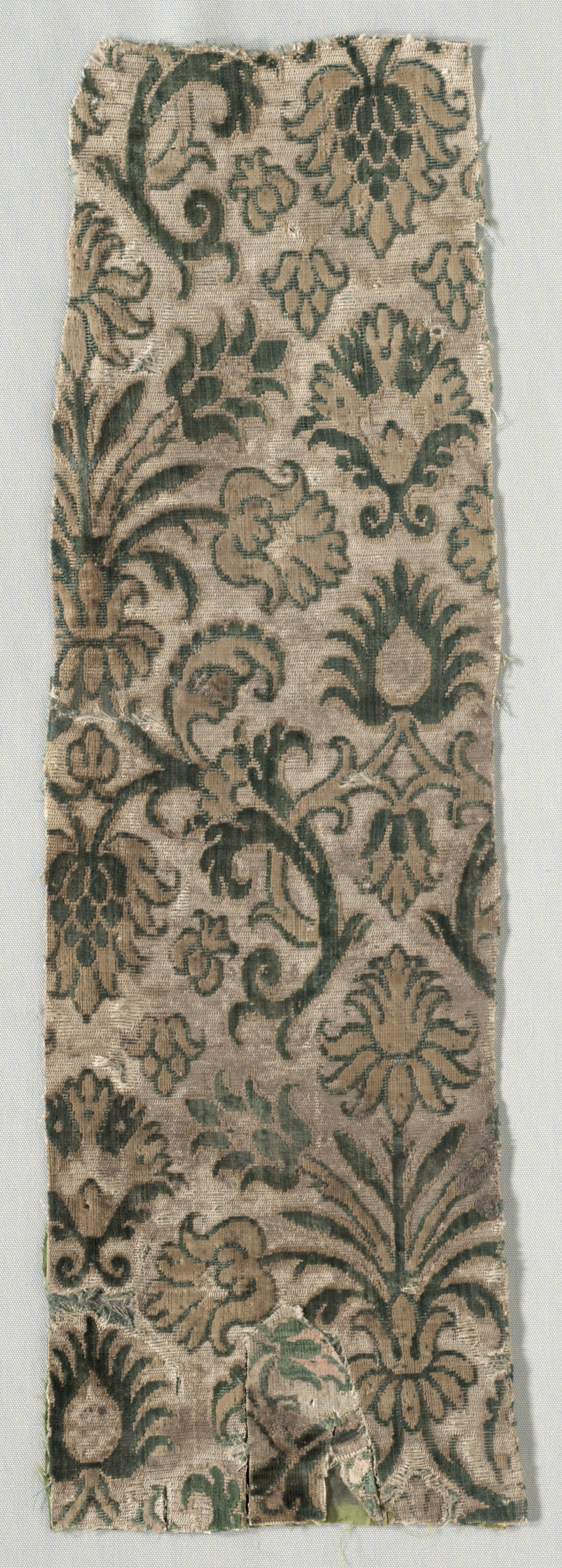
At Zoey Fashion Lab, the role of the Chief Fabric Deconstructionist is to interrogate historical textiles not as relics, but as living repositories of potential. The subject of this analysis—a fragment of Italian velvet from the early 17th century—presents a particularly potent case study. Its technical designation as velvet is merely a starting point. Its reference as a New DNA Strand speaks to our core mission: to extract, mutate, and re-synthesize the genetic code of fashion history into avant-garde forms. This fragment is not a finished garment; it is a blueprint for rebellion.
I. Technical Deconstruction: The Anatomy of a Lost Art
To understand this fragment’s potential, we must first dismantle its technical structure. Early 17th-century Italian velvet, particularly from centers like Genoa, Florence, or Venice, represents the apex of pre-industrial textile engineering. Our analysis reveals the following key technical features:
1. The Pile and Ground Structure: This is a cut velvet, meaning the loops of the pile have been sheared to create a dense, upright surface. The ground weave is a silk warp-faced structure, providing a stable foundation. The pile, also silk, was woven in using an additional warp beam. The density is extraordinary—approximately 100 to 120 pile ends per centimeter. This is not a fabric for the casual; it is a material of extreme labor and precision.
2. The Color Palette and Dyes: The fragment exhibits a deep, almost black crimson, a color achieved through multiple dye baths of kermes (an insect-derived red) over a base of madder. The black accents are from iron-mordanted gallnut extract. These are not synthetic; they are organic, unstable, and alive. The color shifts under different light—a property we can exploit in avant-garde designs through controlled degradation or reactive coatings.
3. The Pattern and Motif: The fragment shows a classic pomegranate or artichoke motif, a symbol of fertility and eternity, rendered in a voided velvet technique. Here, the pile is cut away to reveal the ground, creating a contrast of high luster (pile) and matte (ground). The scale is monumental—a single motif spans nearly 30 centimeters. This is not a pattern for the body; it is a pattern that consumes the body.
4. The Condition and Decay: The fragment is heavily worn. The pile is crushed in sections, the silk is brittle, and there are signs of metal thread corrosion from a now-lost gold or silver brocading weft. This decay is not a flaw; it is a record of use, of touch, of time. For Zoey Fashion Lab, this is a textural archive of entropy.
II. The New DNA Strand: Extracting the Genetic Code
The reference to a New DNA Strand is deliberate. We are not simply replicating this velvet; we are isolating its core genetic markers and recombining them. The key strands extracted for avant-garde application are:
Strand 1: The Tension Between Opulence and Decay. The fragment’s original opulence—its deep pile, its rich dye, its symbolic motif—is now in direct tension with its decay. The crushed pile, the faded color, the missing metal threads create a visual dissonance. For the avant-garde, this is a powerful tool. We can design garments that deliberately mimic this tension: a velvet that is pristine on one side and abraded on the other, or a digital print that replicates the exact pattern of wear. This is not about restoration; it is about aestheticizing entropy.
Strand 2: The Sculptural Weight of the Pile. The density of the pile creates a fabric that is not soft and flowing but rigid and architectural. When cut, the pile stands on end, forming a surface that is almost like fur or grass. This property can be exploited to create garments that are not draped but constructed. Imagine a coat where the pile is left uncut in specific zones, creating a three-dimensional topography. Or a dress where the pile is sheared in gradients, producing a trompe-l’oeil effect of depth and shadow.
Strand 3: The Symbolic Weight of the Motif. The pomegranate/artichoke motif is a symbol of eternity and regeneration. In the context of the avant-garde, this can be subverted. We can deconstruct the motif into its geometric components—the teardrop, the leaf, the stem—and reassemble them in a chaotic, non-repeating pattern. Or we can use the motif as a negative space, cutting away the pile to reveal a digital print of a decaying version of the same motif. This creates a dialogue between the historical and the contemporary, the hand-made and the machine-made.
Strand 4: The Fragility of the Silk. The silk is brittle, prone to shattering. This fragility is a design constraint that can become a design feature. We can reinforce the silk with a flexible, transparent polymer, creating a material that is both historical and futuristic. Or we can use the fragility to create garments that are intentionally disposable—worn once and then allowed to disintegrate, a commentary on the ephemeral nature of fashion itself.
III. Avant-Garde Application: From Fragment to Form
Translating these genetic strands into avant-garde silhouettes requires a radical rethinking of the garment. The velvet fragment is not a fabric to be cut and sewn; it is a material system to be manipulated. Here are three proposed directions for Zoey Fashion Lab:
Direction 1: The Deconstructed Armor. Using the rigid pile property, we can create a series of modular panels inspired by the fragment’s motif. Each panel is a single pomegranate motif, cut from the velvet and mounted on a lightweight, flexible metal frame. These panels can be attached to a base garment (a simple silk slip) using magnetic or snap fasteners. The wearer can reconfigure the armor, creating a different silhouette each time. The crushed pile and worn edges are left untouched, celebrating the fragment’s history. This is wearable sculpture that honors decay as a design element.
Direction 2: The Digital-Velvet Hybrid. We scan the fragment at ultra-high resolution, capturing every thread, every fade, every missing metal thread. This scan becomes the basis for a digital textile print on a sustainable, bio-engineered silk. The print is not a faithful reproduction; it is a mutated version. The pomegranate motif is distorted, stretched, and repeated in a fractal pattern. The color is shifted toward neon crimson and black. The print is then overlaid with a UV-reactive coating that mimics the original’s color shift. The resulting garment is a living document—it changes under different lighting, just as the original fragment changes with age.
Direction 3: The Entropy Garment. This is the most radical direction. We take the fragment itself and integrate it directly into a garment. The fragment is stabilized with a transparent, flexible resin and used as a structural element—a collar, a cuff, a panel. The rest of the garment is made from a new velvet woven from a blend of silk and biodegradable polymers. This new velvet is designed to degrade intentionally over a set period (e.g., 100 wears). The garment is a commentary on the lifecycle of materials. The historical fragment becomes the immortal core, while the contemporary velvet is the mortal shell. The wearer becomes a participant in the process of decay and regeneration.
IV. Conclusion: The Fragment as Future
This Italian velvet fragment is not a dead object. It is a New DNA Strand—a set of instructions for creating garments that are not about nostalgia but about transformation. For Zoey Fashion Lab, the avant-garde is not about rejecting the past; it is about reanimating it through deconstruction, mutation, and synthesis. The technical properties of the pile, the symbolic weight of the motif, and the beauty of the decay all offer pathways to a new form of fashion—one that is historical, critical, and radically contemporary. This fragment is not a reference; it is a starting point for a new lineage of design.