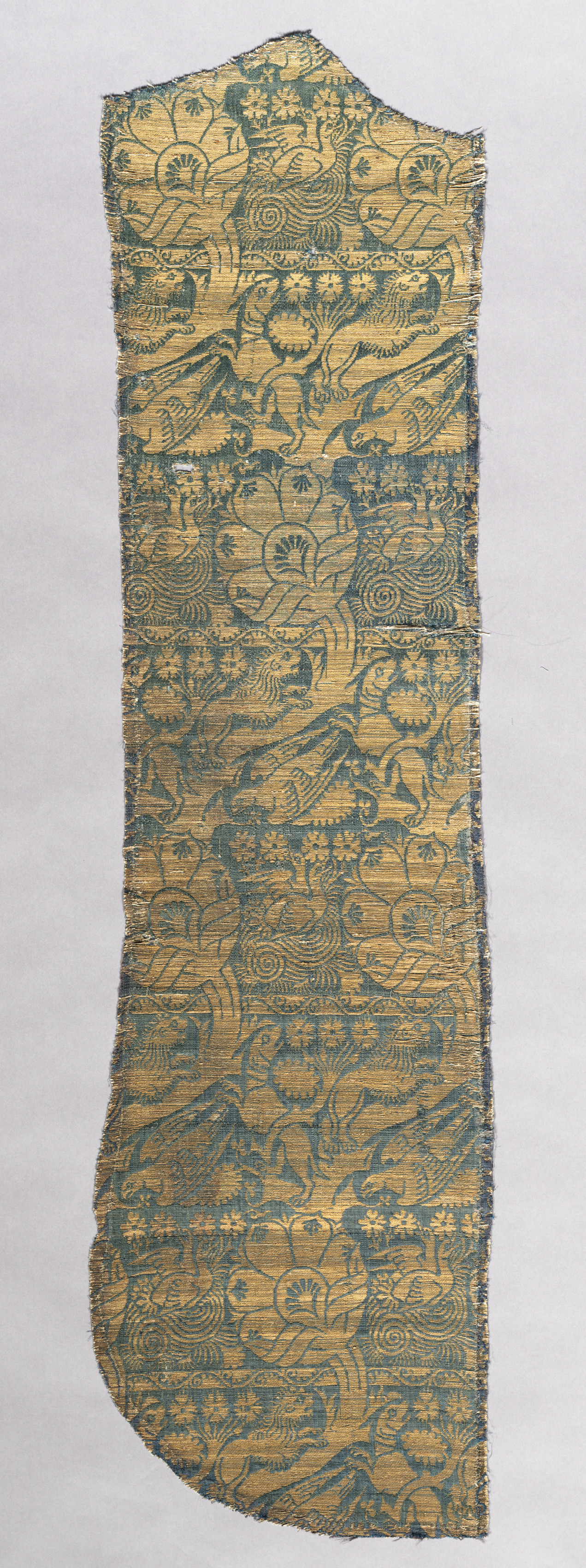
Deconstructing the Code: The Zoey Fashion Lab Analysis of the Chasuble Fragment with Realistic Animals
At Zoey Fashion Lab, our mission is to dissect historical textiles not as relics, but as living blueprints for the future of fashion. The subject of this analysis—a Chasuble Fragment with Realistic Animals, originating from 14th–15th century Italy, crafted from silk and gold thread in a complex lampas weave—presents a profound paradox. It is a sacred garment, yet its surface teems with the profane vitality of the natural world. For the avant-garde designer, this fragment is not merely a decorative artifact; it is a New DNA Strand—a genetic code of structural tension, material opulence, and narrative complexity waiting to be spliced into contemporary haute couture.
Technical Matrix: The Lampas Weave as Structural Blueprint
The technical foundation of this fragment is the lampas weave, a sophisticated technique that binds a pattern weft to a ground warp. This is not a simple embroidery; it is an integrated, multi-layered system. The silk provides a luminous, fluid ground, while the gold thread—likely a gilded membrane wrapped around a silk core—introduces rigid, reflective structure. For Zoey Fashion Lab, this represents a binary code of luxury: the soft versus the hard, the matte versus the metallic, the organic versus the industrial.
In an avant-garde context, this weave structure can be abstracted into a design principle. Imagine a modern garment where the "ground" is a sheer, bio-engineered silk, and the "pattern" is a rigid, 3D-printed gold-alloy lattice that moves with the body but retains its structural integrity. The lampas technique teaches us that decoration need not be applied; it can be integral to the garment's architecture. The gold thread does not sit on the silk; it is woven through it, creating a single, inseparable entity. This is the first lesson for the contemporary designer: pattern and structure are one.
Iconographic Deconstruction: Realistic Animals in Sacred Space
The presence of "realistic animals" on a liturgical chasuble is a deliberate act of visual tension. In medieval Italy, such imagery—often lions, birds, or mythical beasts—served as allegories for Christ or the faithful. Yet, the "realistic" treatment suggests a fascination with the observable world, a pre-Renaissance impulse that grounds the spiritual in the tangible. For the avant-garde, this is a powerful tool: the collision of the sacred and the secular.
Zoey Fashion Lab interprets these animals as biomorphic code. They are not merely decorative motifs; they are living symbols that disrupt the garment's intended function. A lion rendered with anatomical precision on a priest's vestment suggests a wildness that cannot be contained by ritual. This concept can be translated into modern design through digital embroidery or laser-cut appliqué that features hyper-realistic animal forms—snakes, wolves, or birds of prey—placed in unexpected locations: a serpent coiling up a tailored sleeve, a hawk's wing spanning the back of a deconstructed blazer. The goal is to create a garment that tells a story of untamed nature invading human artifice.
The New DNA Strand: Splicing Historical Complexity into Avant-Garde Form
To call this fragment a "New DNA Strand" is to recognize it as a source of genetic information for design. In biology, DNA is a sequence of instructions. Here, the fragment provides a sequence of material, iconographic, and technical instructions that can be recombined. The avant-garde designer must act as a genetic engineer, extracting key elements and splicing them into unexpected contexts.
- Material Splicing: The contrast of silk and gold thread can be reimagined using modern materials. Replace silk with a biodegradable, lab-grown spider silk for sustainability, and replace gold thread with recycled metallic fibers or even conductive threads that can light up or change color. The lampas structure remains, but the genetic code is updated for the 21st century.
- Iconographic Splicing: The realistic animals can be digitized and abstracted. Use AI to generate hybrid creatures—part lion, part mechanical bird—that are then woven or printed onto the fabric. This creates a new mythology for the garment, one that speaks to our era of genetic modification and digital reality.
- Structural Splicing: The chasuble's original form—a poncho-like vestment—can be deconstructed. Take the lampas weave and use it not as a full garment but as a structural insert within a modern silhouette. For example, a tailored coat might have a lampas panel across the shoulders, referencing the chasuble's weight and drape, while the rest of the garment is made of a stark, minimalist wool.
Avant-Garde Application: From Fragment to Collection
Zoey Fashion Lab proposes a capsule collection titled "Sacred Menagerie." Each piece is a deconstruction and reconstruction of the chasuble's DNA. The collection would feature:
- The Lattice Gown: A floor-length dress in black silk charmeuse, with a lampas-inspired lattice of gold-toned, 3D-printed polymer across the bodice. The lattice forms the silhouette of a crouching lion, visible only at certain angles or under UV light. This piece embodies the hidden narrative of the original fragment.
- The Deconstructed Chasuble Coat: A voluminous coat cut in the shape of a chasuble, but with asymmetrical seams and removable panels. The front is solid black wool; the back is a lampas weave of silk and recycled gold thread, depicting a flock of birds in flight. The coat can be worn open, closed, or with the back panel detached and worn as a separate scarf. This references the ritualistic layering of the original garment.
- The Bio-Luminous Top: A cropped top woven with a lampas structure using conductive threads and small LEDs. The pattern is a digital rendering of a medieval bestiary animal, which pulses with light when the wearer moves. This piece is a living fabric, merging the ancient weave with contemporary technology.
Conclusion: The Fragment as a Living Codex
The Chasuble Fragment with Realistic Animals is far more than a historical curiosity. It is a codex of design principles that speaks directly to the avant-garde sensibility. Its lampas weave teaches us the unity of structure and decoration. Its animal imagery teaches us the power of symbolic disruption. Its material opulence teaches us the value of contrast. For Zoey Fashion Lab, this fragment is a New DNA Strand—a sequence of instructions that, when decoded and recombined, can generate fashion that is not only beautiful but intellectually rigorous, narrative-driven, and technically innovative. The future of fashion lies not in forgetting the past, but in deconstructing its codes to build new ones. This fragment is our starting point.