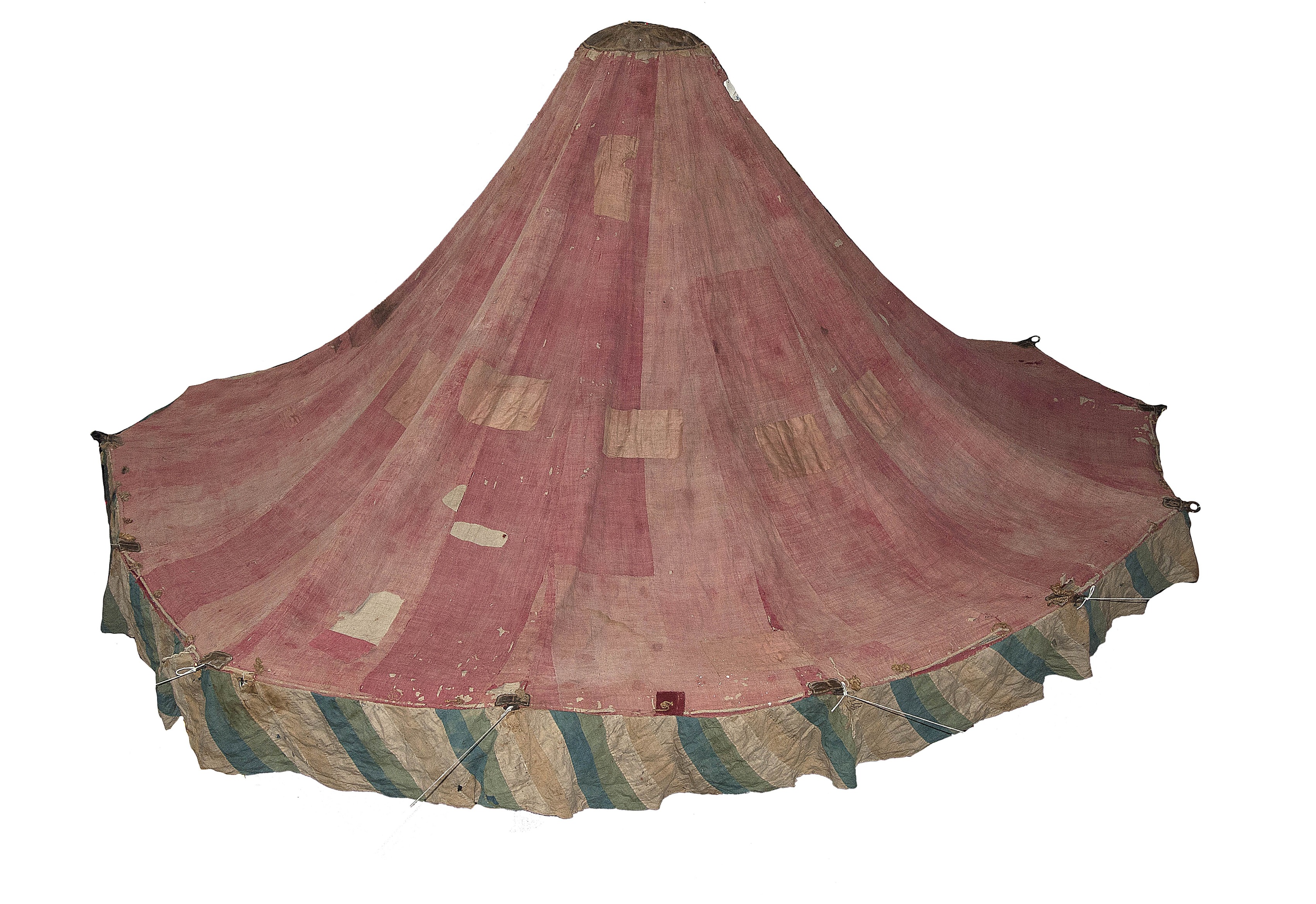
Deconstructing the Regal Canopy: An Avant-Garde Analysis of the Royal Round Tent (Roof) for Zoey Fashion Lab
As the Chief Fabric Deconstructionist for Zoey Fashion Lab, it is my privilege to present a radical reinterpretation of a historical artifact: the Royal Round Tent, made for Muhammad Shah during the Qajar period in Iran (1779-1925). This object, sourced from Rasht, is not merely a relic of imperial shelter; it is a blueprint for avant-garde fashion architecture. We will dissect its materiality, technical construction, and symbolic resonance to extract principles that challenge contemporary design. The tent’s roof, a convergence of luxury and utility, offers a profound lesson in structural storytelling—a core tenet of our lab’s ethos.
Material Subversion: From Shelter to Silhouette
The tent’s interior is a symphony of tactile contrasts: wool in plain weave serves as the foundational canvas, while silk embroidery in chain stitch creates luminous, raised patterns. The inclusion of tape and leather introduces linear rigidity and organic softness. For the avant-garde designer, this is not a decorative choice but a structural manifesto. We can reimagine these materials as a layered garment system: the wool becomes a base layer or a structured coat, its plain weave providing a neutral ground for narrative. The silk chain stitch, traditionally used for floral or geometric motifs, can be abstracted into 3D embroidery that forms architectural pleats or asymmetrical drapes, echoing the tent’s radial geometry. Leather tape, often used for reinforcement, can be recontextualized as functional corsetry or external boning, dictating the shape of a silhouette.
The exterior, composed of cotton and wool plain weave, is a study in pragmatic opulence. The cotton offers breathability and lightness, while the wool provides insulation and weight. In an avant-garde context, this duality translates to reversible or convertible garments. A coat might feature a cotton exterior for daytime fluidity and a wool interior for dramatic, weighted draping at night. The rope and iron ring, functional elements for structural tension, become hardware for deconstruction. Imagine a dress where iron rings serve as adjustable fasteners, allowing the wearer to alter the garment’s volume, or rope integrated as a structural belt that cinches or releases fabric, creating shifting silhouettes. This is not about replicating the tent but about weaponizing its engineering for wearable art.
Technical Deconstruction: The Chain Stitch as a Structural Language
The technical specification emphasizes silk embroidery in chain stitch. Historically, this stitch creates a continuous, looping line, resembling a chain. For Zoey Fashion Lab, this is a code for movement and connectivity. We can deconstruct this technique into a parametric design system. Instead of hand-embroidering motifs, we can use digital embroidery machines to generate chain-stitch patterns that function as dynamic seams. These seams can be placed at stress points—shoulders, hips, elbows—to allow for articulation, or they can be used to create tension-based textures that pull fabric into unnatural, sculptural forms.
The inlaid work in the wool interior, likely a technique of embedding contrasting materials, suggests a patchwork or appliqué approach. For an avant-garde collection, this translates to material juxtaposition. We can inlay recycled plastics, metallic threads, or even conductive fibers into a wool base, creating garments that are both historically reverent and futuristic. The inlay becomes a cartography of cultural layers, where each embedded fragment tells a story of trade, conquest, or artistry. This aligns with the Archive Resonance reference: “器物与绘画不仅是时代技艺的结晶,更是文化碰撞与美学交融的无声见证” (Objects and paintings are not only the crystallization of era techniques, but also silent witnesses of cultural collision and aesthetic fusion). Our garments must embody this collision.
Symbolic Resonance: The Tent as a Mobile Throne
The Royal Round Tent was a symbol of power and mobility for Muhammad Shah. Its roof, a canopy of authority, was designed to be both portable and imposing. In an avant-garde context, this translates to wearable architecture. We can design garments that function as personal pavilions—dramatic capes, oversized hoods, or collapsible structures that expand and contract. The iron ring, originally used to hoist the tent, becomes a central hardware element for a dress’s neckline or a coat’s collar, allowing the wearer to adjust the garment’s height or volume. This is power dressing redefined: not through shoulder pads but through mechanical agency.
The Qajar period was marked by a fusion of Persian, Russian, and European influences. The tent’s design likely incorporated motifs from these cultures. For our lab, this is a directive to hybridize references. We can combine the tent’s radial symmetry with asymmetrical draping techniques from Japanese avant-garde designers, or integrate the chain stitch with laser-cut leather. The result is a collection that is chronologically and geographically fluid. The tent’s roof, a circle, becomes a mandala of design—a symbol of unity and infinity—that we can fragment, distort, and reassemble.
Avant-Garde Application: Collection Concepts
Based on this analysis, I propose three collection pillars for Zoey Fashion Lab:
1. “Structural Opulence”: A series of outerwear pieces that mimic the tent’s roof. A wool and silk coat with chain-stitch embroidery that forms geodesic lines, reinforced with leather tape. The coat features an iron ring at the back, allowing it to be worn as a cape or hoisted into a canopy. This garment is both a statement piece and a functional shelter.
2. “Inlaid Narratives”: A dress constructed from wool panels with inlaid silk and metallic fragments. The chain stitch is used to create a digital-age pattern—circuit board motifs or pixelated florals—bridging the Qajar era with contemporary technology. The dress includes rope ties that can be tightened or loosened, altering its silhouette from column to A-line.
3. “Mobile Authority”: A jumpsuit with adjustable iron ring fasteners at the shoulders and waist, allowing the wearer to change the garment’s structure. The exterior is cotton plain weave, dyed in deep Qajar reds and blues, while the interior is wool with chain-stitch embroidery in gold. The rope is woven into a belt that can be detached and used as a functional accessory, such as a bag strap or a headpiece.
Conclusion: The Tent as a Living Archive
The Royal Round Tent is not a static artifact but a living archive of design intelligence. Its materials, techniques, and symbolic weight offer a vocabulary for avant-garde expression. At Zoey Fashion Lab, we do not merely preserve history; we deconstruct and reanimate it. By dissecting this tent’s roof, we have uncovered principles of structural tension, material hybridity, and cultural narrative that will inform our next collection. The tent’s legacy is not in its original form but in its transformation into wearable art—a testament to the eternal dialogue between the past and the future.