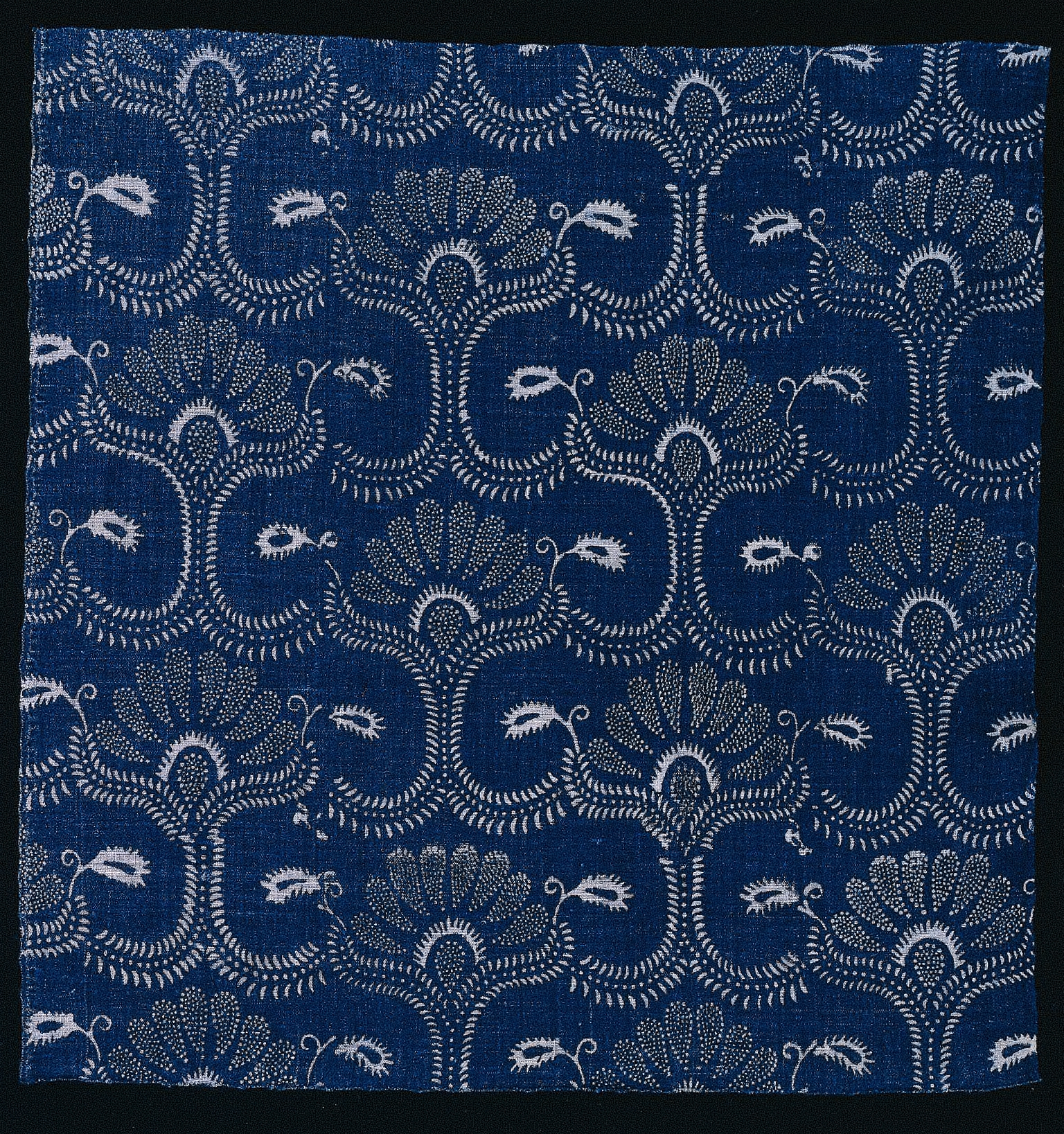
Deconstructing the Alsatian Loom: The Stylized Leaf as a Proto-Avant-Garde Gesture
As the Chief Fabric Deconstructionist for Zoey Fashion Lab, I am tasked with unearthing the radical potential latent within historical textiles. Our current subject—a late 18th-century French wax-resist, indigo-dyed cotton from Sain-Bel, Alsace, bearing a stylized leaf design printed via woodblock—presents a fascinating paradox. At first glance, it is a humble artifact of provincial craftsmanship. Yet, within its measured loom width, its chemical resist process, and its graphic botanical motif, we discover a blueprint for a proto-avant-garde aesthetic. This analysis will dismantle the textile’s technical, spatial, and visual components, revealing how its constraints and processes prefigure the disruptive, pattern-breaking logic of modern design.
I. The Loom Width as a Spatial Constraint and Liberation
The fabric’s original loom width—likely between 18 and 24 inches, a standard for 18th-century French toiles and indiennes—is not a mere historical footnote. It is the primary architect of the design’s rhythm. This narrow field dictated a specific relationship between the repeat and the viewer. The stylized leaf motif could not sprawl; it had to compress, repeat, and stack within a tight vertical corridor.
For the avant-garde designer, this constraint becomes a generative force. The narrow loom width forces a radical economy of form. The leaf is not naturalistic; it is abstracted into a crisp, graphic silhouette—a precursor to the bold, simplified shapes of Matisse’s cut-outs or the repetitive, almost hypnotic patterns of Op Art. The woodblock’s hard, carved edge creates a high-contrast, two-dimensional effect that flattens depth, a move that would later define modernist painting’s rejection of illusionism.
From a deconstructionist perspective, we see the loom width as a frame for seriality. The repeat is not a decorative afterthought but a structural imperative. Each leaf is a unit in a sequence, a motif that gains meaning through its neighbors. This echoes the serial repetition found in Andy Warhol’s silkscreens or the minimalist grids of Agnes Martin. The 18th-century weaver, bound by the loom, unknowingly created a system of mechanical reproduction that the 20th-century avant-garde would consciously embrace.
II. The Wax-Resist and Indigo: A Chemistry of Negative Space
The technical process—wax-resist printing followed by indigo dyeing—is where the fabric’s true radicality lies. This is not a surface decoration; it is a subtractive, negative-space process. The wax is applied to areas meant to remain white, acting as a barrier. The indigo bath then saturates the exposed fibers. The design emerges not from adding color, but from withholding it.
This method inverts the conventional relationship between figure and ground. The leaf is not a positive shape painted onto a dark field; it is a void, a hole in the blue. The white of the base cotton is the active, resistant element. This inversion is a core avant-garde strategy—think of the cut-paper works of Henri Matisse or the negative-space sculptures of Henry Moore. The fabric’s surface becomes a dialectic between presence and absence.
Furthermore, the indigo dye itself is a chemical agent of temporal transformation. Indigo is not a pigment that sits on the fiber; it is a vat dye that oxidizes, turning from greenish-yellow to deep blue upon exposure to air. The fabric’s color is a record of a chemical reaction, a performative act. For the avant-garde designer, this introduces a conceptual layer: the textile is not a static object but a document of a process. This aligns with the principles of Arte Povera and Process Art, where the material’s behavior is the artwork’s subject.
III. The Stylized Leaf: From Botanical Illustration to Graphic Sign
The leaf motif, while derived from nature, is aggressively stylized. It is not a faithful botanical study. The woodblock carver has simplified the leaf into a series of bold, geometric curves and sharp points. The veins are reduced to a few crisp lines. This is a semiotic reduction—the leaf is transformed from a natural object into a graphic sign.
This move from representation to abstraction is the very engine of modernism. The stylized leaf of Sain-Bel is a direct ancestor of the Art Deco lotus or the Bauhaus geometric leaf. It demonstrates a pre-industrial understanding of what we now call visual branding: a motif that is instantly legible, reproducible, and scalable. The leaf becomes a logo, a vector of identity for the textile.
In the context of the late 18th century, this stylization was partly a technical necessity. The woodblock could not capture fine detail; it demanded bold, clean lines. But this limitation became an aesthetic virtue. The resulting design has a brutalist clarity that feels startlingly contemporary. It is a pattern that could sit comfortably alongside a Jonathan Saunders print or a Marimekko floral. The leaf’s repetition creates a visual rhythm that is both hypnotic and unsettling—a precursor to the psychedelic patterns of the 1960s, which also used repetition and high contrast to distort perception.
IV. The Provenance of Sain-Bel: A Site of Cultural Collision
Alsace, in the late 18th century, was a borderland—a crossroads of French, German, and Swiss influences. The town of Sain-Bel was a center for the production of indiennes, cotton fabrics inspired by Indian chintzes that had flooded European markets via the East India Companies. This textile is not a pure expression of French taste; it is a hybrid artifact, a product of global trade and cultural appropriation.
For the avant-garde designer, this provenance is a declaration of impurity. The fabric refuses to be pinned down to a single cultural identity. Its stylized leaf borrows from Indian floral motifs, its indigo dyeing technique echoes Japanese shibori and West African resist-dyeing, and its woodblock printing is a European adaptation of Asian techniques. This global mash-up is a core avant-garde strategy—think of Picasso’s African masks or the cross-cultural sampling in contemporary fashion.
The fabric’s existence in the Archive Resonance collection, with its reference to the 16th-17th centuries, further emphasizes this temporal dislocation. The object is a palimpsest, bearing traces of multiple eras and geographies. To deconstruct it is to acknowledge that no design is pure; every pattern is a conversation across time and space.
V. Avant-Garde Application: The Fabric as a System
For Zoey Fashion Lab, this textile is not a source of nostalgia but a system of operations. Its deconstruction yields a set of actionable principles:
1. Constraint as Catalyst: The narrow loom width teaches us that boundaries are generative. For a contemporary collection, we can impose similar constraints—limiting the color palette to two, restricting the motif to a single shape, or working within a specific repeat size. This forces a radical focus that can produce unexpectedly bold results.
2. Negative-Space Design: The wax-resist process suggests a design methodology based on subtraction rather than addition. Instead of layering patterns, we can carve away color, creating designs that emerge from the ground. This is a sculptural approach to textile design, where the fabric’s own structure becomes the pattern.
3. The Sign as Motif: The stylized leaf is a masterclass in visual economy. It is a shape that is instantly recognizable yet abstract enough to be endlessly reinterpreted. For Zoey Fashion Lab, this means developing a signature graphic vocabulary—a set of motifs that function as brand identifiers, scalable across garments, accessories, and digital media.
4. Process as Narrative: The indigo dyeing process is a story of transformation. We can make this process visible in the final garment, perhaps through intentional fading, visible resist marks, or seams that reveal the fabric’s construction. This is a deconstructivist fashion strategy, where the garment’s making is part of its aesthetic.
In conclusion, the late 18th-century Alsatian wax-resist textile is not a relic. It is a prototype for a way of thinking about design that is rigorous, conceptual, and cross-cultural. Its narrow loom width, its subtractive dyeing process, its stylized leaf, and its hybrid provenance all converge to create a proto-avant-garde object. By deconstructing it, Zoey Fashion Lab can extract a methodology that is both historically grounded and radically forward-looking. The leaf is not just a leaf; it is a blueprint for disruption.