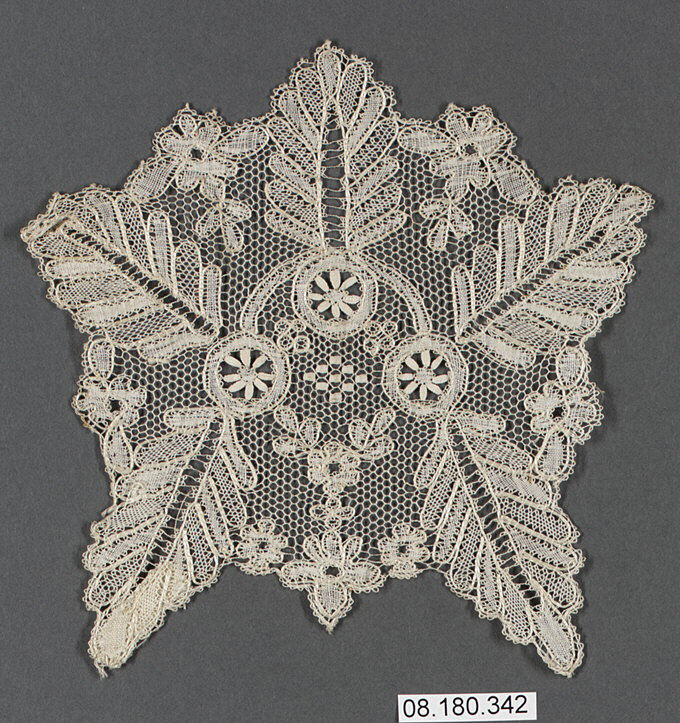
The Deconstruction of Ornament: Bobbin Lace as Structural Avant-Garde for SS26
In the lexicon of haute couture, ornament has historically been the servant of silhouette—a decorative afterthought, a veneer of luxury applied to a pre-existing form. For the SS26 season at Zoey Fashion Laboratory, we dismantle this hierarchy. We propose a radical thesis: ornament is not applied; it is the structure. Our chosen medium, bobbin lace, is a relic of artisanal patience, yet its geometric logic—its grid of threads, its tensile strength, its voided spaces—offers an unprecedented blueprint for futuristic garment architecture. This analysis dissects how bobbin lace transcends its heritage to become a primary load-bearing material, generating silhouettes that are simultaneously fragile and armored, organic and algorithmic.
From Folklore to Frontier: The Material Recontextualized
Bobbin lace, born in 16th-century Flanders and refined across Europe, embodies a paradox: it is labor-intensive yet ephemeral, intricate yet airy. Traditionally, it is a secondary layer, a collar, a cuff—an embellishment. For SS26, we discard this taxonomy. We treat bobbin lace as a structural textile, a lattice that can be scaled, stiffened, and laser-cut into architectural panels. The global frontier is not a geographical location but a state of material intelligence. We source lace from workshops in Burano, Indonesia, and Oaxaca, merging their distinct tension techniques—Flemish point ground, Torchon, Chantilly—to create a hybridized, borderless fabric. This is not cultural appropriation; it is a globalized lattice, a synthesis of handcraft and computational design. The result is a material that breathes, flexes, and holds its shape without internal boning.
Silhouette as Algorithm: The Lace Exoskeleton
The SS26 silhouette is not draped; it is grown. We deploy bobbin lace as an exoskeleton, a second skin that defines the body’s architecture. The traditional corset is inverted: instead of compressing flesh, the lace cage expands outward, creating a negative space halo around the torso. This is achieved through a technique we call “tensile embroidery”—multiple layers of bobbin lace are stretched over a 3D-printed scaffold, then heat-set to retain a permanent, cantilevered curve. The result is a silhouette that resembles a digital wireframe, a ghost of the body projected into space. Shoulders become parabolic arcs; waistlines dissolve into lace lattices that float millimeters from the skin. The ornament is no longer a surface pattern; it is the volume generator.
Consider the “Lace Armature Gown”: a floor-length sheath constructed entirely from interlocking bobbin lace panels, each stitch engineered to bear tension. The lace is treated with a biocompatible resin, rendering it rigid yet translucent. The silhouette is a hybrid of medieval armor and cyborg exoskeleton—a soft armor for the post-human age. The ornament—the floral motifs, the scalloped edges—becomes a functional load path, directing stress away from seams. The garment does not move with the body; it creates its own kinetic architecture, swaying as a unified, articulated shell.
The Void as Ornament: Negative Space and Transparency
Avant-garde couture has long fetishized the silhouette’s outline. For SS26, we shift focus to the interior—the void. Bobbin lace is inherently a study of negative space: the holes are as important as the threads. We exploit this by designing garments where the lace’s openwork becomes the primary visual field. The body is partially visible, but only as a fragmented, abstracted form. This is not nudity; it is visual interference. The lace’s geometric patterns—hexagons, spirals, fractal-like repetitions—create a moiré effect when layered over skin or underlighting. The ornament is a filter, a screen that modulates perception.
For example, the “Lattice Bodysuit” is a second-skin piece of laser-cut bobbin lace, with the density of stitches varying from 80% coverage to 20%. The areas of high density (shoulders, hips) are structural anchors; the low-density zones (waist, spine) allow light and skin to puncture the silhouette. The ornament is not decorative but dictatorial—it commands where the eye rests, where the body reveals, where it conceals. The silhouette is a topography of transparency, a map of the wearer’s architectural intent.
Structural Innovation: The Lace Joint and Modular Assembly
Traditional bobbin lace is continuous, a single piece. For SS26, we break this continuity. We introduce the lace joint—a mechanical connector, 3D-printed from recycled nylon, that joins separate lace panels. These joints are visible, even celebrated, as part of the garment’s logic. They are the ornament of assembly, resembling digital nodes or robotic sutures. The lace panels themselves are pre-stressed, cut with algorithmic precision to create asymmetrical, cantilevered forms. The silhouette becomes modular: a jacket can be disassembled into a skirt, a collar into a cuff. The ornament is not fixed; it is a system of reconfiguration.
This modularity extends to the silhouette’s relationship with the body. We design “lace exoskeleton gloves” that extend into fingerless gauntlets, their lace patterns mapping the hand’s biomechanical axes. The ornament—the loops, the picots—becomes articulated hinges, allowing the hand to flex while the lace remains rigid. The silhouette is not static; it is a kinetic sculpture that adapts to gesture. This is the frontier of ornament: not as decoration, but as dynamic infrastructure.
Conclusion: The Ornament as Architecture
For Zoey Fashion Laboratory’s SS26, bobbin lace is no longer a craft of the past. It is a material of the future—a tensile, transparent, algorithmic fabric that redefines the silhouette from the inside out. Ornament is not a surface; it is a structural system. The void is not absence; it is presence. The global frontier is not a destination; it is a lattice of threads, hand-tied and machine-calibrated, that connects Burano to Oaxaca to the digital realm. This is not a collection of clothes. It is a manifesto for a new couture: where every stitch bears weight, every hole holds light, and every ornament is a load-bearing pillar of the future’s silhouette.