The Armored Silhouette: Deconstructing the Shield as a Blueprint for SS26 Avant-Garde Couture
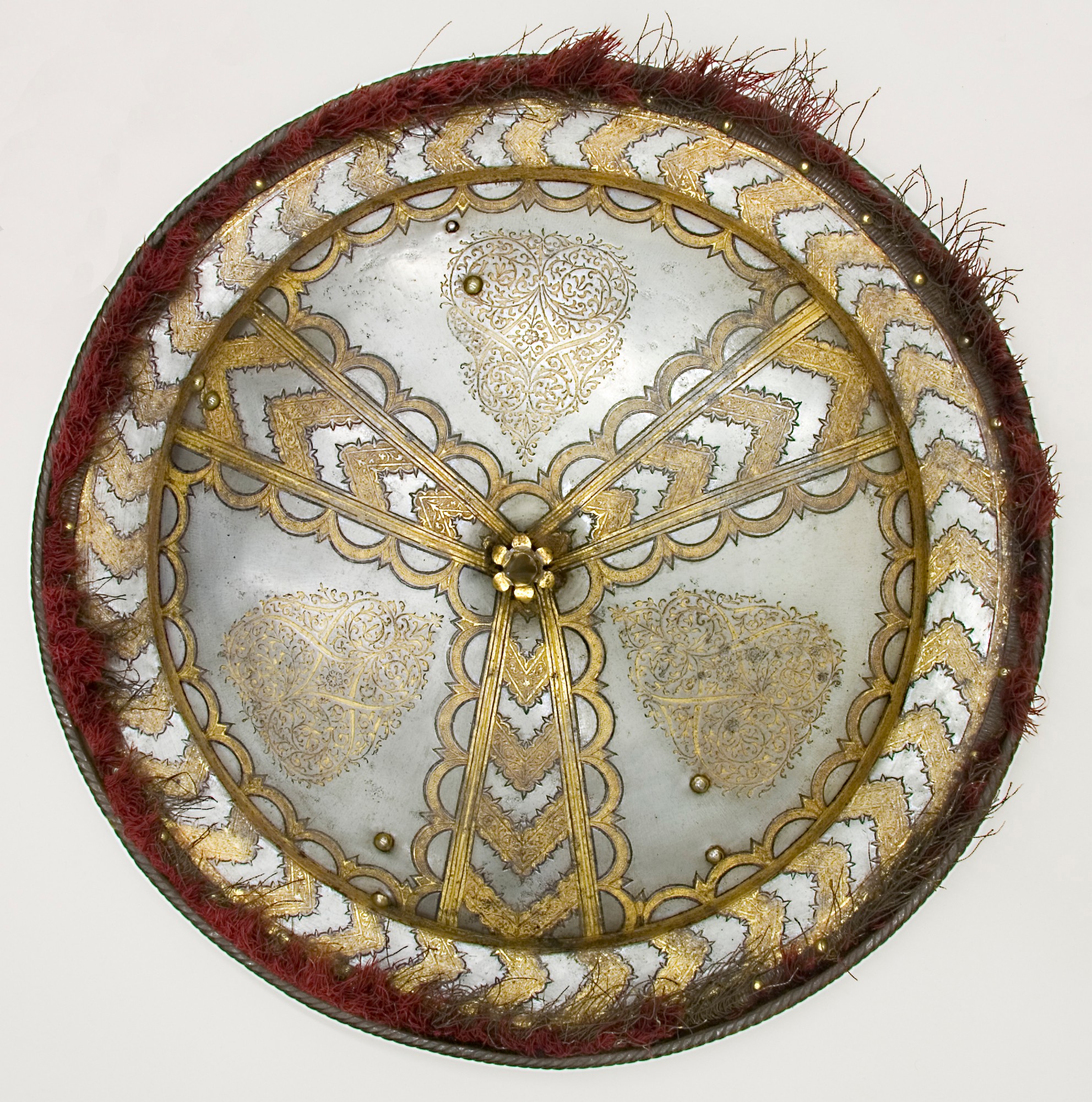
The shield, historically a symbol of defense, heraldry, and static protection, is undergoing a radical recontextualization within the Zoey Fashion Laboratory. In this standalone avant-garde study for Spring/Summer 2026, we dissect the shield not as a relic of warfare, but as a dynamic, architectural blueprint for the future of the human form. The subject, a probable German-crafted shield from the late Gothic period, constructed from steel, gold, brass, and velvet, serves as a profound paradox: a rigid, metallic object imbued with soft, tactile luxury. This analysis will explore how its structural logic—its curvature, its layering, its material tension—can be transmuted into a futuristic, deconstructive silhouette that challenges the very notion of clothing as mere covering. The SS26 collection, which we tentatively call “Aegis Morphology,” proposes that the shield is not a barrier to the body, but a new exoskeletal extension of it.
I. Material Alchemy: From Armor to Second Skin
The original shield’s composition—steel, gold, brass, and velvet—offers a masterclass in material contrast. The steel provides the structural spine, the gold and brass introduce a metallic opulence that catches light like a futuristic beacon, and the velvet, often lining the interior or applied as a decorative band, introduces a subversive softness. For SS26, we propose a radical reinterpretation of these materials through a lens of “liquid armor.” Steel is not used as solid plate, but as laser-cut, flexible mesh, engineered to drape like a second skin while retaining its structural integrity. Gold is not applied as foil, but as a micron-thin electroplated finish on high-tensile synthetic fibers, creating a shimmering, almost holographic surface that mimics the reflective properties of polished brass. The velvet, traditionally a sign of interior comfort, is inverted and externalized. We envision a garment where a structural steel-brass cage is partially exposed, with panels of deep, crushed velvet cascading from the shoulders or hips, creating a tension between hard and soft, static and flowing. This is not armor; it is “armature-as-fabric,” where the weight of history is translated into a lightweight, breathable, and kinetic materiality.
II. Silhouette Innovation: The Curved Plane and the Asymmetric Enclosure
The shield’s defining feature is its curvature—a convex surface designed to deflect force. In traditional couture, this translates to the bustle, the peplum, or the shoulder pad. But for SS26, we push this logic to its extreme. The silhouette is no longer a simple curve; it is a “displaced plane.” Imagine a jacket where the right shoulder is constructed from a single, sweeping, cantilevered piece of steel-brass composite, curving outward and upward like a protective wing. The left side, conversely, is left entirely bare, a sheer, velvet-lined cutout that reveals the collarbone and upper arm. This is the “asymmetric shield silhouette,” a direct deconstruction of the shield’s symmetrical form. The garment becomes a three-dimensional sculpture, with the shield’s geometry translated into a series of overlapping, non-repeating arcs. The waist is not cinched; it is defined by a rigid, brass-rimmed ‘buckler’ that sits off-center, creating a visual pivot point. The lower half of a dress might feature a single, enormous, curved panel of steel mesh that sweeps from the left hip to the right knee, then abruptly stops, leaving the other leg exposed in a cascade of velvet ribbons. This is not a garment that follows the body; it is a garment that redefines the body’s spatial relationship with the environment, creating a silhouette that is both protective and provocative, a “futuristic exoskeleton of vulnerability.”
III. Structural Innovation: The Deconstructive Joint and the Tension System
The key to this collection lies not in the panels themselves, but in the “joints”—the points of connection. A Gothic shield’s hardware—rivets, buckles, and leather straps—are our primary structural vocabulary. We reimagine these as functional, visible, and deconstructive elements. Instead of hidden seams, we use oversized, brushed brass rivets that pivot like ball joints, allowing the wearer to adjust the angle of a shoulder plate or the drape of a velvet panel. The “tension system” is a novel innovation: a network of thin, gold-plated cables and adjustable brass turnbuckles that run across the back or along the spine. By tightening or loosening these cables, the wearer can alter the silhouette from a closed, protective shell to an open, deconstructed frame. This transforms the garment from a static object into a “wearable mechanism,” a piece of kinetic architecture. The velvet is not simply sewn; it is suspended and stretched between steel frames, creating a drum-tight surface that catches the light or a billowing, airy pocket that moves like a sail. This is the “deconstructive joint,” where the garment’s construction is its primary aesthetic, and the act of wearing becomes an act of perpetual assembly and disassembly.
IV. Futuristic Context: The Shield as a Symbol of Digital and Biological Protection
Why the shield for SS26? In an era of digital surveillance, environmental precarity, and biological uncertainty, the shield is no longer a medieval artifact; it is a “contemporary metaphor.” This collection proposes that fashion can be a form of protective cognition. The steel mesh becomes a Faraday cage for the body, a barrier against electromagnetic fields. The gold and brass finishes are not merely decorative; they are conductive, hinting at garments that could interact with wearable technology, perhaps projecting a personal data field or a light-based ‘force field’ around the wearer. The velvet, with its tactile, almost organic feel, represents the biological—the soft, vulnerable interior that needs protection. The silhouette itself is a “bio-digital exoskeleton,” a fusion of organic and inorganic. The asymmetric curves are not random; they are derived from the shield’s original function of deflecting projectiles, now reinterpreted as deflecting social, digital, and environmental ‘projectiles.’ The garment becomes a “portable sanctuary,” a statement of personal sovereignty in a fragmented world. The wearer is not a warrior; they are a “cyborgian guardian,” navigating the future with a body that is both armored and expressive, structurally innovative and deeply human.
In conclusion, this avant-garde analysis of the shield for SS26 is not a nostalgic revival of medieval armor. It is a forward-looking, structural manifesto. By deconstructing the shield’s material, silhouette, and structural logic, Zoey Fashion Laboratory proposes a new paradigm: “fashion as architecture of the self.” The shield becomes a blueprint for a future where clothing is not passive, but active; not covering, but revealing; not protective, but empowering. The SS26 collection “Aegis Morphology” will stand as a testament to the power of deconstructive thinking, where the oldest form of defense is reborn as the most advanced form of expression.