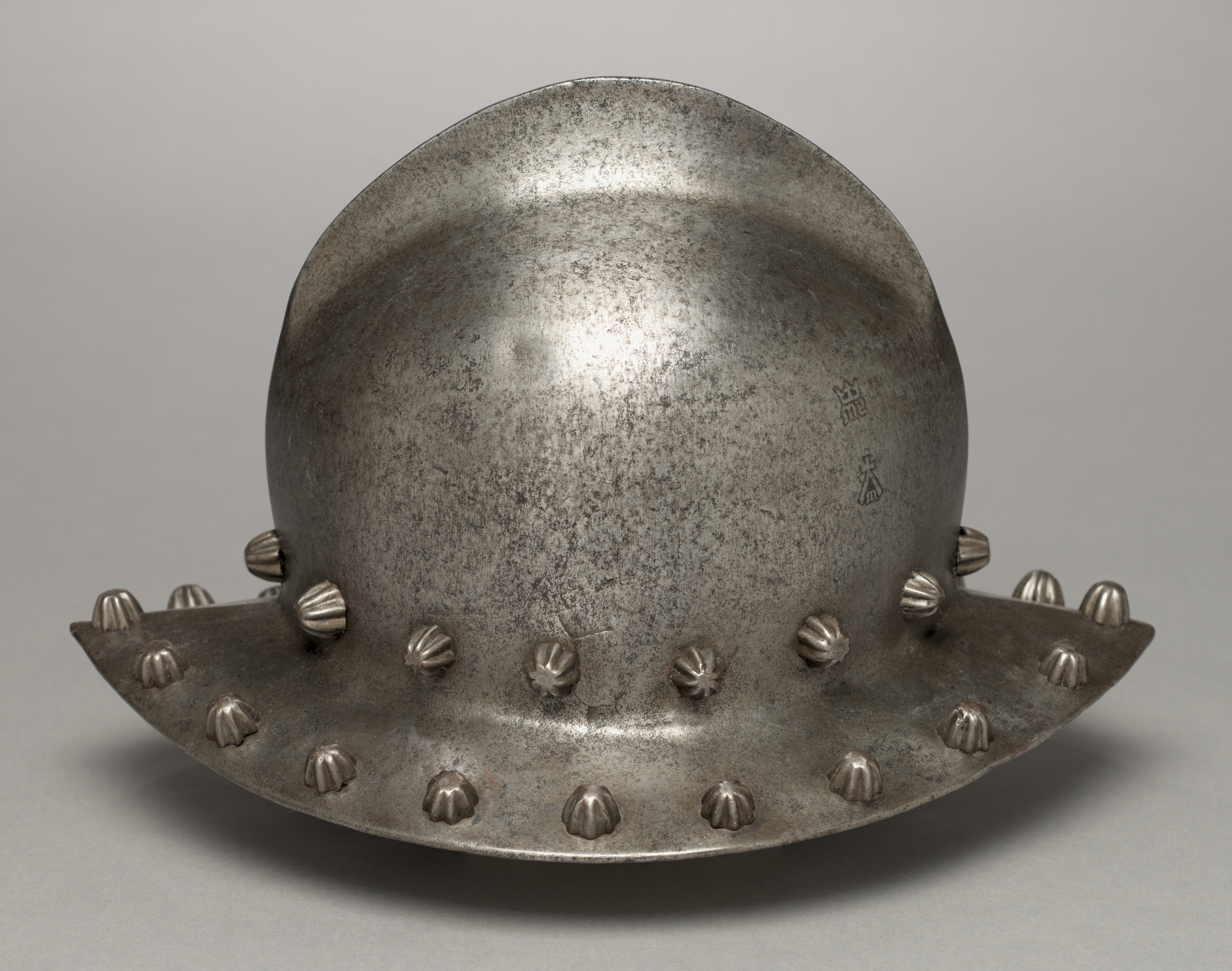
Deconstructing the Milanese War Hat: A Steel Strand in Zoey Fashion Lab’s Avant-Garde DNA
At Zoey Fashion Lab, the role of the Chief Fabric Deconstructionist is to dissect historical artifacts not merely as objects of antiquity, but as living, breathing templates for future garment design. Today’s subject—the Milanese War Hat (commonly known as the Kettle Hat), forged from steel circa 15th century Italy—presents a unique challenge. Its rigid, protective silhouette and martial origins seem antithetical to the fluid, expressive world of avant-garde fashion. Yet, within its cold, hammered contours lies a New DNA Strand—a genetic code of structural defiance, utilitarian elegance, and brutalist poetry that Zoey Fashion Lab can splice, mutate, and re-engineer into a revolutionary collection.
I. The Original Strand: Anatomy of a Steel Silhouette
The Kettle Hat, or capellina, is a masterclass in functional geometry. Its defining features—a broad, downward-sloping brim and a domed crown—were designed to deflect downward strikes and shield the wearer from falling debris. The steel construction is not merely a material choice; it is a statement of permanence and protection. For the deconstructionist, this hat is a primary structural unit. The brim acts as a horizontal plane, a visor that both conceals and reveals the face. The crown is a volumetric dome, a negative space that once housed a soldier’s skull. In Zoey Fashion Lab’s vocabulary, these elements translate into architectural shoulders, exaggerated collars, and rigid, cantilevered hems that challenge the body’s natural drape.
The key technical feature is the riveted joinery—the points where brim meets crown. These are not seamless transitions; they are deliberate, visible connections. This is a critical New DNA Strand: the celebration of assembly. In our avant-garde practice, we will not hide seams. Instead, we will amplify them, using oversized metallic grommets, exposed stitching, and laser-welded joints to mimic the hat’s industrial honesty. The steel’s patina—its scratches, dents, and oxidation—becomes a narrative of use, a texture we replicate through distressed leather, brushed aluminum threads, and hand-painted metallic finishes on organic fabrics.
II. Deconstructing the Brim: From Shield to Silhouette
The brim of the War Hat is a study in functional asymmetry. It is not uniform; it dips lower in the front to shield the eyes, rises at the sides for peripheral vision, and extends at the back to protect the neck. This is a dynamic, non-linear edge—a direct challenge to the symmetrical, body-conforming shapes of traditional fashion. For Zoey Fashion Lab, this becomes a new pattern-cutting language.
We deconstruct the brim into modular panels. Imagine a coat where the left shoulder extends into a rigid, flared wing—a direct translation of the hat’s front brim—while the right shoulder remains softly draped. This asymmetrical protection is not just aesthetic; it is a commentary on modern vulnerability. The steel’s reflective quality is translated through liquid-metal finishes on liquid silk or high-gloss PVC, creating a surface that catches light like polished armor. The brim’s downward curve is reinterpreted as a cowl neckline that sweeps from the nape to the collarbone, offering both drama and a sense of armored comfort.
The rivet points on the brim’s edge become a new closure system. Instead of buttons or zippers, garments are fastened with oversized, hand-hammered steel clasps, or even magnetic panels that snap together with a satisfying clang. This is hardware as ornament, a direct lineage from the War Hat’s functional fastenings.
III. The Crown: Volumetric Headgear as Garment Core
The domed crown of the Kettle Hat is a compressed volume. It is a negative space that once defined the soldier’s head. In our deconstruction, we invert this volume and project it outward. The crown becomes a pectoral shell—a rigid, breastplate-like insert that sits over the chest, crafted from molded resin or layered leather with a steel-gray finish. Alternatively, it is transformed into a dramatic hood that rises from the shoulders, its internal structure supported by hidden boning or 3D-printed latticework, mimicking the hat’s internal dome.
The ventilation holes found on some historical examples—small perforations for airflow—are a key New DNA Strand. In our collection, these become laser-cut perforations that pattern entire garments. A floor-length gown might feature thousands of tiny steel-colored holes, creating a mesh-like effect that is both protective and transparent. This is armor as lace, a paradoxical fusion of military rigidity and delicate exposure.
The lining of the original hat, often leather or padded fabric, is our soft interior. We juxtapose the cold steel exterior with plush, tactile interiors—velvet, shearling, or quilted silk—in the same garment. A jacket might have a rigid, steel-effect outer shell but a deep burgundy or charcoal velvet lining that caresses the skin. This duality of hardness and softness is the emotional core of the design.
IV. Material Alchemy: Steel as Textile
The steel of the War Hat is not a fabric, but it is a textile in potential. For Zoey Fashion Lab, we do not simply use metal as an accent; we weave it into the garment’s very structure. This involves several techniques:
- Chainmail as Fabric: Interlocking steel rings, inspired by the hat’s riveted construction, form a flexible, drapable mesh for sleeves or skirts.
- Metalized Threads: Stainless steel filaments are woven into organic fibers (cotton, wool, linen) to create a fabric that is both soft and structurally stiff, with a metallic sheen that catches light like polished armor.
- Layered Plates: Small, overlapping steel or aluminum scales are sewn onto a fabric base, mimicking the hat’s overlapping brim and crown sections. This creates a living armor that moves with the body but retains its protective silhouette.
The patina—the greenish-blue oxidation of aged bronze or the rust of iron—is a color palette. We use fabric dyes, metallic paints, and even chemical treatments on leather to replicate these weathered tones. The collection is not pristine; it is post-apocalyptic elegance, where every garment tells a story of use, battle, and survival.
V. The Avant-Garde Manifestation: A New Silhouette
The final collection, titled “Capellina: The Dome of Defiance,” presents a series of transformed silhouettes. The War Hat’s DNA is visible in every piece:
- The Brim Coat: A floor-length duster with an asymmetrical, rigid collar that sweeps down to the waist on one side, resembling the hat’s brim. The collar is lined with steel-gray chainmail, while the rest of the coat is a liquid-metal silk.
- The Crown Corset: A structural bodice that rises into a domed shoulder piece, supported by a hidden steel frame. The front is perforated with a geometric pattern, revealing a soft, velvet underlayer.
- The Rivet Dress: A sculptural gown constructed from overlapping, riveted leather panels. The seams are exposed and exaggerated, with oversized steel grommets as the only closures. The hem is asymmetrical, dipping lower in the front like the hat’s brim.
- The Patina Jumpsuit: A one-piece garment in distressed, hand-painted denim that mimics verdigris patina. The shoulders are built up with molded, steel-effect resin plates, and the entire piece is fastened with magnetic steel clasps.
This is not costume; it is wearable architecture. The War Hat’s New DNA Strand has been spliced into Zoey Fashion Lab’s genetic code, producing a collection that is at once protective, provocative, and profoundly avant-garde. The wearer is not merely dressed; they are armored for the future, carrying the spirit of the Milanese soldier into a new era of sartorial rebellion.