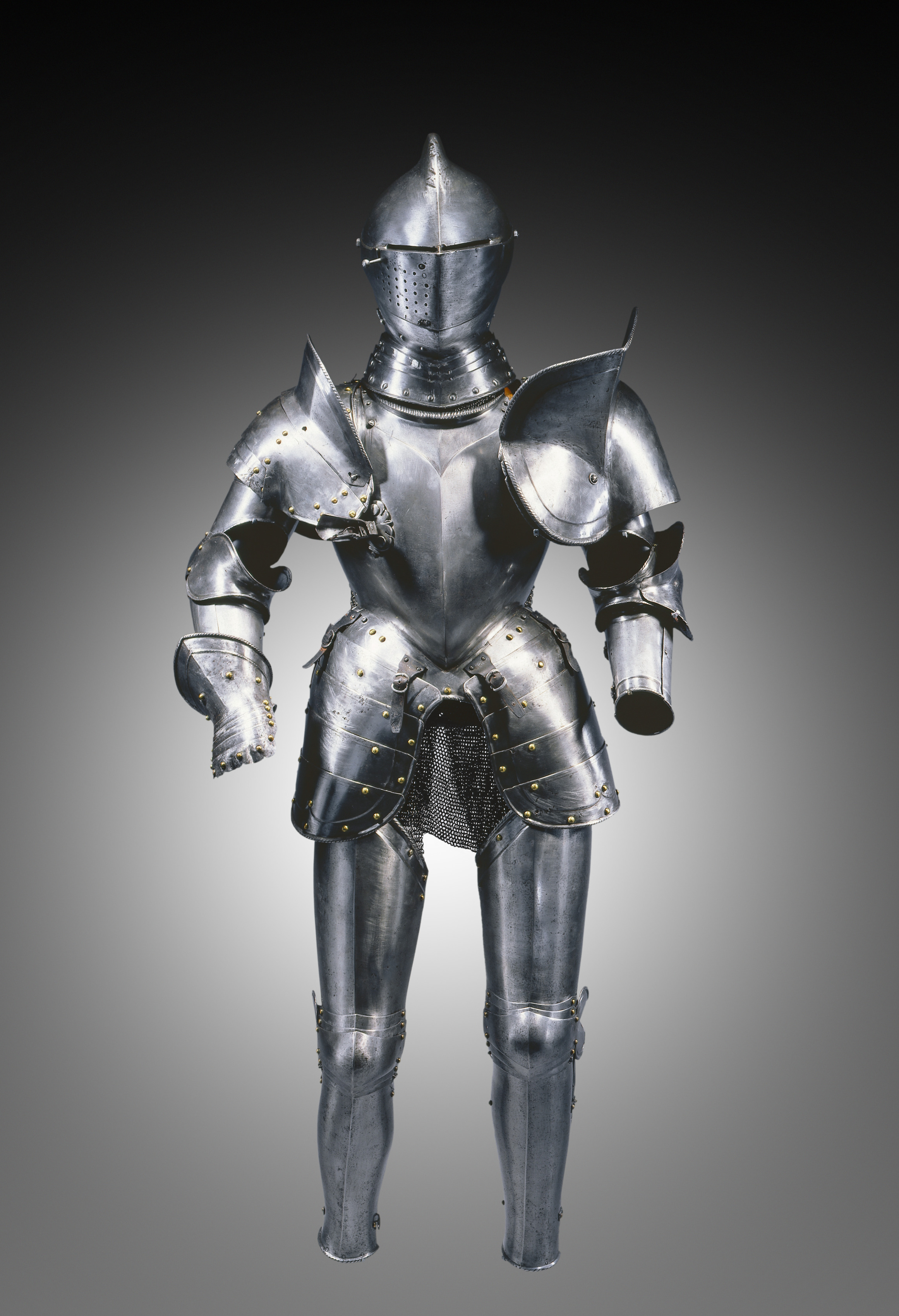
Fabric Deconstruction Analysis: The Tilting Suit (Composed)
Subject Identification & Provenance
The subject under analysis is a Tilting Suit (Composed), originating from South Germany in the 16th century. This piece is not a single, intact artifact but a composite construction—a deliberate assembly of disparate elements. The technical materials include steel, leather straps, and brass rivets. For Zoey Fashion Lab, this suit serves as a New DNA Strand, a foundational genetic code that informs our avant-garde deconstruction methodology. The suit’s origin in South Germany places it within a tradition of precision armor-making, yet its composition—fragmented and reassembled—mirrors the laboratory process of splicing genetic material to create new life forms.
Technical Materiality: Steel, Leather, Brass
The steel plates exhibit a cold, industrial hardness, yet their surfaces bear the patina of time—oxidized, scarred, and burnished. This is not pristine metal but a palimpsest of conflict. The leather straps, once supple, are now cracked and stiff, their fibers telling stories of tension and release. Brass rivets, oxidized to a verdigris green, serve as structural punctuation marks, holding the composition together while also signaling decay. For the avant-garde designer, these materials are not merely historical; they are raw data points for a new aesthetic language. The steel’s rigidity can be reinterpreted as exoskeletal armor for the modern body, while the leather’s fragility becomes a metaphor for the tension between protection and vulnerability. The brass rivets, in their corrosion, suggest a wabi-sabi acceptance of impermanence, a core tenet of deconstructivist fashion.
The Composed Nature: A Deconstructivist Blueprint
The term “Composed” is critical. This suit is not a singular, unified object but a collage of fragments. It likely incorporates elements from multiple armor sets, perhaps even from different periods or regions. This deliberate fragmentation is a precursor to deconstructivist fashion, where garments are intentionally taken apart and reassembled in new configurations. The suit’s composition reveals exposed seams, overlapping plates, and asymmetrical joints. These are not flaws but design features that challenge the conventional idea of armor as a seamless, protective shell. In the context of Zoey Fashion Lab, this suit becomes a template for deconstruction: we can isolate the steel plates as modular components, the leather straps as connective tissue, and the brass rivets as functional adornments. The suit’s composite nature suggests a non-linear timeline, where past and future coexist in a single garment.
New DNA Strand: Genetic Code for Avant-Garde Design
Viewing this Tilting Suit as a New DNA Strand allows us to extract its genetic information and apply it to contemporary design. The suit’s structure is akin to a double helix: two intertwined narratives of protection and exposure, strength and fragility. The steel plates represent the hard-coded genetic material, while the leather straps are the regulatory sequences that allow for flexibility and movement. The brass rivets are the epigenetic markers that modify expression based on environmental stress. For Zoey Fashion Lab, this DNA can be replicated, mutated, and hybridized. We can extract the suit’s structural grammar—its use of negative space, its emphasis on joint articulation, its balance of mass and void—and apply it to non-armor materials like nylon, latex, or recycled plastics. The suit’s avant-garde potential lies in its rejection of functional purity; it is not designed for combat but for conceptual confrontation.
Avant-Garde Interpretation: The Suit as Performance
The Tilting Suit, when viewed through an avant-garde lens, becomes a performance object. Its tilting nature—the fact that it is designed for the joust, a sport of controlled chaos—suggests a dynamic, unstable form. This instability is a hallmark of avant-garde fashion, where garments are often asymmetrical, deconstructed, and in motion. The suit’s exaggerated shoulder plates, articulated joints, and reinforced chest can be reinterpreted as exaggerated silhouettes that distort the human form. The leather straps, originally functional, become decorative harnesses that emphasize the body’s contours. The brass rivets, once utilitarian, become studded embellishments that catch light and draw the eye. This suit is not a costume but a sculptural intervention that challenges the wearer’s relationship to space and movement.
Deconstruction Techniques for Zoey Fashion Lab
To fully integrate this suit into our avant-garde practice, we must apply specific deconstruction techniques:
1. Fragmentation and Reassembly: Isolate individual steel plates and leather straps. Reassemble them in non-sequential order, creating unexpected juxtapositions. For example, attach a shoulder plate to a hip section, or use a leather strap as a collar.
2. Material Hybridization: Combine steel with soft, organic materials like silk, wool, or even hair. The contrast between hard and soft creates tactile tension. Brass rivets can be replaced with glass beads or ceramic buttons to shift the piece’s weight and texture.
3. Exposed Construction: Leave seams, rivet holes, and leather edges raw. This unfinished quality celebrates the process of making, a key tenet of deconstructivist fashion. The suit’s internal structure becomes its external aesthetic.
4. Asymmetry and Imbalance: Remove one shoulder plate entirely, or attach a leather strap that trails on the ground. This deliberate imbalance creates a sense of dynamic tension, as if the suit is in mid-motion.
5. Functional Redundancy: Add non-functional elements, such as extra rivets or straps that serve no purpose. This ornamental excess challenges the idea of utility, a core concept in avant-garde design.
Conclusion: The Suit as a Living Archive
The Tilting Suit (Composed) is more than a historical artifact; it is a living archive of deconstructivist potential. Its South German origins, steel and leather construction, and composite nature provide a rich genetic code for Zoey Fashion Lab to decode and re-express. By treating this suit as a New DNA Strand, we can generate garments that are not merely inspired by the past but are mutations of it—avant-garde forms that speak to the present. The suit’s tilting, unstable energy becomes a metaphor for the modern condition: fragmented, reassembled, and always in motion. In our lab, this suit will not be preserved but activated, its components extracted and recombined into new, provocative forms. The steel, leather, and brass are not endpoints but starting points for a continuous process of deconstruction and creation.