Deconstructing the Morion: A Synthesis of Martial Heritage and Avant-Garde DNA
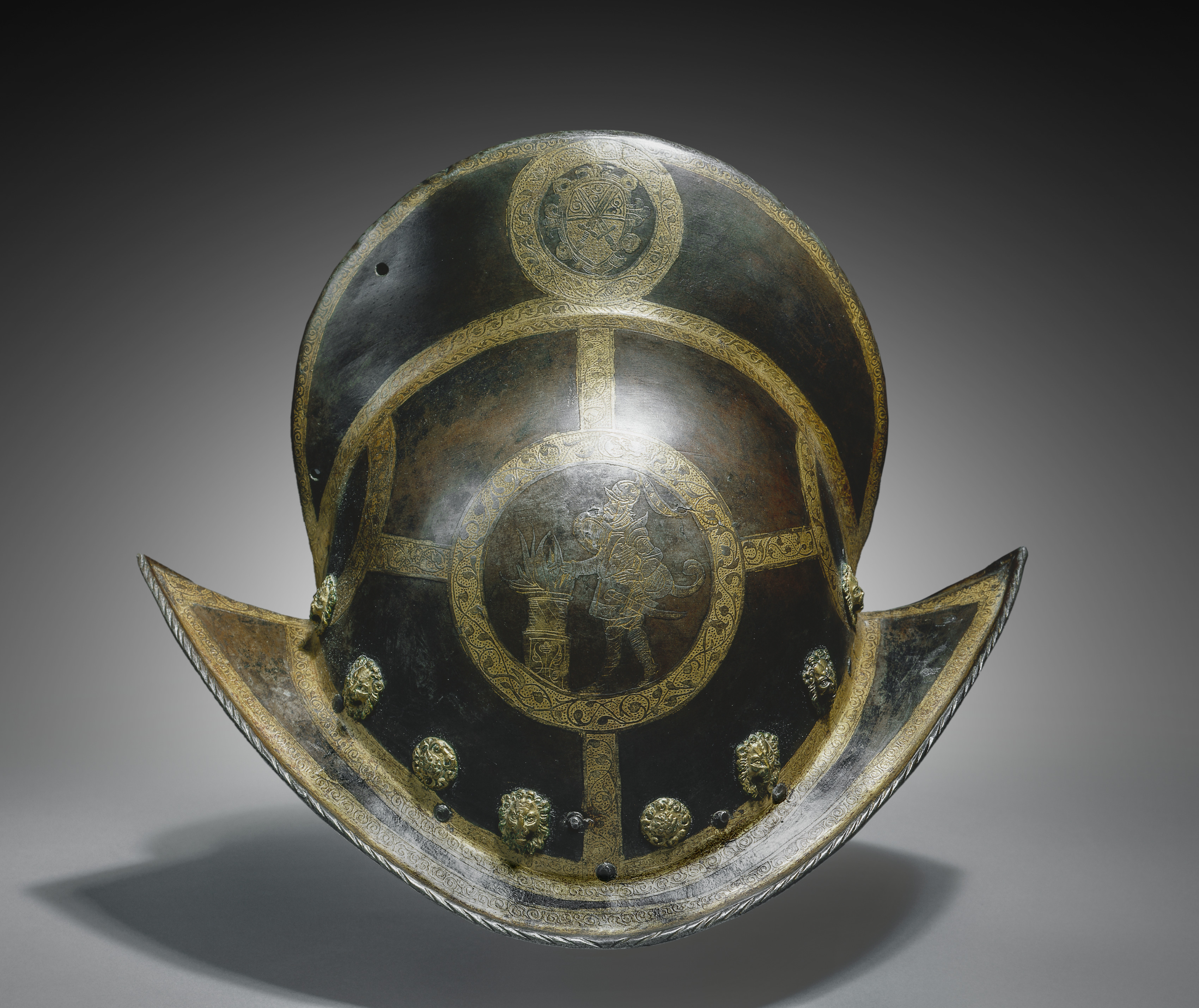
As the Chief Fabric Deconstructionist for Zoey Fashion Lab, my role is to dissect historical artifacts not merely as relics, but as blueprints for radical textile and structural innovation. The subject of this analysis—the Morion of the State Guard of Elector Christian I of Saxony, originating from Nuremberg, Germany, circa late 16th century—presents a formidable challenge and a profound opportunity. Crafted from russet steel, etched, and gilded, this helmet is far more than a piece of armor. It is a codified language of power, protection, and precision. When viewed through the lens of our New DNA Strand—our proprietary methodology for extracting and re-engineering historical aesthetics into avant-garde fashion—this Morion becomes a foundational source code for a collection that redefines militaristic elegance, structural integrity, and metallic surface manipulation.
The Material Lexicon: Russet Steel as a Textile Analog
To the untrained eye, the Morion is a rigid, unyielding object. To a fabric deconstructionist, it is a study in tension, compression, and surface narrative. The russet steel—a dark, brownish-black patina achieved through controlled oxidation—is not a flaw but a deliberate finish. It mimics the organic, weathered textures we seek in high-end leathers and heavy wools. In our New DNA Strand analysis, we isolate this russet finish as a colorway and texture archetype. We translate its deep, smoky hue into a base for double-faced satin, where one side is a matte, charcoal-brown and the reverse is a high-shine, oil-slick black. The steel’s surface, with its subtle variations in tone from handling and age, informs a new jacquard weave that incorporates metallic threads at irregular intervals, creating a fabric that shifts in light like a polished blade. This is not armor; it is armor as drape.
The etched and gilded elements are the critical points of rupture. The etching—acid-cut lines that create intricate arabesques, floral motifs, and martial symbols—is a form of negative-space design. In fabric terms, we replicate this through laser-cut perforations in layers of bonded neoprene and silk organza. The gilding, applied as gold leaf or mercury amalgam, is a statement of preciousness against the brutalist steel. Our avant-garde translation employs hand-applied liquid metal foiling on sheer mesh, creating a floating, ethereal gilding that does not weigh down the garment. The juxtaposition of the dark, grounded base with the luminous, volatile gold becomes a central tension in our design language.
Structural Anatomy: The Morion as a Pattern for Deconstruction
The Morion’s silhouette is iconic: a high, rounded crest (the comb), a sweeping brim that flares outward and upward, and a pointed peak at the front and back. This is not a passive shape. It is engineered for deflection and visibility. In our deconstructionist process, we do not replicate the helmet; we drape its negative space. The comb becomes a structural shoulder piece, a sculpted collar that rises from a tailored blazer, or a spine-like insert in a backless gown. The brim is reimagined as an asymmetrical hemline, a dramatic hat brim, or a detachable capelet that arcs away from the body.
We employ pattern engineering derived from the helmet’s construction. The Morion was typically raised from a single sheet of steel, hammered into a compound curve. This monocoque construction is a metaphor for seamless garment construction. We use thermofusible interfacing and bonded seams to create garments that hold their shape without internal boning. The result is a collection of pieces that are simultaneously soft and rigid, fluid and architectural. A coat, for instance, might have a front panel that is a single, unbroken piece of bonded wool and metallic foil, echoing the helmet’s forged unity, while the back is a cascade of pleated silk, mimicking the plume of feathers often worn with the Morion.
Surface Narrative: Etching, Gilding, and the Language of Power
The etched and gilded decoration on the Morion is not arbitrary. It is a coded message of allegiance, status, and divine right. The motifs—often including the Elector’s coat of arms, classical figures, and scrolling foliage—are a visual manifesto. In our New DNA Strand framework, we treat these motifs as digital embroidery and print templates. We abstract them, scaling them up and fragmenting them. A single gilded vine from the helmet’s surface becomes a continuous, hand-embroidered gold thread that snakes across the back of a leather corset. The coat of arms is deconstructed into its geometric components—shields, lions, stars—and re-printed as a pixelated, distorted camouflage pattern on a technical jersey.
The gilding itself is a study in light. On the helmet, it catches the sun and signals rank from a distance. In our collection, we achieve this through lenticular fabrics and holographic laminates that shift from gold to silver to bronze as the wearer moves. We also introduce a new technique: cold gilding on leather, where thin sheets of 24-karat gold are applied to distressed calfskin, then partially abraded to reveal the dark, russet-toned leather beneath. This mimics the wear and tear of a battlefield, yet retains the opulence of a courtly object. The result is a garment that tells a story of use, of history, of power both won and displayed.
Avant-Garde Synthesis: The Morion as a Wearable Sculpture
The final synthesis in our New DNA Strand is the transformation of the Morion from a functional object into a conceptual, avant-garde statement. We do not design for reenactment. We design for the future of fashion, where history is a resource, not a constraint. The helmet’s protective function is reimagined as psychological armor. A floor-length gown with a built-in, detachable collar that rises to frame the face like the helmet’s brim. A jumpsuit with integrated, sculpted shoulder caps that echo the comb. A series of accessories—gauntlets, gorgets, and buckled belts—that reference the armor’s fastenings but are rendered in soft, pliable materials like silicone-coated neoprene and molded resin.
The color palette is strictly drawn from the Morion: russet brown, oxidized black, and burnished gold. We introduce a fourth element: a deep, blood-ruby red, referencing the velvet linings and plumes of the original State Guard uniforms. This red appears as a lining, a trim, or a sudden flash of color in an otherwise monochromatic look. The overall effect is one of controlled aggression, of refined brutality. It is a collection for the woman who commands space without raising her voice, who wears her history as a badge of honor, not a burden.
Conclusion: The Deconstructed DNA
The Morion of the State Guard of Elector Christian I of Saxony, in its russet steel, etching, and gilding, is a masterclass in material storytelling. Through the New DNA Strand of Zoey Fashion Lab, we have extracted its core principles: the tension between dark and light, the architecture of protection, and the surface as a narrative field. We have translated its rigid steel into flowing fabrics, its etched symbols into abstract prints, and its gilded accents into luminous, tactile details. The result is not a costume, but a new lexicon of avant-garde fashion—one that honors the precision of Nuremberg’s armorers while pushing the boundaries of what a garment can be. This is deconstruction not as destruction, but as a profound act of re-creation.