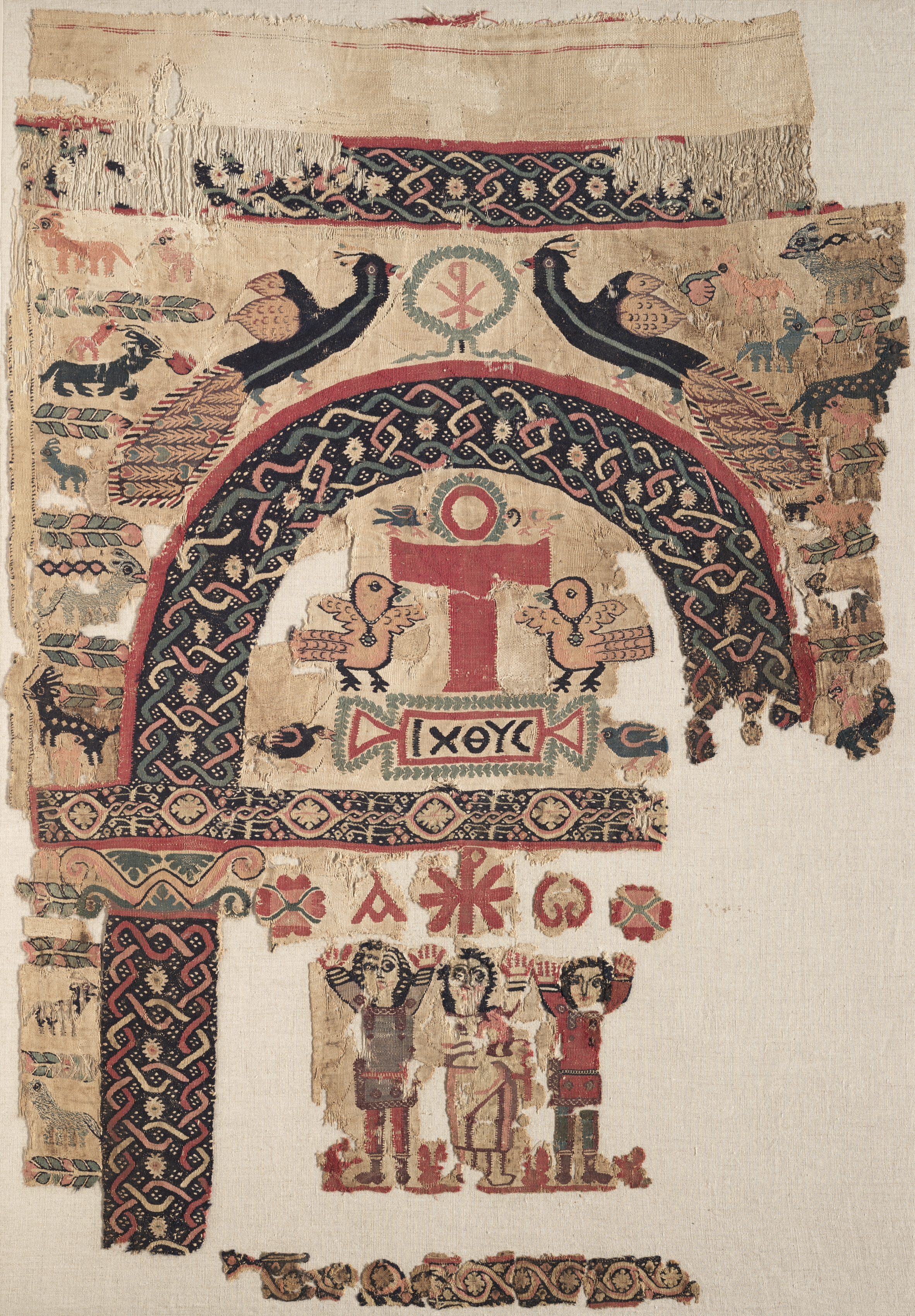
Deconstructing the Sacred: An Avant-Garde Analysis of the Byzantine Hanging with Christian Images
As Chief Fabric Deconstructionist for Zoey Fashion Lab, it is my privilege to present a rigorous analysis of a textile artifact that transcends its historical origins to become a potent source of avant-garde inspiration. The subject is a hanging from Byzantine Egypt, dating to approximately the 6th-7th century, a period of profound cultural synthesis. Constructed from dyed wool and undyed linen using a combination of plain weave (tabby) and inwoven tapestry weave, this object is not merely a decorative panel. It is a fractured narrative, a technological hybrid, and a testament to the collision of iconographic authority and material experimentation. For Zoey Fashion Lab, we approach this piece not as a relic, but as a proto-avant-garde manifesto, a blueprint for deconstructing the relationship between the sacred, the profane, and the garment itself.
I. Material and Techné: The Antithesis of Purity
The technical construction of this hanging is the first site of deconstruction. The use of undyed linen as the ground warp and weft establishes a baseline of raw, unadorned materiality. This is not a precious silk or shimmering gold thread; it is humble, earthy, and functional. Against this ascetic backdrop, the dyed wool is introduced via the tapestry weave technique. Wool, with its inherent texture and ability to absorb vibrant, fugitive dyes, becomes the agent of figuration. The tapestry weave itself—where the weft threads do not run the full width of the fabric but are manipulated to create distinct color blocks and shapes—is a technique of interruption. It is a structural stutter, a deliberate break in the uniform flow of the tabby ground.
For the avant-garde designer, this is a critical lesson. The hanging does not attempt to hide its construction. The warp threads are visible in the ground, and the slits where different colored wefts meet are left as honest seams. This is a rejection of illusionism. The sacred images—likely a Christ figure, the Virgin, or saints—are not painted or embroidered over the fabric; they are woven into its very structure. This material integration suggests that the divine is not a superficial decoration but a fundamental, albeit disruptive, part of the fabric of existence. Zoey Fashion Lab can translate this by using contrasting materials—say, a harsh, industrial linen base with soft, hand-dyed wool appliqués that are stitched in a way that reveals the join, celebrating the process of creation rather than concealing it.
II. Iconography as Fragmentation: The Sacred in Rupture
The "Christian Images" in this hanging are not presented as seamless, unified icons. The tapestry weave inherently fragments the image. The weaver must build the figure row by row, color block by color block. The result is a figure that is pixilated, abstracted, and geometrically simplified. The human form is reduced to a series of angular, interlocking shapes. This is not a naturalistic portrait; it is a theological diagram. The eyes are large and frontal, the body is stiff and hieratic, and the drapery is rendered as a series of crisp, flat folds.
This fragmentation is the precursor to Cubism, to the deconstructed garments of Rei Kawakubo, and to the digital glitch aesthetics of contemporary fashion. The hanging teaches us that the sacred can be rendered through dislocation. The figure’s authority comes not from its lifelike quality but from its very artificiality, its structural insistence on being a made object. For Zoey Fashion Lab, we can extract this principle by taking a traditional garment silhouette—a coat, a dress—and breaking it into its constituent geometric parts. We can re-weave it with contrasting panels, using the tapestry technique as a metaphor for the construction of identity itself. The "Christian Image" becomes a cultural code that is simultaneously present and broken, allowing for new, hybrid meanings to emerge.
III. The Byzantine-Egyptian Crucible: A Collision of Worlds
The origin of this hanging—Byzantine Egypt—is crucial. It is a product of a society where classical Greco-Roman naturalism, Coptic Egyptian abstraction, and Byzantine imperial theology collided. The result is a visual language that is neither purely one nor the other. The figures may have the frontal, iconic gaze of Byzantine art, but the stylized patterns and the vibrant, earthy colors (often reds, blues, and greens derived from local plants and insects) are distinctly Egyptian. This is a hybrid artifact, born from cultural friction.
This historical context is a powerful model for the avant-garde. The hanging refuses to be a pure expression of a single tradition. It is a negotiated space. For Zoey Fashion Lab, this is a directive to embrace cultural collision. We can deconstruct the "Christian" imagery by re-contextualizing it within non-Western textile traditions. Imagine a Byzantine-style halo rendered in the bold, geometric patterns of a Coptic tunic, or a Christ figure whose drapery is inspired by the pleats of an ancient Egyptian sheath dress. The Archive Resonance reference—speaking of the 16th and 17th centuries as a period of cultural exchange—is a reminder that such collisions are not new. They are the very engine of aesthetic evolution. Our task is to make these collisions visible, to amplify the dissonance rather than resolve it.
IV. From Hanging to Garment: Avant-Garde Applications
How does this analysis translate into a garment for Zoey Fashion Lab? The hanging is a two-dimensional object meant to be viewed, but its principles can be directly applied to three-dimensional, wearable forms. We propose a collection of deconstructed vestments.
First, the silhouette would be based on the Coptic tunic—a simple, T-shaped form—but it would be radically altered. The tapestry weave technique would be translated into patchwork and piecing. Large, rectangular blocks of fabric, each dyed a different color and woven with a different texture, would be joined with visible seams, mimicking the slits of the tapestry. The "Christian Images" would not be printed or embroidered but constructed through the garment’s structure. A saint’s halo could be a circular, stiffened collar. The figure’s frontal gaze could be a large, appliquéd eye on the chest, rendered in contrasting materials.
Second, the materiality would be a direct reference. We would use a base of raw, undyed linen or hemp for the body of the garment, representing the plain weave ground. The "tapestry" elements would be introduced using hand-dyed wool, but also incorporating unexpected materials like recycled plastic yarns or metallic threads to create a friction between the ancient and the futuristic. The garment would not be comfortable in a conventional sense; it would be architectural and demanding, forcing the wearer to inhabit a space of cultural and spiritual tension.
Finally, the deconstruction would be literal. The garment would be designed to be reversible, modular, or even partially un-woven. The wearer could choose to reveal the "sacred" image or to turn it inward, hiding it against the body. This reflects the historical reality of these hangings—they were used in both public liturgical settings and private domestic spaces. The garment becomes a portable relic, a site of personal and cultural memory that is constantly being re-negotiated.
V. Conclusion: The Sacred as a Structural Problem
The Byzantine hanging with Christian images is not a finished statement. It is a problem—a problem of how to make the transcendent material, how to contain the sacred within the profane limits of thread and weave. For Zoey Fashion Lab, this is the ultimate avant-garde challenge. We are not interested in simply reproducing the iconography. We are interested in the structural logic that produced it. The tapestry weave’s fragmentation, the hybrid cultural origins, the honest display of technique—these are the elements that resonate with our mission.
By deconstructing this hanging, we are not destroying it. We are liberating its principles from the museum case and returning them to the realm of the wearable. The garment becomes a new kind of icon: one that is deliberately broken, self-aware, and open to endless reinterpretation. This is the avant-garde as a form of sacred archaeology, digging into the material past to unearth the radical, unfinished future of fashion.