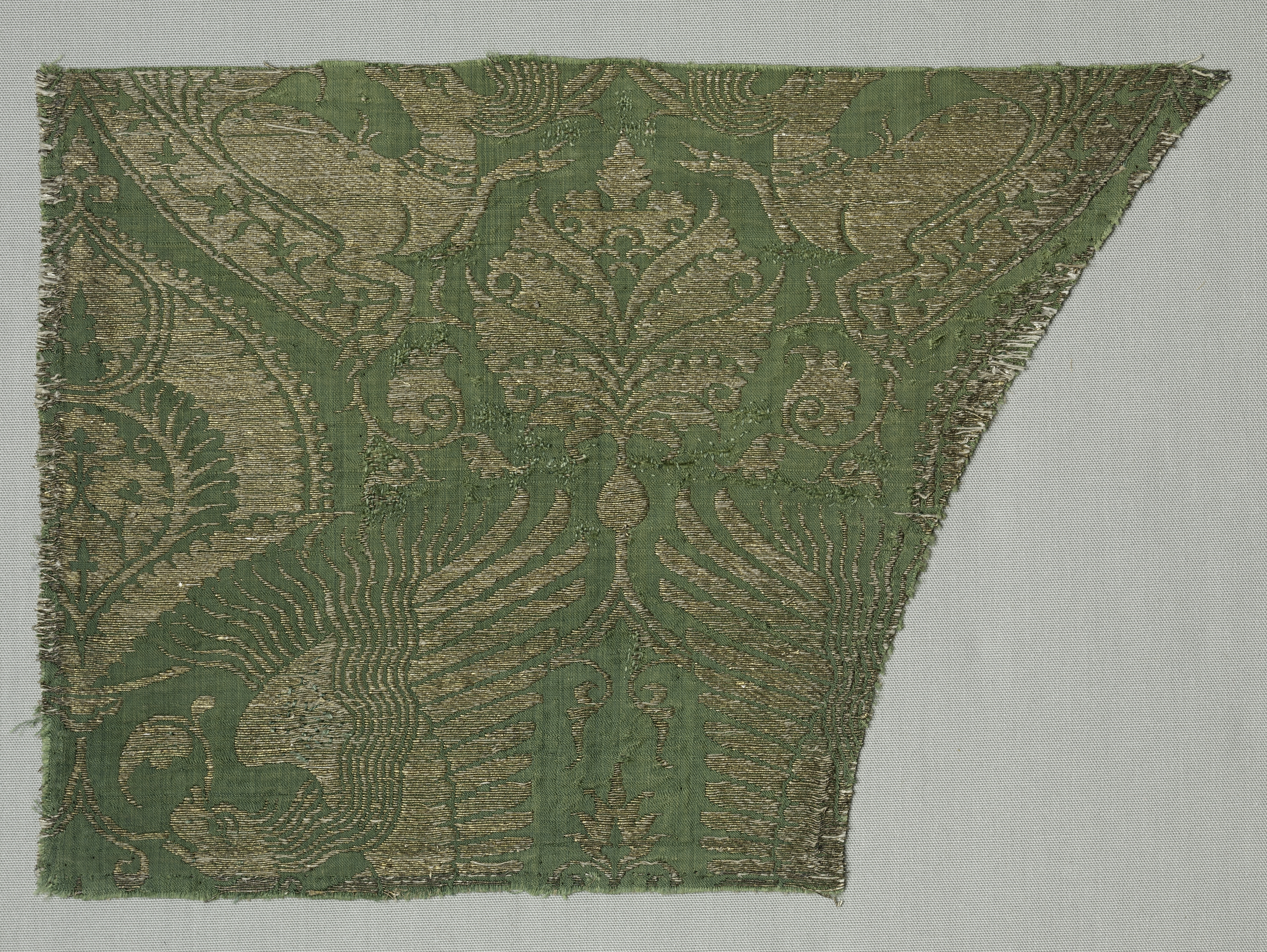
Deconstructionist Analysis: Exotic Gold-patterned Silk from Venice
Material Provenance and Historical Context
The fabric under examination originates from the venerable textile workshops of Venice, Italy, a city whose mercantile history is woven into the very threads of global fashion. This particular specimen—an exotic gold-patterned silk—represents a pinnacle of Renaissance-era craftsmanship, yet its resonance with Zoey Fashion Lab’s avant-garde ethos is immediate and profound. The silk base, derived from the finest Bombyx mori cocoons, provides a luminous, fluid ground. The gold thread, likely a composite of gilded silver or gold leaf wrapped around a silk core, introduces a metallic tension that is both opulent and architectural. This is not merely a fabric; it is a document of cultural exchange, Venetian trade routes, and the alchemical mastery of dye and metal.
The technical construction is a masterclass in structural complexity. The fabric employs a compound weave known as lampas, which combines two distinct weave structures: a 2/1 twill and a 1/3 twill. In lampas, the ground weave (here, the 2/1 twill) provides the base structure, while the pattern weave (the 1/3 twill) floats supplementary warps or wefts to create the intricate gold motif. This dual-weave system allows for a dramatic interplay of light and texture. The 2/1 twill offers a subtle, diagonal ribbing that catches ambient light, while the 1/3 twill, with its longer floats, allows the gold thread to dominate the surface, creating a reflective, almost liquid metallic finish. The result is a fabric that shifts in appearance with every movement—matte in one light, blindingly brilliant in another.
Deconstructing the Motif: The Split-Leaf Palm and the Mirror
The decorative motif—a complex, split-leaf palm (palmette) rendered in gold against a silk ground—is not a simple botanical imitation. It is a semiotic device. Drawing from the archive reference “一面是光洁银镜上以黄金镶嵌的纷繁棕叶纹,另一面是冰冷石棺板上以浮雕诉说的生命叙事” (a smooth silver mirror inlaid with intricate gold palm leaves on one side, and a cold stone sarcophagus narrating life through relief on the other), we understand this pattern as a dialectic. The gold palm leaves are not just ornament; they are the “mirror” reflecting wealth, power, and the ephemeral beauty of the natural world. Simultaneously, the structure of the weave—the rigid, systematic repetition of the 1/3 twill—echoes the “stone sarcophagus,” a container for memory, history, and death. The fabric becomes a wearable paradox: a celebration of life’s vibrancy (the gold leaf) and a memento mori (the structural, tomb-like restraint of the weave).
For Zoey Fashion Lab, this duality is the core of avant-garde expression. The fabric’s pattern is not meant to be merely seen but to be read. The split-leaf palm, a motif that traces back to ancient Mesopotamia and was later adopted by Venetian weavers, symbolizes regeneration and victory. Yet its fragmentation—the “split” in the leaf—suggests rupture, deconstruction, and the breaking of historical continuity. This aligns perfectly with the avant-garde imperative to dismantle and reassemble. The gold thread, traditionally a signifier of divine or royal status, is here repurposed as a tool of disruption. It catches the eye, but its metallic rigidity also creates a barrier, a cold, reflective surface that distances the viewer, much like the silver mirror in the archive reference.
Structural Tension: Twill and the Avant-Garde Body
The technical choice of combining 2/1 twill and 1/3 twill is not arbitrary; it is a deliberate manipulation of fabric hand and drape. The 2/1 twill, with its shorter floats, creates a relatively stable, matte ground that resists draping. The 1/3 twill, with its longer floats, introduces areas of increased flexibility and luster. This creates a tectonic quality. When the fabric is cut and sewn, these differing structural zones will respond to stress, gravity, and movement in distinct ways. An avant-garde garment constructed from this material would not hang passively; it would perform. The gold-patterned areas might buckle or shimmer, while the silk ground might flow or cling. This is a fabric that demands a sculptural approach to design—one that treats the garment as an architectural intervention on the body.
Consider the implications for a Zoey Fashion Lab collection. The fabric’s inherent tension between matte and shine, between stability and fluidity, can be exaggerated through strategic cutting. A bias-cut panel of the 1/3 twill area could create a liquid gold cascade, while a rigid, structured sleeve cut from the 2/1 twill ground could evoke armor. The gold thread, being metallic, is also inherently fragile; it can tarnish, bend, or break. This impermanence is a powerful avant-garde statement. The garment becomes a living artifact, one that will age, change, and potentially decay. It refuses the static perfection of traditional luxury, embracing instead the beauty of entropy.
Avant-Garde Application: Deconstruction as Design Philosophy
To fully harness this fabric, Zoey Fashion Lab must embrace a deconstructionist methodology. This means not merely using the fabric as a decorative surface, but interrogating its construction. The first step is to un-weave the pattern. By carefully removing the gold weft threads from specific areas, the designer can create voids, revealing the raw silk ground beneath. This act of removal—of negative space—transforms the fabric from a complete narrative into a fragmented text. The split-leaf palm motif becomes a ghost of itself, a memory of opulence.
Next, consider re-weaving or re-stitching. The gold threads, once extracted, can be used as embroidery or structural elements in other parts of the garment. They can be woven into seams, creating visible, scar-like joins. This technique echoes the “stone sarcophagus” reference—the seams become the relief carvings, telling a new story of construction and deconstruction. The garment is no longer a seamless, flawless object; it is a collage of its own history.
Finally, the fabric’s dual-weave structure allows for inversion. By cutting the fabric and reassembling it with the 1/3 twill side facing inward, the designer can create a garment that is matte on the outside but reveals flashes of gold when the wearer moves. This play of concealment and revelation is quintessentially avant-garde. It challenges the viewer’s gaze, refusing to offer a static, easily consumable image. The wearer becomes an active participant in the garment’s unfolding narrative.
Conclusion: The Fabric as a Philosophical Proposition
The Exotic Gold-patterned Silk from Venice is not a relic to be preserved; it is a proposition to be deconstructed. Its technical complexity—the marriage of 2/1 twill and 1/3 twill in a lampas weave—offers a structural vocabulary for avant-garde design. Its motif, the split-leaf palm, is a symbol of both vitality and fragmentation, mirroring the archive’s duality of life and death. For Zoey Fashion Lab, this fabric is a tool for critical making. It demands that the designer engage with history, material science, and semiotics. The resulting garment will not be a simple dress; it will be a wearable argument, a deconstructed archive, a mirror that reflects not just the body but the very process of creation and decay.
In the hands of Zoey Fashion Lab, this silk becomes a statement: that true luxury is not about preservation, but about transformation. It is about taking the opulent, the historical, and the technically masterful, and breaking it open to reveal the raw, the fragile, and the deeply human. The gold may tarnish, the silk may fray, but the idea—the resonance of the archive—will endure.