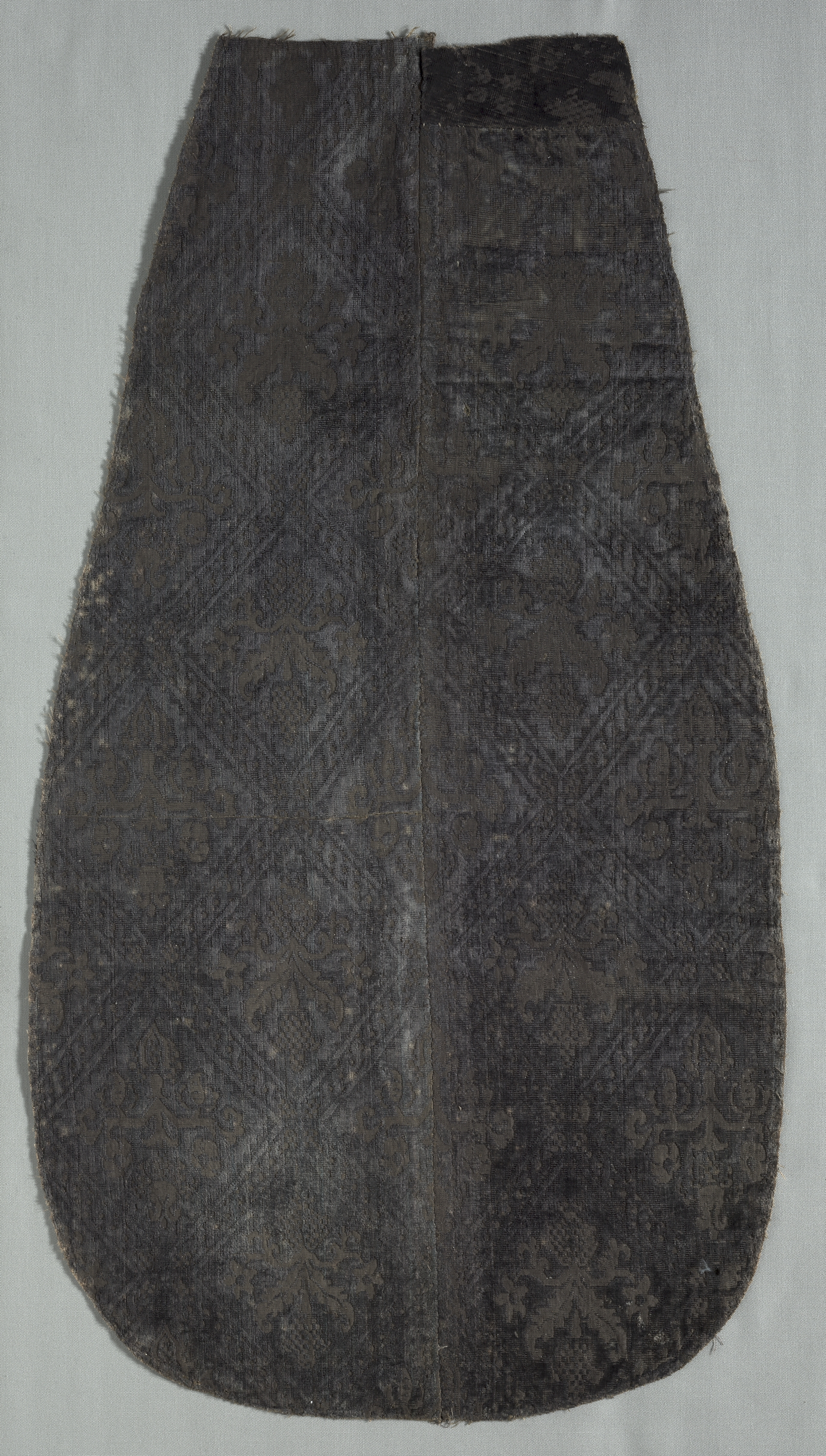
Technical Analysis: Velvet Fragment, Italy, Late 16th Century
The provided velvet fragment represents a pinnacle of Renaissance textile craftsmanship. Originating from the Italian workshops of the late 1500s, this piece would have been produced on a complex drawloom, a technology that allowed for the creation of intricate, pre-programmed patterns. The fabric is a pile-on-pile or voided velvet, a technique where the pile (the soft, raised surface) is cut at different heights or entirely removed (voided) to create a luminous, multi-level pattern against a contrasting ground, often silk satin. This process was extraordinarily labor-intensive, requiring exceptional skill to achieve precise, crisp design definitions. The raw material—likely high-grade silk—and the depth of the pile speak to a luxury item destined for ecclesiastical vestments, aristocratic attire, or opulent domestic furnishings.
Deconstructionist Lens: The "New DNA Strand" Reference
The directive to reference a "New DNA Strand" is a powerful conceptual pivot. It instructs us to move beyond historical appreciation and engage in a molecular-level interrogation of the fragment. We are to treat this velvet not as a static artifact, but as a living genetic code for future creation.
First, we isolate the core genetic markers. The primary "base pairs" of this textile are: Contrast (light-catching pile vs. shadowed void), Dimensionality (tactile height variation), and Ornamentation (structured, symbolic pattern). These are its heritable traits. The deconstruction process involves sequencing this code by physically and conceptually breaking the fragment apart. We examine the reverse side—the structural skeleton of warps and wefts—to understand its foundational integrity. We consider severing the pile from its ground, treating the lush, severed pile as a raw material for new flocking or embedding, and the voided satin ground as an independent canvas. The pattern itself is extracted from its original context, ready to be mutated, scaled, pixelated, or rendered in alien materials.
Recombinant Design Strategy for Avant-Garde Application
Avant-garde fashion thrives on contradiction, conceptual rigor, and the recontextualization of codes. Our strategy is not to reproduce historical velvet, but to use its sequenced DNA to engineer a new organism within the Zoey Fashion Lab ecosystem.
Material Mutations
The "velvet" concept is preserved, but its material expression undergoes radical mutation. We propose:
Biotechnical Pile: Cultivate or 3D-print pile from unexpected, sustainable, or responsive materials—algae-based biopolymers that change color with pH, recycled thermoplastic filaments forming geometric, rigid piles, or silicone micro-injections creating a liquid, tactile surface.
Ground Transmutation: Replace the silk ground with materials that enhance the contrast principle: mirrored metallics, distressed technical neoprene, or translucent mesh. The voided areas become windows, reflections, or breaths within a dense, tactile landscape.
The Structural Exposed: Invert the hierarchy. Make the foundational loom structure—the grid of warps and wefts—the primary aesthetic, using industrial cords, cables, or laser-cut leather straps. The "pile" becomes an occasional, parasitic growth on this exposed armature.
Pattern and Dimensionality Re-coded
The Renaissance pattern, perhaps a pomegranate (symbol of fertility) or acanthus (symbol of enduring life), is dissected.
Data Disruption: Subject the pattern to digital glitching, algorithmic repetition until it becomes abstract noise, or splice it with patterns from incompatible systems (circuit boards, topographic maps). The ornamentation becomes a comment on information overload or hybrid identities.
Extreme Dimensionality: Exaggerate the pile-on-pile principle into architectural forms. Create deep, cavernous voids in garments, with pile surfaces rising like terrain. This transforms clothing into inhabitable space, challenging the relationship between body, garment, and environment.
The Negative as Positive: Focus solely on the "voided" pathways. Create garments that are essentially the negative space of the original pattern, realized in rigid or transparent materials, with the "pile" implied only by its absence.
Conceptual Avant-Garde Synthesis
The final creations must resonate with contemporary avant-garde dialogues: sustainability, identity, technology, and the body politic.
Garment as Archive/Prophecy: A coat where one side presents the "original" fragment, meticulously preserved, while the other side explodes into its recombinant future—a tangible dialogue between archive and laboratory.
Responsive Velvet Systems: Integrate the velvet-like surface with soft robotics or LED fibers. The pile responds to touch, sound, or biometric data, making the historical luxury textile an interface for communication and expression.
Deconstructed Uniformity: Apply the velvet's principles of structured ornament to the silhouette of utilitarian workwear or tailoring. A severe woolen coat erupts with localized, mutated velvet growths at stress points—a metaphor for the personal emerging from the uniform.
Conclusion: From Fragment to Framework
The late 16th-century Italian velvet fragment is not an endpoint, but a point of origin. Through the Chief Fabric Deconstructionist's methodology, it has been sequenced, its DNA—contrast, dimensionality, and ornamentation—identified and isolated. The avant-garde mandate requires us to splice this code with the materials, concerns, and technologies of our moment. The outcome is a collection that speaks in the vocabulary of luxury and history but articulates a future-facing statement. It honors the fragment not through replication, but through radical, respectful evolution, positioning Zoey Fashion Lab at the intersection of deep historical knowledge and fearless innovation. The velvet’s new DNA strand is now a replicable, mutable framework for all future design at the Lab.