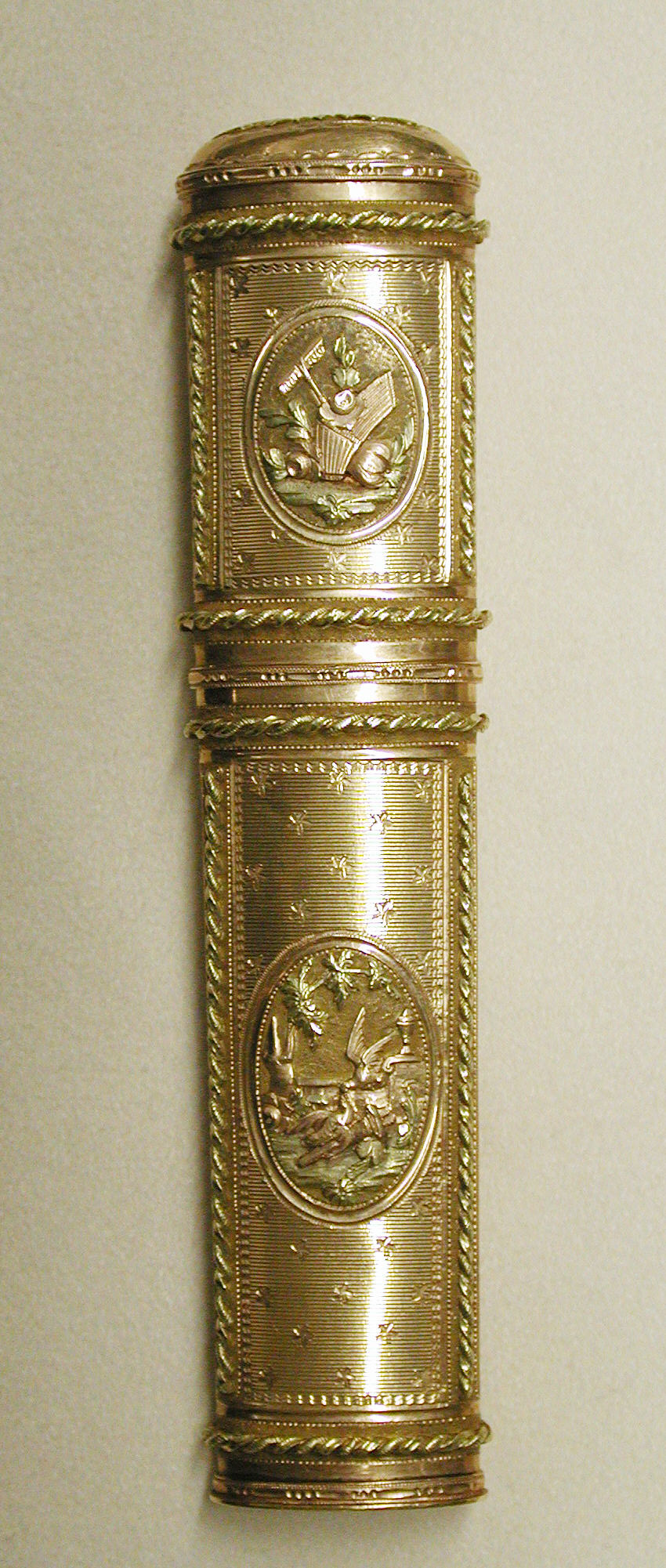
Étui: The Architecture of Concealment and Revelation
In the ever-evolving lexicon of avant-garde couture, the Étui—a term historically reserved for the delicate, protective casing of precious objects—has been radically reimagined by Zoey Fashion Laboratory. For SS26, this archetype transcends its ornamental origins to become a manifesto of structural innovation, a dialogue between concealment and exposure, and a prophetic silhouette for the Global Frontier. Drawing from the aesthetic polarity of archive node Mirror with Split-Leaf, where a resplendent golden filigree of palm leaves dances across a silvered mirror on one side, while a cold sarcophagus narrates life through bas-relief on the other, this collection posits the Étui as both a second skin and a portable architecture.
Deconstructing the Dual Narrative: Mirror and Sarcophagus
The conceptual bedrock of this analysis rests on the dialectic tension inherent in the archive node. The golden palm-leaf motif, rendered in intricate embossed appliqué on panels of liquid silver lamé, represents the exterior—the societal façade of opulence, growth, and the relentless pursuit of light. Conversely, the stone sarcophagus narrative manifests as interior lining, underlayers, and unexpected cutouts, revealing a story of mortality, memory, and the weight of history. The Étui for SS26 is not a simple container; it is a wearable binary system. The garment’s outer shell, a sculpted carapace of gold-threaded technical mesh, is punctuated by strategic “fractures”—laser-cut apertures that expose a second, darker stratum of charcoal-washed, bas-relief-embossed silk matte. This is the futuristic silhouette of the palimpsest, where each layer critiques and completes the other.
Structural Innovation: The Kinetic Gold Exoskeleton
The most radical departure from conventional couture is the kinetic gold exoskeleton. Rejecting static embroidery, Zoey Fashion Laboratory engineers the Étui as a dynamic, responsive structure. Using a proprietary alloy of recycled aerospace-grade aluminum and 24-karat gold leaf, the laboratory has crafted a series of articulated, leaf-shaped “scales” that are individually mounted on micro-hinges. This creates a living armor that rustles and shifts with every movement, mimicking the organic flutter of palm fronds in a thermal current. The silhouette is not draped but constructed as a series of interlocking modules: a high, rigid mandarin collar that flares into shoulder pauldrons, a cinched, corseted torso that opens into a fluted, asymmetrical hemline. The waist is defined not by a belt but by a negative-space cutout, framed by a golden ribcage of these articulated scales, offering a glimpse of the body as the ultimate “object” within the Étui.
The Fragment as a Whole: Deconstructing the Silhouette
Futurism in SS26 is not about seamless unity; it is about the poetics of the fragment. The classic sheath dress, the epitome of the Étui form, is exploded. A floor-length column gown is bisected horizontally at the hip, with the upper half rendered in the silver mirror finish and the lower half in the gold-scaled exoskeleton, leaving a three-inch gap of exposed, illuminated skin. This is the “split-leaf” silhouette, a direct homage to the archive node. The hemline is not a line but a topography—a jagged, laser-cut edge that mimics the contours of a cracked stone tablet. Sleeves are optional, replaced by detachable “wing” panels that extend from the shoulder to the mid-thigh, each panel a miniature Étui itself, housing hidden pockets or digital interfaces.
Material Alchemy: Gold as Narrative and Nullifier
Gold, in this context, is not a mere symbol of wealth. It is a material of temporal paradox. The gold-filament weave used for the base fabric is a technical marvel—it is lightweight, breathable, and possesses a memory function that allows it to hold sharp, sculptural pleats that would be impossible in traditional metals. The finish oscillates between mirror-polish and matte, achieved through a selective chemical etching process that mirrors the dual nature of the archive node. On one panel, the gold is blinding, reflecting the viewer’s own image (the mirror). On an adjacent panel, the same material is dulled, textured with a microscopic relief of ancient scripts (the sarcophagus). This material alchemy forces a constant re-evaluation of the wearer’s relationship to space and time.
Prognosis for SS26: The Étui as a Universal Prototype
Zoey Fashion Laboratory’s Étui is not a garment for a single body; it is a prototype for a new genre of wearable architecture. For SS26, the laboratory predicts a migration from fluid draping to modular, exoskeletal construction. The future of couture lies in the ability to encapsulate and reveal identity through structural means. The Étui, in its final form, is a portable monument—a golden tomb that is also a mirror for the living. It demands that the wearer become both the curator and the artifact. The collection’s true innovation is its adaptive tension: the garment that protects also exposes; the gold that glorifies also entombs. In this dialectic, Zoey Fashion Laboratory does not merely dress the future—it builds it, one articulated scale, one split-leaf, one silent narrative at a time.