Deconstructing the Mamluk Silk Fragment: A Blueprint for Avant-Garde Innovation
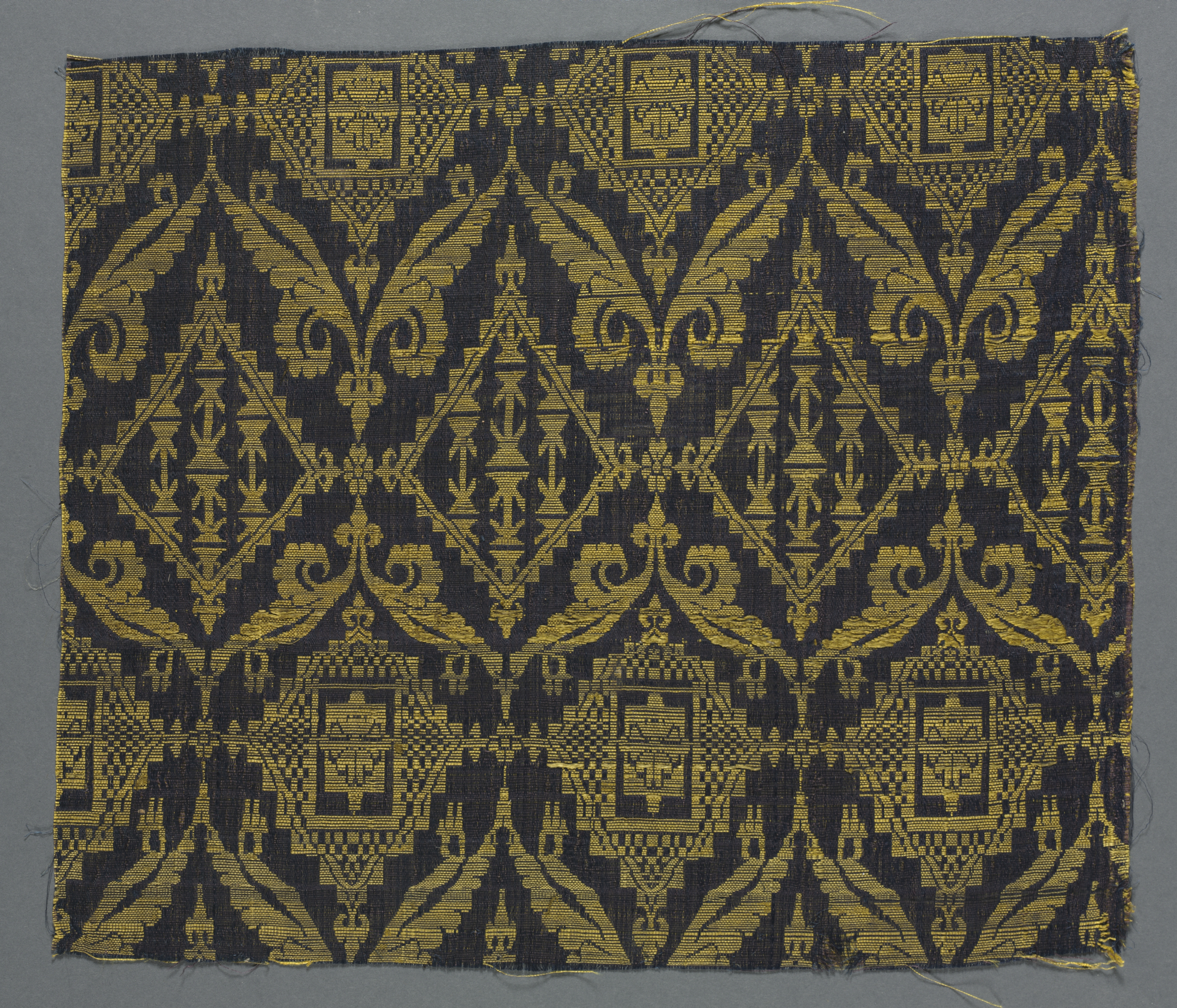
At Zoey Fashion Lab, the role of the Chief Fabric Deconstructionist is to dissect historical textiles not merely as artifacts, but as living blueprints. The subject of this analysis—a silk fragment from the Mamluk Dynasty (1250–1517), likely originating in Syria or Egypt—presents a profound opportunity. This piece, executed in a sophisticated lampas weave, is not a relic to be preserved under glass. Instead, it is a New DNA Strand, a genetic code for an avant-garde collection that challenges the boundaries of form, texture, and narrative. This report will deconstruct the fragment’s technical, aesthetic, and symbolic components, translating each into actionable design principles for a cutting-edge fashion line.
Technical Deconstruction: The Lampas Weave as Structural Poetry
The lampas weave is a complex, compound structure where a pattern weft, typically of a contrasting color and material, floats over a ground weave. In this Mamluk fragment, the ground is a tightly woven silk warp and weft, providing a stable, lustrous base. The pattern wefts, often in gold or vibrant colors, create intricate geometric and floral motifs. This is not a simple fabric; it is a system of tension and release. The floating wefts create a subtle relief, a topographic map of the weaver’s intent. For the avant-garde designer, this suggests a radical approach to construction: fabric as architecture. Instead of cutting and sewing, consider deconstructing the weave itself. By selectively removing pattern wefts, we can create negative space, transparency, and a deliberate, controlled decay. This technique, which we term “weft erosion,” can produce garments that appear to be in a state of becoming, where the structure is both revealed and hidden. The lampas weave also offers a lesson in density and drape. The ground weave provides a crisp, almost paper-like stiffness, while the pattern wefts add weight and a slight, tactile irregularity. This duality can be exploited to create garments that are simultaneously structured and fluid—a jacket that holds its shape at the shoulders but cascades into a liquid train, or a dress that is rigid in the bodice and flowing in the skirt. The key is to reverse the traditional hierarchy: let the pattern wefts become the primary structural elements, and the ground weave become the decorative, secondary layer.
Aesthetic Deconstruction: Geometry, Light, and the Illusion of Movement
Mamluk silk fragments are renowned for their intricate geometric and arabesque patterns, often arranged in repeating, interlocking bands. These designs are not merely decorative; they are visual representations of infinite space, mathematical precision, and the divine order. For the avant-garde, this aesthetic is a goldmine of kinetic illusion. The repeating patterns, when viewed from different angles or under shifting light, appear to move, creating a moiré effect or a subtle vibration. To harness this, we propose a technique called “pattern displacement.” By cutting and reassembling the fabric in non-repeating, asymmetrical ways, we can break the original pattern’s rhythm, creating a jarring, yet harmonious, visual discord. For example, a sleeve could be constructed from multiple, rotated fragments of the same pattern, causing the geometric lines to collide and diverge. This creates a garment that is alive with optical tension, a static object that appears to be in perpetual motion. The use of gold and silver metallic threads in the original fragment is another critical element. These threads catch and reflect light, creating a shimmering, ethereal quality. In an avant-garde context, we can amplify this effect by layering the silk with transparent, light-diffusing materials like organza or fine mesh. This creates a depth of field, where the metallic threads appear to float within the garment, like light trapped in amber. The overall silhouette should be monumental yet weightless, drawing inspiration from the fragment’s original function as a ceremonial or funerary textile. Think oversized, cocoon-like shapes, exaggerated shoulders, and sweeping trains that mimic the folds of a draped shroud. The color palette should be restrained—deep indigos, oxidized coppers, and faded golds—to allow the texture and pattern to dominate.
Symbolic Deconstruction: Power, Transience, and the Avant-Garde Narrative
Beyond its technical and aesthetic qualities, the Mamluk silk fragment carries a powerful symbolic weight. It was a product of a wealthy, cosmopolitan empire, used for courtly robes, religious vestments, and trade goods. It signifies power, status, and cultural exchange. Yet, the fragment is also a testament to transience. It is a remnant, a piece of a larger whole that has been lost to time. This duality—of opulence and decay—is the core of its avant-garde potential. The garment we design must embody this contradiction: it must look both imperial and fragile, as if it has been excavated from a tomb and then reimagined for a future world. This can be achieved through deliberate imperfections. We can introduce frayed edges, deliberate tears, and asymmetrical hems that mimic the wear of centuries. But these should not look accidental; they should be choreographed acts of destruction, placed strategically to highlight the fabric’s strength and vulnerability. The narrative of the collection should be one of reclamation. We are not merely copying a historical pattern; we are re-coding it. The geometric motifs, once symbols of divine order, can be reinterpreted as fractured data streams or digital glitches. The gold threads, once signs of wealth, can become lines of energy or neural pathways. This transformation is achieved through the deconstruction process itself. By cutting, reassembling, and layering the fragment, we are performing a ritual of rebirth. The final garment is not a reproduction; it is a new entity, born from the DNA of the old. It speaks to the contemporary moment—a time of cultural fragmentation, technological acceleration, and a deep yearning for connection to the past.
Design Implementation: From Fragment to Garment
Based on this deconstruction, we propose a signature piece for the Zoey Fashion Lab avant-garde collection: a “Lampas Deconstruction Coat.” This coat will be constructed from multiple, carefully curated fragments of the Mamluk silk, sourced from a single, authenticated piece. The fragments will be arranged in a non-linear, mosaic-like pattern, with the original geometric lines deliberately misaligned. The coat will have a sculptural, exaggerated silhouette—a broad, almost architectural shoulder, a narrow waist, and a dramatically flared skirt that extends to the floor. The interior will be lined with a transparent, black mesh that allows the silk’s reverse side to be visible, creating a ghostly, double-layered effect. Key areas—the shoulders, the cuffs, and the hem—will be deliberately frayed and unhemmed, with loose threads left to trail. These frayed edges will be hand-stitched with metallic thread in a contrasting color, creating a deliberate, decorative scar. The coat will be closed with a single, oversized, oxidized silver clasp that resembles an ancient buckle, but with a sleek, futuristic finish. This garment is not a costume; it is a statement. It challenges the viewer to see the past not as a static relic, but as a dynamic, mutable source of inspiration. It is a testament to the power of deconstruction—not as an act of destruction, but as a method of creative genesis. The Mamluk silk fragment, through this process, becomes a New DNA Strand, a code that we have read, rewritten, and woven into the future of fashion.