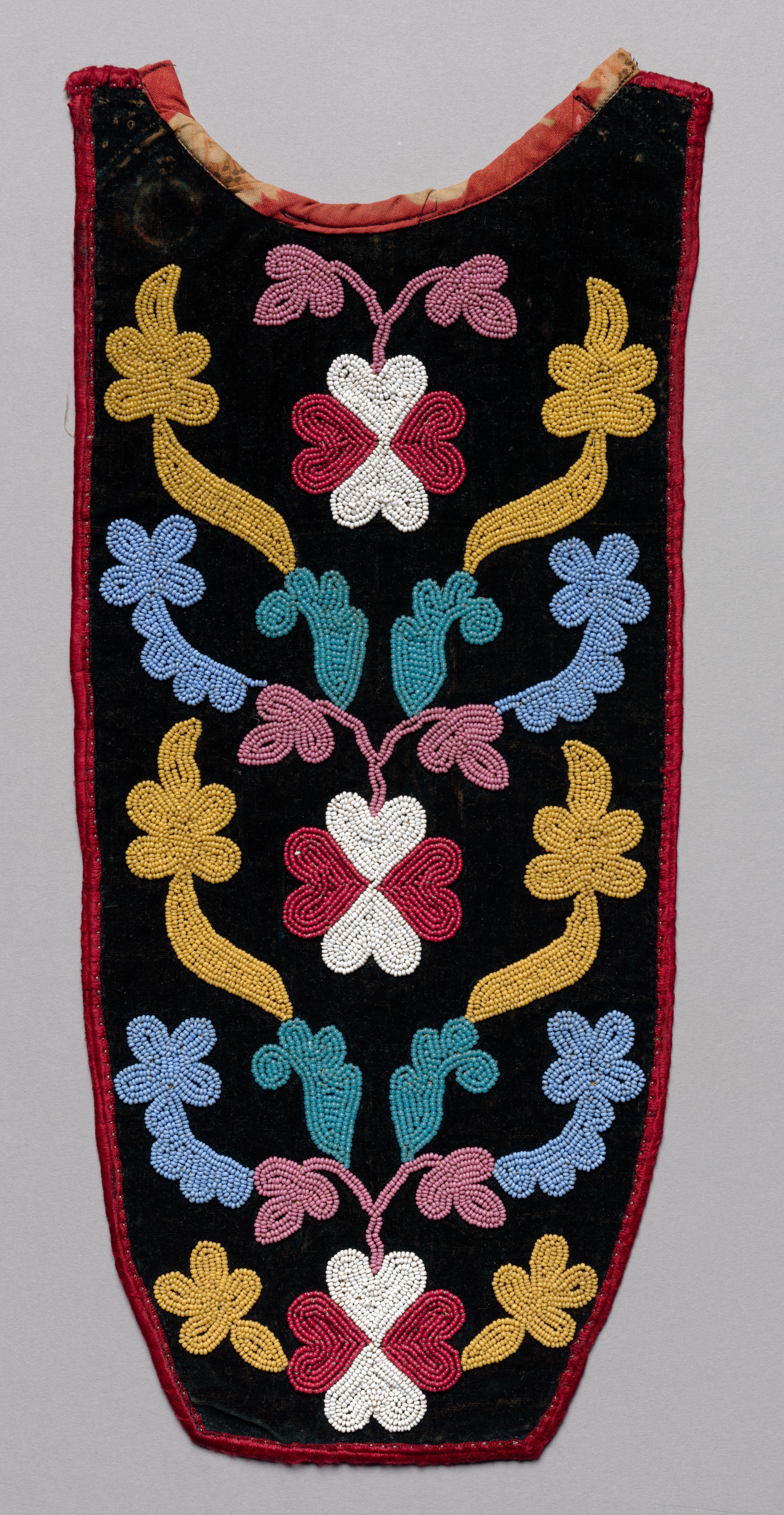
Deconstructing the Placket: An Avant-Garde Analysis of an Anishinaabe/Cree Garment Fragment
As Chief Fabric Deconstructionist at Zoey Fashion Lab, I am tasked with dissecting not merely the physical components of a garment, but the cultural, technical, and conceptual DNA that defines its existence. The subject of this analysis is a placket—a seemingly simple structural element—sourced from the Northeast Woodlands, Great Lakes Region, with probable origins among the Anishinaabe (Ojibwe) or Nehiyawak (Cree) peoples. The materials—velvet and cotton—are deceptively familiar. Yet, when viewed through the lens of an avant-garde aesthetic and the metaphor of a "New DNA Strand," this placket reveals itself as a site of radical cultural and technological hybridization.
Materiality: The Paradox of Velvet and Cotton
The choice of velvet and cotton is the first critical node in our deconstruction. Velvet, a pile weave historically associated with European aristocracy and colonial trade, is an imported material. Its presence in Indigenous regalia from the Great Lakes region is a testament to adaptation and cultural resilience. The Anishinaabe and Cree peoples did not simply adopt velvet; they recontextualized it. Velvet’s deep, absorbent nap became a perfect canvas for beadwork and quillwork, its plushness contrasting with the hard, reflective surfaces of glass beads. In this placket, the velvet is not a sign of colonial subjugation but of indigenized luxury—a deliberate appropriation of a foreign material to serve Indigenous aesthetics of prestige, ceremony, and identity.
The cotton, by contrast, is a structural backbone. Often used for linings or interfacings in this context, cotton provides stability and breathability. Its plain weave is the antithesis of velvet’s opulence. Together, they form a dialectic: the visible surface (velvet) performs cultural memory and visual power, while the hidden structure (cotton) ensures functionality and endurance. In an avant-garde reading, this pairing is a statement on the tension between ornament and utility, between the performed self and the practical body.
Technical Analysis: The Placket as DNA Strand
In traditional garment construction, the placket is a reinforcing slit, often found at the neck or wrist, allowing for ease of dressing and closure. But here, we treat the placket as a New DNA Strand—a genetic code that carries information about construction, use, and cultural transmission. The placket’s cut, stitching, and finishing techniques are not arbitrary; they are the stitches of cultural memory.
Examining the placket’s edges, we note the use of hand-stitched or machine-stitched seam finishes. In historical Anishinaabe or Cree garments, such details were often executed with sinew or cotton thread, reflecting a pre-industrial precision. The placket’s orientation—likely vertical, running from the neckline downward—suggests a garment that was pulled over the head, a common design in both Indigenous and European-influenced trade coats. However, the asymmetry of the placket’s placement or its unexpected width could be a deliberate avant-garde intervention. If the placket is wider than standard, it becomes a sculptural element, a band that draws the eye and disrupts the garment’s silhouette.
Furthermore, the placket’s closure mechanism—whether buttons, toggles, or ties—is a critical technical detail. Buttons, often made of bone, metal, or glass, were trade goods that Indigenous artisans repurposed. In an avant-garde context, the absence of visible fasteners or the use of hidden magnetic snaps could be a contemporary reinterpretation, preserving the visual purity of the velvet while modernizing function. This is the mutation in the DNA strand: a traditional structure re-engineered for a new aesthetic language.
Cultural DNA: Anishinaabe and Cree Aesthetics
The placket is not a neutral element. In Anishinaabe and Cree visual culture, symmetry and asymmetry coexist. Traditional floral beadwork often follows a symmetrical pattern, yet the placement of such motifs on a garment can be asymmetrical to accommodate movement or spiritual symbolism. The placket, as a central vertical axis, often becomes a canvas for narrative. If this placket bears any residual beadwork, quillwork, or embroidery—even as faded impressions or ghost stitches—it would tell a story of clan identity, personal history, or spiritual protection.
The color of the velvet is also a carrier of meaning. Deep indigo, crimson, or black are common in Great Lakes regalia, each associated with specific ceremonies or seasons. An avant-garde interpretation might deconstruct this color coding by using a monochromatic palette or by introducing a neon or metallic thread for the placket’s stitching, creating a jarring yet respectful dialogue between tradition and futurism.
Moreover, the placket’s role as a threshold—between the body and the garment, between the inside and outside—is significant. In many Indigenous worldviews, clothing is an extension of the self, a protective layer. The placket, as an opening, is a point of vulnerability and agency. An avant-garde design might exaggerate this opening, making it a gash or a seam that refuses to close, symbolizing the ongoing trauma of colonization but also the resilience of cultural continuity.
Avant-Garde Reimagination: The Placket as Proto-Fashion
To approach this placket from an avant-garde perspective is to see it as proto-fashion—a raw, unfinished idea that challenges conventional garment hierarchies. The avant-garde seeks to disrupt, to question, and to recontextualize. Here, the placket is not a minor detail but the primary conceptual element. Imagine this placket removed from its original garment and reimagined as a standalone piece: a velvet band worn as a collar, a belt, or a headpiece. Its cotton lining could be exposed, frayed, or dyed in contrasting colors, turning the inside out—a classic avant-garde gesture that reveals the hidden labor and structure.
The New DNA Strand metaphor becomes literal if we consider the placket as a template for digital fabrication. Using 3D scanning and parametric design, we could map the placket’s curves, stitch patterns, and wear patterns, then generate a series of variations that hybridize Indigenous geometry with algorithmic abstraction. The result would be a collection of plackets that are both archaeological artifacts and futuristic prototypes.
Conclusion: A Living Code
This placket, of velvet and cotton, from the Anishinaabe or Cree peoples, is far more than a functional slit. It is a living code—a strand of cultural DNA that encodes adaptation, resistance, and beauty. In the hands of Zoey Fashion Lab, it becomes a site for radical deconstruction and reconstruction. By honoring its origins while pushing it into the avant-garde, we do not appropriate; we amplify. We recognize that Indigenous fashion is not a relic but a dynamic, evolving force. The placket, in its quiet utility, holds the potential to redefine how we see structure, ornament, and identity in contemporary fashion.
As we continue to deconstruct, we must ask: How can this placket be a bridge between ancestral knowledge and speculative futures? The answer lies not in preserving it as a museum piece, but in letting it mutate, grow, and inspire new strands of design that are as resilient and beautiful as the cultures that created it.