Deconstructing the Burgonet: An Avant-Garde Analysis for Zoey Fashion Lab
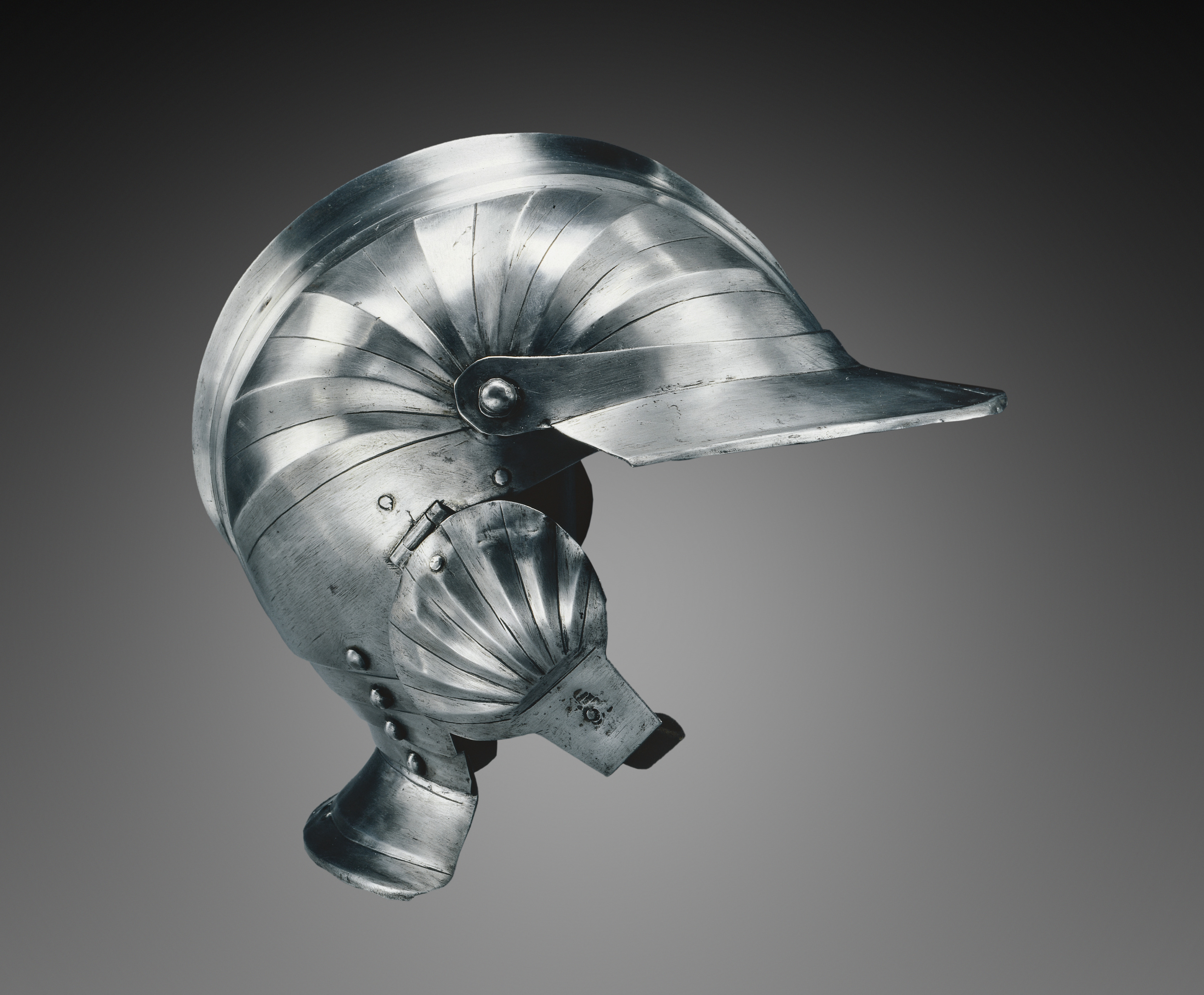
The burgonet, a quintessential piece of 16th-century military headgear, offers a rich tapestry of structural, symbolic, and aesthetic elements ripe for deconstruction. For Zoey Fashion Lab, this artifact—specifically an Italian (Milanese) example crafted from steel with radiating flutings—transcends its historical role as battlefield protection. It becomes a New DNA Strand in the evolution of avant-garde fashion, a coded blueprint for reimagining form, texture, and the very concept of armor in a contemporary context. This analysis will dissect the burgonet’s core components, translate its technical vocabulary into a modern design language, and propose how its essence can be woven into the lab’s disruptive collections.
I. The Structural Lexicon: Steel as a Second Skin
The burgonet’s primary material—steel—is inherently antithetical to conventional fashion textiles. Yet, its use in the 16th century was not merely for protection but for projection of power, status, and identity. The Milanese smiths, renowned for their metallurgical precision, created a form that followed a strict functional logic: a close-fitting skull cap, a distinctive peak (or brim) at the front, and often a falling buffe (a protective lower face guard). For Zoey Fashion Lab, this steel becomes a metaphor for impermeable structure.
In an avant-garde context, the steel’s rigidity can be reinterpreted through high-tech materials that mimic its weight and sheen while allowing for movement. Consider carbon fiber, liquid metal finishes, or laser-cut leathers that achieve the same geometric precision. The burgonet’s radiating flutings—parallel, channeled grooves that fan outward from the crown—are not decorative whims; they are a structural innovation. These flutings increase the helmet’s strength without adding mass, much like the ribbed vaulting in Gothic architecture. For the Lab, this translates into a design principle: surface relief as structural integrity. Imagine a jacket or a bodice where vertical or radiating pleats, folds, or bonded layers create a similar effect—a garment that is both lightweight and armored, both fluid and rigid.
II. The Radiating Flutings: A New DNA Strand in Surface Design
The radiating flutings are the burgonet’s most distinctive visual signature. In the original, they serve to deflect blows and soften the glare of sunlight. For Zoey Fashion Lab, they become a primary design motif—a New DNA Strand that can be replicated, mutated, and scaled across a collection. This is not mere historical quotation; it is a genetic extraction of a formal language.
Avant-garde fashion thrives on the transformation of surface. The flutings can be translated into:
- Textile engineering: Using heat-set pleats, smocking, or bonded fabrics to create permanent, radiating ridges on skirts, sleeves, or capes.
- Digital fabrication: 3D-printed panels or laser-cut overlays that echo the precise, mathematical rhythm of the original flutings. This allows for a hyper-customization where each “groove” can vary in depth, width, or angle.
- Light manipulation: The flutings create a play of light and shadow, a visual dynamism that shifts with the wearer’s movement. The Lab could explore iridescent or metallic foils, or even integrated LEDs, to animate the surface in real-time, turning the garment into a living sculpture.
This approach aligns with the avant-garde imperative to challenge the static nature of clothing. The burgonet’s flutings are not passive; they are active participants in the helmet’s function. Similarly, a Zoey Fashion Lab garment should not merely drape; it should perform—through structure, through light, through the very tension of its form.
III. The Avant-Garde Recontextualization: Armor as Vulnerability
The burgonet is, at its core, a tool of aggression and defense. The avant-garde fashion designer, however, often subverts such binaries. For Zoey Fashion Lab, the burgonet’s militaristic origins can be deconstructed to explore themes of protection versus exposure, strength versus fragility.
Imagine a collection where the burgonet’s form is fragmented. The helmet’s peak becomes a sharp, asymmetric shoulder pad. The flutings are isolated as a series of detachable, modular panels that can be worn as a collar, a belt, or a cuff. The falling buffe is reinterpreted as a face-obscuring veil made of metallic mesh or laser-cut leather, simultaneously shielding and revealing the wearer. This deconstruction of the whole into parts is a hallmark of avant-garde design, allowing the original object to be reassembled into a new, ambiguous identity.
Furthermore, the burgonet’s gender neutrality is significant. While historically worn by men, its form is androgynous—a skull cap that fits any head. In the Lab’s hands, this becomes a unisex template for a new kind of body armor, one that does not conform to traditional silhouettes. The steel’s coldness can be juxtaposed with soft, organic materials like silk, wool, or even latex, creating a dialectic between the industrial and the natural. This tension is the lifeblood of avant-garde fashion: the unexpected marriage of the hard and the soft.
IV. Technical Translation: From Smithy to Atelier
To actualize this New DNA Strand, Zoey Fashion Lab must engage in a technical translation of the burgonet’s construction methods. The Milanese smiths worked through hot forging, hammering, and planishing—processes of compression and shaping. The Lab’s equivalent might involve:
- Molding and casting: Using resin or thermoplastic to create the fluted forms, then applying metallic finishes.
- Laser sintering: 3D printing metal or nylon powders to achieve the exact, repeatable geometry of the flutings.
- Hand-finishing: Just as the original smiths polished and etched the steel, the Lab’s artisans can apply patinas, burnishing, or chemical treatments to give the surfaces a lived-in, historical depth.
The burgonet’s articulation—the way its parts move relative to each other (e.g., the pivoting cheek pieces)—can inspire hinged or jointed garments. A jacket with articulated sleeves that lock into position, or a skirt with panels that fan open and closed, would echo the helmet’s functional mechanics while pushing fashion into the realm of wearable kinetic sculpture.
V. Conclusion: The Burgonet as a Catalyst for Disruption
The 16th-century Milanese burgonet, with its steel structure and radiating flutings, is far more than a historical curiosity. For Zoey Fashion Lab, it represents a primordial template for avant-garde expression. Its New DNA Strand lies in the fusion of extreme structure with dynamic surface, of historical weight with futuristic lightness. By deconstructing its form, translating its materials, and subverting its symbolism, the Lab can create garments that are not just clothing but statements of intent—armor for the modern psyche, ready to face the battles of identity, technology, and art. The burgonet, once a shield for the head, becomes a crown for the avant-garde.