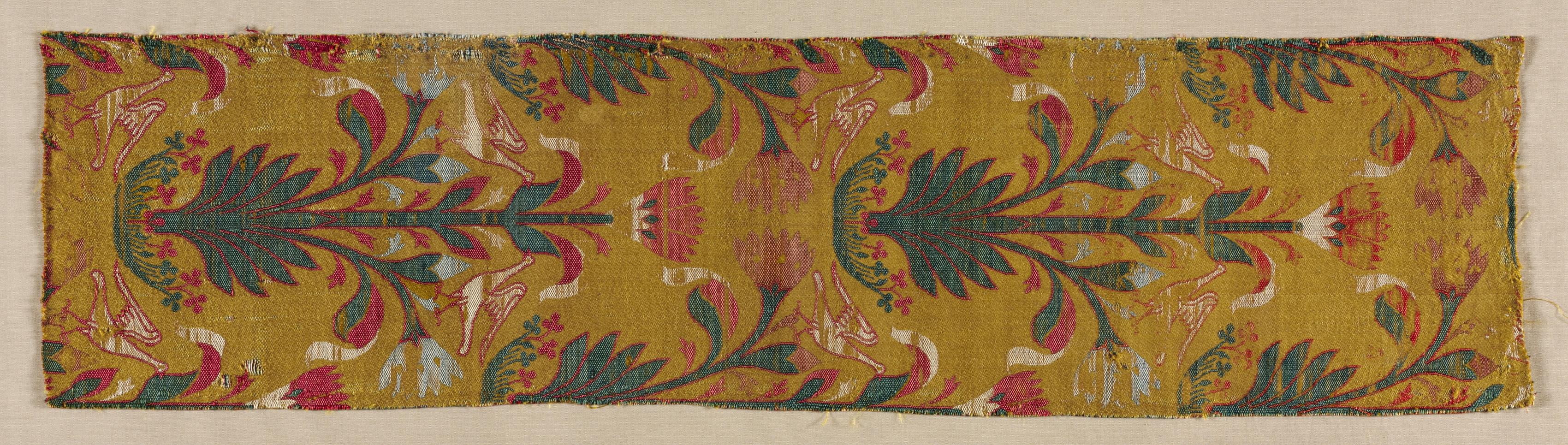
Deconstructing the Mudejar Silk Fragment: A Blueprint for Avant-Garde Innovation
At Zoey Fashion Lab, we approach historical textiles not as artifacts to be preserved, but as living data sets—biological and cultural DNA strands waiting to be reinterpreted. The subject of this analysis is a 15th-century Mudejar silk fragment from Spain, executed in a complex lampas weave. This piece, which we have designated as “New DNA Strand,” offers a profound technical and aesthetic vocabulary for our avant-garde design philosophy. By deconstructing its material, structural, and symbolic elements, we can extract principles that challenge contemporary fashion norms and generate entirely new forms of expression.
Material and Technical Analysis: The Lampas Weave as a Structural Blueprint
The fragment’s lampas weave is a masterclass in structural complexity. Unlike simpler weaves, lampas involves multiple warp and weft systems—typically a ground weave and a pattern weave—that interlock to create a dense, reversible fabric. This technical layering is not merely decorative; it is a system of controlled tension and release. For Zoey Fashion Lab, this translates directly into our avant-garde approach to garment construction. We see the lampas weave as a metaphor for deconstructing the human silhouette: the ground weave represents the body’s foundational structure, while the pattern weave is the disruptive, ornamental force that redefines space and volume.
From a material science perspective, the silk fibers in this fragment are remarkably preserved, retaining a luster that speaks to the quality of 15th-century Spanish sericulture. The high tensile strength of silk allows for both drape and rigidity—a duality we exploit in our designs. We can extract this silk’s protein structure and replicate its molecular elasticity using bio-fabricated silk proteins, creating new textiles that mimic the original’s hand-feel but with programmable properties, such as thermochromic color shifts or self-healing capabilities. The fragment’s color palette—faded ochres, deep indigos, and muted cinnabars—provides a chromatic DNA that informs our digital color mapping for reactive dyes.
Historical and Cultural Context: The Mudejar Aesthetic as a Disruptive Force
The Mudejar style, born from the coexistence of Christian, Islamic, and Jewish cultures in medieval Spain, is inherently a synthesis of opposites. This fragment’s geometric interlacing, arabesque motifs, and stylized vegetal forms are not mere decoration; they represent a visual language of hybridity. For Zoey Fashion Lab, this is a direct precedent for our avant-garde ethos of breaking down cultural and aesthetic boundaries. The Mudejar approach to pattern—where Islamic geometric rigor meets Christian figurative restraint—offers a template for algorithmic pattern generation. We can digitize these motifs and use generative AI to produce infinite variations, then apply them to asymmetrical, sculptural silhouettes that reject traditional tailoring.
The 15th-century Spanish context also imbues this fragment with a sense of historical rupture. The Reconquista was reshaping the Iberian Peninsula, and this textile was produced in a period of intense cultural negotiation. Our avant-garde practice embraces this rupture: we do not seek to recreate the past but to disrupt the present by recontextualizing historical techniques. The Mudejar silk becomes a “New DNA Strand” because it carries the genetic code of a hybrid identity—one that we can splice with contemporary digital fabrication, 3D printing, and zero-waste pattern cutting.
Deconstructing the Visual Language: Geometry, Repetition, and Asymmetry
Upon close examination, the fragment’s pattern reveals a grid-based structure overlaid with curvilinear elements. This interplay between order and chaos is central to our design methodology. The geometric interlace—often composed of eight-pointed stars and interlacing bands—creates a visual rhythm that can be translated into parametric design. We can use this geometry to generate laser-cut patterns for leather or bio-fabricated materials, where negative space becomes as important as the fabric itself. The repetition of motifs, while mathematically precise, is not monotonous; subtle variations in thread thickness and color saturation introduce a human imperfection that we celebrate in our avant-garde work.
We also note the fragment’s asymmetrical composition. While many Islamic textiles are strictly symmetrical, this Mudejar piece shows a slight imbalance—a shift in the pattern’s axis that suggests a hand-crafted deviation. This imperfection is a design tool. In our collections, we deliberately distort traditional patterns to create deconstructed silhouettes: a sleeve that extends into a train, a collar that morphs into a hood, or a hemline that follows the fragment’s original edge rather than a straight line. The fragment’s frayed edges, preserved in our analysis, become a design feature in our garments, where raw, unfinished seams are celebrated as part of the narrative.
From Fragment to Future: Translating the “New DNA Strand” into Avant-Garde Garments
The designation “New DNA Strand” is not metaphorical; it is a design protocol. We have isolated three core genetic sequences from this fragment:
1. Structural Hybridity: The lampas weave’s dual-system construction inspires our use of multi-layer, reversible fabrics. We are developing a textile that combines a silk organza base with a laser-cut, thermoplastic polyurethane (TPU) overlay, allowing the garment to shift from opaque to translucent when activated by body heat. This mimics the lampas’s interplay between ground and pattern.
2. Algorithmic Geometry: The Mudejar grid is the foundation for our generative pattern system. Using custom software, we input the fragment’s motif coordinates and generate thousands of variations, each with a unique distortion. These are then printed onto silk using digital jacquard looms, creating one-of-a-kind yardage that retains the historical essence while being entirely novel.
3. Deconstructed Silhouette: The fragment’s irregular edges and asymmetrical pattern inform our zero-waste pattern cutting. We design garments that follow the fabric’s natural drape and pattern flow, rather than forcing the textile into standard shapes. This results in garments that are sculptural, with built-in folds, overlaps, and unexpected volumes—a direct homage to the lampas weave’s structural complexity.
Conclusion: The Fragment as a Living System
This 15th-century Mudejar silk fragment is not a relic; it is a living system of design intelligence. At Zoey Fashion Lab, we treat it as a “New DNA Strand” because it contains the genetic code for a fashion future that is technically rigorous, culturally hybrid, and aesthetically disruptive. By deconstructing its weave, its history, and its visual language, we extract principles that allow us to reconstruct fashion itself. The avant-garde is not about rejecting the past—it is about using the past as a catalyst for radical innovation. This silk fragment, with its lampas weave and Mudejar soul, is our blueprint for garments that are not just worn, but experienced as living, evolving structures.