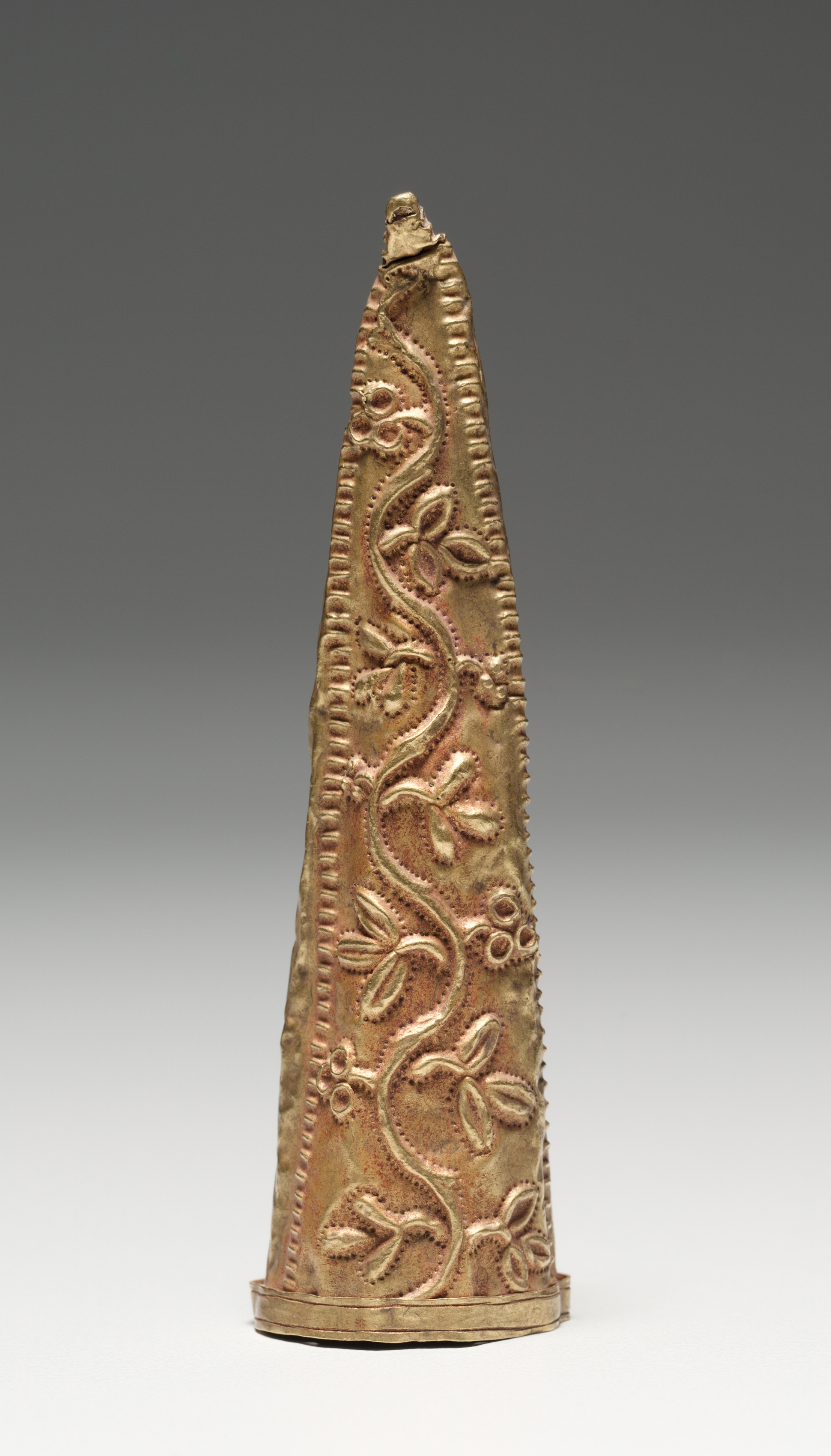
Deconstructing the Sika Bọfa: Avant-Garde Resonance in Asante Goldsmithing
At Zoey Fashion Lab, we do not merely study artifacts; we deconstruct their material narratives to extract the latent codes of avant-garde expression. The subject of this analysis—a knife-sheath tip (sika bọfa) from the Asante Empire, likely crafted in Kumasi by a member of the goldsmiths’ guild—presents a profound paradox. This object, forged from gold and intended for ceremonial or status display, embodies a tension between functional utility and pure aesthetic excess. Our analysis will dissect its technical, cultural, and symbolic dimensions, revealing how this historical piece prefigures the avant-garde’s obsession with hybridity, surface tension, and the subversion of form.
Technical Mastery: The Avant-Garde as Precision
The sika bọfa is not a sheath in the Western sense; it is a terminal cap, often cast using the lost-wax technique, that once adorned a ceremonial knife. The gold used is not merely a material but a medium of political and spiritual authority. The technical execution is staggering: the surface is a field of intricate, split-leaf patterns (mirror with split-leaf), where gold is inlaid into a polished silver or blackened ground, creating a visual oscillation between positive and negative space. This is not decoration; it is a deliberate manipulation of optical perception.
For the avant-garde, technical precision is a weapon. The Asante goldsmith’s ability to achieve micro-level detail—the undulating palm fronds, the geometric interstices—parallels the precision of a Balenciaga seam or a Rei Kawakubo cut. The sika bọfa anticipates the avant-garde’s love of surface as narrative. The gold does not simply cover; it interrupts the metal ground, creating a visual rhythm that is both chaotic and controlled. This is the same logic found in Alexander McQueen’s intricate beading or Iris van Herpen’s 3D-printed lattices: the material becomes a code, readable only by those who understand the language of craft.
Cultural Context: The Guild as Collective Avant-Garde
The object’s origin—the Asante goldsmiths’ guild in Kumasi—is crucial. This was not an individual artist but a collective of master artisans operating within a strict courtly system. Yet, within this system, innovation flourished. The guild’s monopoly on goldworking allowed for experimentation with alloys, casting methods, and symbolic motifs. This mirrors the avant-garde’s historical reliance on collective movements—the Bauhaus, the Wiener Werkstätte, or even contemporary fashion houses like Comme des Garçons—where individual genius is subsumed into a shared aesthetic language.
The sika bọfa was not a weapon; it was a sign. Its owner, likely an okyeame (royal spokesperson) or high-ranking official, used it to project power. But the object’s avant-garde quality lies in its redundancy. The sheath tip is the most visible part of the knife, yet it has no practical function in cutting. It is pure signifier. This is the essence of the avant-garde: form that exceeds function. Duchamp’s readymades, Warhol’s Brillo boxes, and McQueen’s platform armadillo shoes all operate on this principle—the object becomes a statement about its own existence.
Symbolic Deconstruction: The Split-Leaf as Avant-Garde Gesture
The split-leaf motif (mirror with split-leaf) is not merely decorative. In Asante symbolism, the palm frond represents peace, victory, and the cyclical nature of life. The split is the key. It introduces a rupture, a fracture in the organic flow. This is the avant-garde’s favorite device: the interruption. Think of the sliced garments of Martin Margiela, the deconstructed seams of Yohji Yamamoto, or the asymmetrical closures of Rick Owens. The split-leaf on the sika bọfa is a visual cut, a deliberate break in the pattern that forces the eye to pause.
This rupture is also a mirror. The polished silver or blackened ground reflects the viewer, while the gold leaf absorbs light. The object becomes a threshold—between the viewer and the viewed, between the sacred and the profane. This resonates with the avant-garde’s obsession with self-reflexivity. The sika bọfa is not just a sheath tip; it is a mirror of the self, a reminder that all objects are projections of human desire. In this, it prefigures the work of artists like Anish Kapoor, whose polished stainless steel sculptures reflect and distort the viewer, or the mirrored surfaces of Yayoi Kusama’s infinity rooms.
Material Alchemy: Gold as Avant-Garde Medium
Gold is a problematic material for the avant-garde. It carries weight of tradition, wealth, and religious significance. Yet, the Asante goldsmiths used it with a radical lightness. The sika bọfa is not a solid gold block; it is a thin, cast shell, often hollow. This dematerialization of the precious metal is an avant-garde gesture. It subverts the expected weight of gold, turning it into a skin, a surface, a veil.
This technique parallels the avant-garde’s use of unexpected materials—Kawakubo’s polyurethane, McQueen’s latex, or Hussein Chalayan’s fiberglass. The sika bọfa treats gold as a fabric, to be stretched, folded, and patterned. The goldsmith’s guild understood that the value of gold is not in its weight but in its capacity to signify. This is the same logic that drives the avant-garde’s fascination with luxury as critique. When Margiela used Hermès scarves to create a patchwork coat, he was not celebrating luxury; he was deconstructing it. The sika bọfa does the same—it uses gold to comment on the nature of power, visibility, and the object itself.
Archive Resonance: The Split-Leaf as Avant-Garde Memory
The reference to Archive Resonance: Mirror with Split-Leaf is critical. It suggests that this object exists in a dialogue with other artifacts, creating a resonant field of meaning. The avant-garde is always an archive of itself—a collection of references, quotations, and reinventions. The sika bọfa is not an isolated object; it is part of a network of Asante goldwork, each piece echoing the other. This is the same logic that drives the work of designers like Raf Simons, who constantly references the archives of his own collections, or the practice of re-edition in contemporary fashion.
The split-leaf motif, when read through the lens of the avant-garde, becomes a memory device. It recalls the split in the self, the fracture in history, the cut that defines modernity. The sika bọfa is a wound in the smooth surface of tradition, a rupture that allows new meanings to emerge. This is the ultimate avant-garde gesture: to take a familiar form—a knife sheath tip—and split it, mirror it, and present it as a question.
Conclusion: The Sika Bọfa as Avant-Garde Prototype
For Zoey Fashion Lab, the sika bọfa is not a historical artifact to be preserved under glass. It is a prototype for a new way of thinking about form, material, and meaning. Its technical precision, its cultural embeddedness, its symbolic rupture, and its material alchemy all converge to create an object that is at once ancient and utterly contemporary. The Asante goldsmith, working in Kumasi centuries ago, understood something that the avant-garde would later formalize: that the most powerful objects are those that resist easy interpretation.
The sika bọfa is a mirror that reflects not just the viewer but the entire history of goldworking, of power, of the split between function and form. It is a knife-sheath tip that cuts not flesh but certainty. In this, it is a perfect subject for deconstruction—a fragment that contains the whole, a surface that conceals depth, an object that is always becoming something else. This is the resonance we seek at Zoey Fashion Lab: the avant-garde as a continuous, global conversation, where the past is not a relic but a living, splitting, mirroring force.