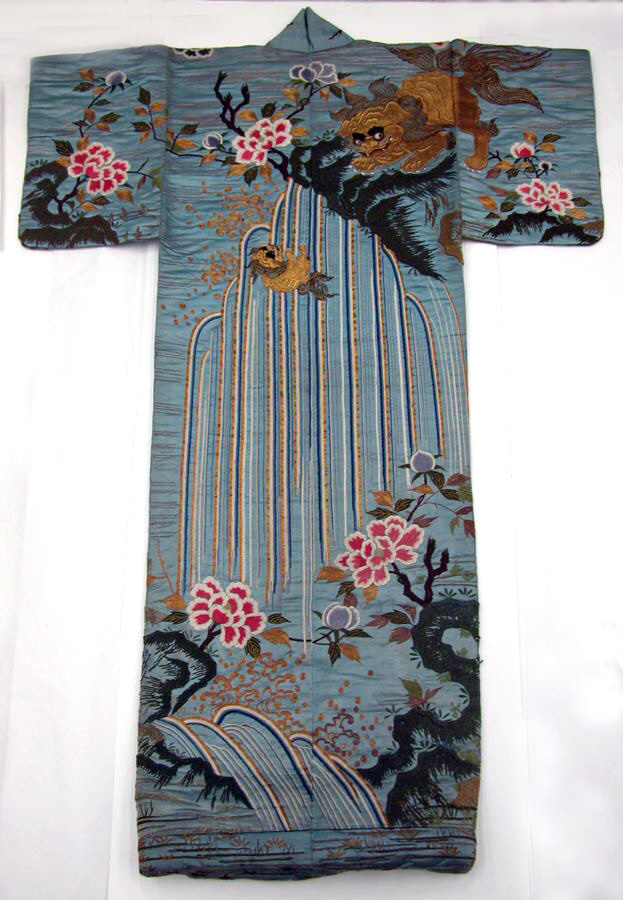
Deconstructing the Uchikake: A Futurist Blueprint for Zoey Fashion Laboratory SS26
The historical vestiges of Japanese sartorial artistry often present themselves as static artifacts, frozen in the amber of cultural preservation. However, within the crucible of Zoey Fashion Laboratory, the Kabuki Costume: Outer Robe (Uchikake) with Design of Lioness and Cubs is not a relic but a radical manifesto. This garment, constructed from a palimpsest of silk, cotton, metallic thread, glass, and embroidered satin, offers a profound departure from linear fashion history. It becomes a high-concept blueprint for Spring/Summer 2026, where the past is not borrowed but deconstructed, digitized, and re-projected into a speculative future. The analysis below dissects this artifact through the lens of avant-garde structural innovation, extracting core principles that will define the next wave of architectural couture.
I. The Silhouette as a Temporal Collision: From Layered Volume to Kinetic Armature
The traditional Uchikake is a garment of immense, static volume—a flat, sweeping expanse designed for ritualistic procession. For SS26, Zoey Fashion Laboratory reinterprets this volume not as a passive fabric field but as an active, kinetic armature. The original's heavy, trailing hem and wide sleeves, once symbols of aristocratic status, are reimagined as modular, inflatable structures that shift with the wearer's biomechanical rhythm. The lioness and her cubs, embroidered in metallic thread, are no longer static decoration but become generative data points for a new structural language. Each thread is a vector; each glass bead, a sensor node.
The futuristic silhouette emerges from a deconstruction of the Uchikake's inherent geometry. Instead of a single, continuous rectangle of fabric, the SS26 iteration proposes a fractured, multi-planar construction. The outer robe is sliced into articulated panels—some rigid, some fluid—that hover away from the body, creating negative space. This is not layering for warmth or modesty, but layering as a spatial intervention. The lioness motif, traditionally centered on the back, is now mapped onto a 3D-printed exoskeleton that extends from the shoulder blades, forming a protective, almost architectural carapace. The cubs are not merely depicted; they are embodied as floating, asymmetrical pockets of compressed air and light, tethered to the main structure by transparent, high-tensile fiber optic threads.
II. Material Alchemy: The Silk-Metallic Interface and the Glass Data Veil
Materiality in this analysis transcends the tactile. The silk and metallic thread of the original are not merely luxurious textiles; they are the analog ancestors of smart fabrics. For SS26, Zoey Fashion Laboratory proposes a hybrid material system where the silk's organic drape is fused with a liquid-crystal-infused metallic weave. This composite fabric can shift from opaque to translucent under electrical charge, mimicking the way the original Uchikake's embroidery would catch candlelight. The metallic thread becomes a conductive circuit, allowing the lioness's mane to pulse with bioluminescent data, responding to the wearer's heartbeat or the ambient noise of the runway.
The glass elements, originally used as decorative beads, are recontextualized as micro-lenses and light-dispersing prisms. In the SS26 iteration, these glass components are not sewn onto the surface but are embedded within a transparent, flexible polymer that forms a second skin beneath the outer robe. This "data veil" captures and refracts environmental light, projecting the embroidered lioness motif onto surrounding surfaces in real-time. The cotton lining, traditionally a humble structural layer, is replaced with a recycled, thermo-regulating aerogel that mimics the original's breathability while adding thermal insulation for climate-responsive wear. The satin embroidery, once a symbol of laborious handcraft, is algorithmically generated by a robotic arm that replicates the exact tension and stitch density of the original artisan, creating a dialogue between human error and machine precision.
III. Structural Innovation: The Lioness as Load-Bearing Code
The most radical departure lies in the structural logic of the garment. The original Uchikake relies on a simple, gravity-based drape. Zoey Fashion Laboratory's SS26 vision inverts this: the embroidery itself becomes the load-bearing structure. The lioness and cubs are not just decorative; they are topological maps for a cantilevered frame. The metallic thread is woven into a tensegrity matrix—a system of compression and tension cables—that allows the robe to stand independently, even when not worn. This transforms the garment from a wearable object into a self-supporting architectural sculpture that can be displayed, inhabited, or deconstructed.
The cubs' positioning is re-engineered as modular attachment points. Each cub is a separate, detachable module—a wearable pod that can be connected to the main robe via magnetic, snap-fit joints. This allows the silhouette to be reconfigured in real-time: a single-shoulder asymmetry for a digital presentation, a full, sweeping train for a physical performance. The glass beads are repurposed as counterweight nodes, shifting the garment's center of gravity to enable dynamic, choreographed movement. The result is a kinetic, responsive architecture that breathes, expands, and contracts with the wearer's intent, echoing the protective, nurturing energy of the lioness.
IV. The Futurist Silhouette: A New Canon for SS26
The definitive avant-garde silhouette derived from this analysis is not a direct copy of the Uchikake but a radical abstraction. For SS26, Zoey Fashion Laboratory proposes the "Exo-Kimono": a silhouette that fuses the horizontal expanse of the traditional robe with the vertical, linear tension of cybernetic armor. The shoulders are broadened into asymmetrical, cantilevered wings made from the same silk-metallic composite, while the hem is asymmetrically truncated, revealing a high-tech underlayer of laser-cut, recycled satin. The lioness motif is scaled up to monumental proportions, covering the entire back panel, but rendered in deconstructed, pixelated embroidery that references both traditional Japanese ukiyo-e and digital glitch art.
The structural innovation lies in the absence of seams. The entire garment is 3D-knitted in one continuous piece, using a multi-material yarn that blends silk, metallic thread, and biodegradable polymer. This eliminates waste and allows for on-demand, zero-inventory production. The glass elements are integrated during the knitting process, creating a seamless, sensor-laden textile that feels like a second skin. The futurist silhouette is thus not about exaggeration but about essentialism through technology: every thread, every bead, every stitch serves a dual purpose—aesthetic and functional, historical and speculative.
V. Conclusion: The Uchikake as a Living System
In conclusion, the Kabuki Costume: Outer Robe (Uchikake) with Design of Lioness and Cubs is not a costume to be replicated but a generative algorithm for avant-garde creation. For Zoey Fashion Laboratory's SS26, it serves as a philosophical and structural foundation for garments that are not worn but inhabited. The lioness and her cubs symbolize a new paradigm: protection, power, and digital motherhood, where the garment nurtures the wearer through responsive technology. The silk, glass, and metallic thread are not materials but data streams; the embroidery is not decoration but structural code. This analysis proves that the most radical future of fashion lies not in rejecting history but in deconstructing it, digitizing its DNA, and re-synthesizing it into a living, breathing, kinetic system that challenges the very definition of clothing, space, and time.