Deconstructing the Halberd: An Avant-Garde Analysis for Zoey Fashion Lab
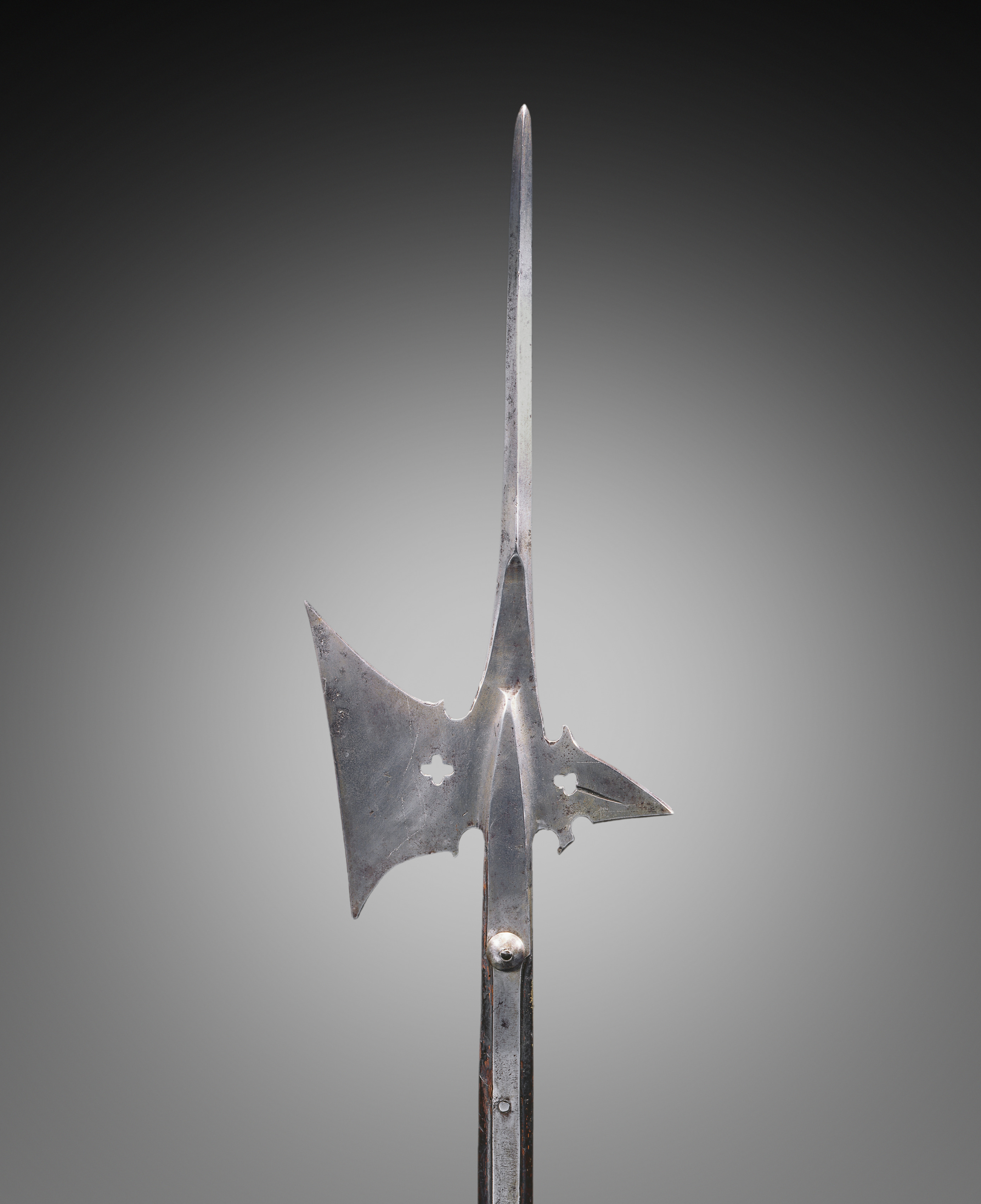
At Zoey Fashion Lab, we do not merely observe historical artifacts; we dissect them, extracting their structural DNA to forge new paradigms in textile and garment design. The subject of this analysis, a German Halberd—comprising a steel, pierced quatrefoil head and a rectangular wood haft with planed corners—presents a rich, paradoxical source of inspiration. While ostensibly a weapon of war, its technical and aesthetic components offer a compelling blueprint for an avant-garde collection. The reference to a "New DNA Strand" is not metaphorical; it is a directive. We must isolate, mutate, and recombine the halberd's core elements—mass, void, linearity, and structural tension—into a living, wearable language.
Phase I: Material and Structural Deconstruction
The halberd is a study in binary opposition. The head, forged from steel, represents density, rigidity, and a cold, reflective surface. The pierced quatrefoil introduces a critical element: negative space. This is not a solid mass but a frame that defines emptiness. The quatrefoil, a four-lobed symbol often associated with heritage and protection, becomes a motif of both strength and vulnerability. For Zoey Fashion Lab, this translates directly into fabric manipulation. Imagine a structured, double-faced wool coat where the interior layer is cut away in a quatrefoil pattern, revealing a sheer, metallic mesh beneath. The steel is not literal but translated through high-tensile technical fabrics—perhaps a bonded nylon with a liquid-metal finish or a woven stainless-steel thread that holds its shape when creased.
The rectangular wood haft with planed corners offers a contrasting vocabulary. Wood implies organic warmth, grain, and a sense of growth, yet the planed corners speak of deliberate, industrial precision. The haft is a line, a vector of force. In garment design, this manifests as linear construction. We can deconstruct the haft into a series of rigid, rectangular panels that form a corset or a sculptural sleeve. The planed corners suggest a softened edge, a transition from the brutal to the refined. This could be achieved through molded leather or a stiffened, woven jute that is then sanded and sealed, creating a surface that feels both ancient and futuristic.
Phase II: The Quatrefoil Motif as a System of Connection
The pierced quatrefoil is not merely a decorative cut-out; it is a connective node. Historically, such piercings reduced weight and allowed for airflow or the attachment of a flag. In our avant-garde interpretation, the quatrefoil becomes a structural fastening system. Instead of buttons or zippers, garments are joined by interlocking quatrefoil-shaped plates, forged from laser-cut acrylic or resin. These plates can be layered, rotated, and pinned, allowing for modular assembly. A jacket, for example, could be assembled from separate panels that lock together via these quatrefoil nodes, creating a silhouette that is both armored and fluid.
This motif also informs surface texture. The negative space of the quatrefoil can be echoed in laser-perforated leather or precision-cut neoprene. The pattern can be scaled up to create a dramatic, open-weave effect on a skirt or scaled down to a micro-perforation on a glove, offering breathability and a subtle, rhythmic pattern. The quatrefoil's four lobes suggest a cyclical, almost organic growth pattern, which can be used to guide the drape of a fabric. A dress cut on the bias could have its hemline shaped by a repeating quatrefoil curve, creating a scalloped edge that mimics the weapon's silhouette.
Phase III: The Haft as a Sculptural Silhouette
The rectangular haft with planed corners is a study in verticality and restraint. It is a line that demands attention. In avant-garde fashion, this translates to exaggerated, elongated forms. Consider a column dress that is constructed from a single, continuous piece of fabric, stiffened with a resin coating to stand away from the body. The planed corners become soft, angular darts that create a subtle, architectural flare at the hip or shoulder. The haft's rectangular cross-section can be reimagined as a structured belt or a collar that frames the neck and shoulders like a yoke.
The haft also suggests a weighted, grounded quality. Unlike a spear, it is not meant to be thrown but held and swung with deliberate force. This translates to garments that have a built-in mass—not through bulk but through density. A cape, for instance, could be lined with a heavy, chain-mail-like fabric that pulls the garment downward, creating a dramatic, gravity-defying silhouette. The planed corners of the haft can be mirrored in the sharp, clean lines of a tailored jacket, where every seam is precisely pressed and every edge is finished with a bias-bound line of contrasting fabric.
Phase IV: The New DNA Strand - Synthesis and Mutation
The "New DNA Strand" is the synthesis of these elements into a cohesive, living system. The halberd is not a static object but a tool of action. Its DNA is one of potential energy—the poised swing, the protective stance. Our garments must embody this kinetic tension. We achieve this through asymmetrical closures, adjustable tension points (like drawcords or buckles that allow the wearer to control the silhouette), and layered, shifting panels that move with the body.
The steel and wood dichotomy is resolved through hybrid materials. Imagine a fabric that is woven from a blend of carbon fiber (for the steel's rigidity) and a bamboo-based cellulose (for the wood's organic feel). This fabric would be lightweight, strong, and have a subtle, iridescent sheen. The quatrefoil pattern is not printed but embedded in the weave, creating a three-dimensional texture that changes with the light. The haft's rectangular form is translated into a modular accessory system—a series of interlocking, rectangular pouches or panels that can be attached to a base garment via magnetic quatrefoil clasps.
Finally, the avant-garde expression demands a disruption of expectation. The halberd is a weapon; our garments are armor for the modern psyche. They protect, project, and provoke. A dress might have a steel-gray, quilted bodice (the head) that transitions into a flowing, wood-grain-printed silk skirt (the haft). The quatrefoil appears as a cut-out at the back, revealing a flash of skin or a secondary, metallic lining. The planed corners of the haft are echoed in the sharp, geometric cut of a sleeve that ends in a pointed, almost dagger-like cuff.
In conclusion, the German halberd, through the lens of Zoey Fashion Lab, is not a relic but a catalyst for creation. Its steel and wood, its voids and lines, its history and form, all combine to form a new genetic code for fashion—one that is structurally rigorous, conceptually rich, and unapologetically avant-garde. This is not about recreating the past but about reassembling its atoms into a future where clothing is both a statement and a system, a tool for transformation. The halberd's DNA is now ours to weave, cut, and wear.