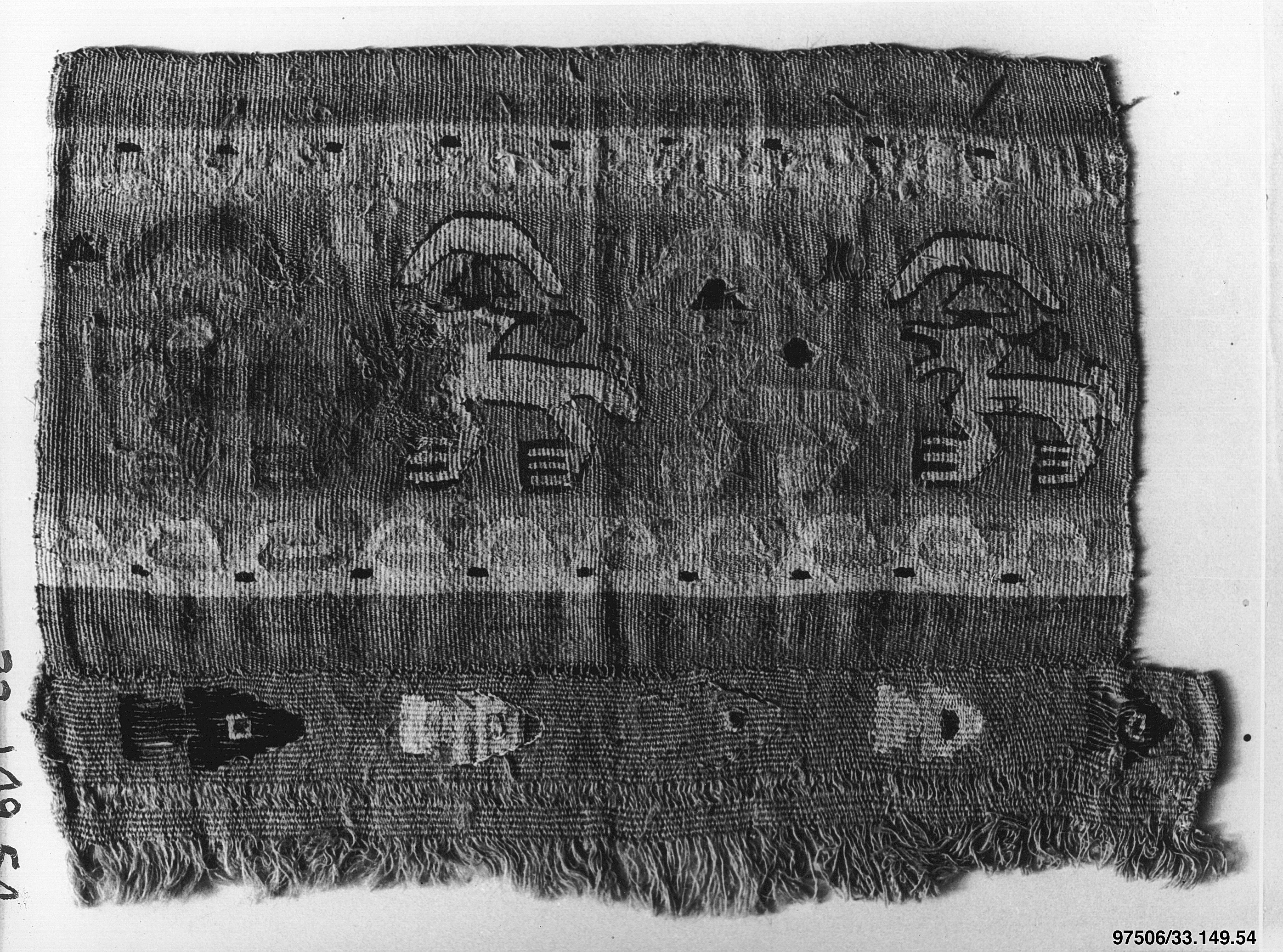
Deconstructing the Threshold: The Border Fragment as a Blueprint for SS26
The avant-garde operates at the frontier of the known, dismantling conventions to forge new visual lexicons. Zoey Fashion Laboratory’s SS26 collection, anchored by the study of a singular artifact—the Border Fragment from the central coast of Peru—transcends archaeological curiosity to become a rigorous manifesto for futuristic silhouettes. This fragment, a composite of camelid hair and cotton, is not merely a textile survivor; it is a structural algorithm that encodes principles of tensile strength, modularity, and asymmetric balance. For the avant-garde curator, this piece offers a radical departure from Western linearity, proposing a new paradigm where garment architecture is born from tension, rupture, and deliberate fragmentation.
The Material Dialectic: Camelid Hair and Cotton as Futurist Progenitors
At first glance, the material pairing of camelid hair and cotton appears rooted in pre-Columbian pragmatism. Yet, within the context of SS26, this combination becomes a study in biomimetic engineering. Camelid hair, with its hollow fiber structure and inherent thermal regulation, offers a natural analog to modern performance textiles. Its irregular, medullated core creates a dynamic surface that catches light unpredictably, producing a chromatic instability that challenges traditional dye processes. For Zoey Fashion Laboratory, this translates into garments that appear to shift in ambient light, a deliberate rejection of static color application.
Cotton, by contrast, provides a structural counterpoint. Its linear, cellulosic fibers offer tensile strength and a crisp drape, enabling precise geometric folds. The interplay between the soft, organic irregularity of camelid hair and the disciplined rigidity of cotton creates a material friction that is the cornerstone of the collection’s silhouettes. This is not a harmonious blend but a deliberate confrontation—a dialectic between the wild and the controlled, the ancient and the futuristic. The fragment’s surviving warp and weft reveal a gradient of density, where the camelid hair forms a cloud-like periphery while the cotton anchors the structure, suggesting a garment that breathes, expands, and contracts with the wearer’s movement.
Structural Innovation: The Fragment as a Modular Chassis
The Border Fragment’s most radical contribution to SS26 lies in its deconstructive geometry. Unlike the rectilinear grids of Western tailoring, this piece exhibits a fractal logic—a series of interconnected, non-repeating shapes that challenge symmetry. The fragment’s edges are not finished but frayed, revealing a deliberate incompleteness that Zoey Fashion Laboratory elevates to a design principle. For SS26, garments are conceived as modular chassis—assemblages of separate, interchangeable panels that can be reconfigured by the wearer. The fragment’s irregular perimeter becomes a blueprint for negative-space seams, where the absence of material is as critical as its presence.
This approach manifests in the collection’s signature silhouette: the Asymmetric Tension Cape. Constructed from a single, continuous length of camelid-cotton blend, the cape is anchored at the left shoulder by a tensile knot, a nod to the fragment’s original weaving techniques. The fabric cascades in a spiral trajectory, folding back upon itself to create a pocket of air between the body and the garment. This is not a draped silhouette but an engineered void, a deliberate architectural gap that challenges the notion of the garment as a second skin. The cape’s hem is left raw, mimicking the fragment’s frayed edges, and is weighted with biodegradable polymer beads that echo the camelid hair’s irregular density.
Futuristic Silhouettes: The Architecture of Rupture
The SS26 collection redefines the human form through rupture and reassembly. Drawing from the fragment’s evidence of repair—a visible mended thread—Zoey Fashion Laboratory introduces the concept of visible reconstruction. Garments are not seamless but deliberately scarred, with exposed seams rendered in contrasting threads of phosphorescent cotton. These seams become narrative lines, tracing the garment’s history of wear and repair, and projecting a future where clothing is a living document.
The Fractured Bodice exemplifies this ethos. Composed of five interlocking panels, each cut from a different segment of the fragment’s pattern, the bodice is held together by a series of tension cables woven from camelid hair. These cables are adjustable, allowing the wearer to alter the silhouette’s volume and asymmetry. The result is a dynamic exoskeleton that shifts from a sculpted, armor-like form to a fluid, second-skin drape. The bodice’s left side is intentionally incomplete, revealing a structural void that exposes the wearer’s torso—a deliberate vulnerability that challenges the traditional armor of high fashion.
Furthering this deconstructive logic, the Floating Hem Trousers abandon the waistband in favor of a floating anchor system. Four points of attachment—two at the hips, two at the lower back—suspend the trousers from a camelid-hair harness. The trousers themselves are cut on the bias, with seams that spiral around the legs, creating a torsional twist that mimics the fragment’s irregular weave. The hem is deliberately frayed, and the fabric’s weight distribution creates a gravity-defying silhouette, where the trousers appear to float away from the body, only to be tethered by the harness.
Color and Texture: The Chromatic Language of Decay
The fragment’s surviving palette—a muted spectrum of faded ochre, charcoal, and undyed cream—informs the collection’s chromatic strategy. Zoey Fashion Laboratory rejects synthetic dyes in favor of natural pigment extraction, using cochineal, indigo, and iron oxide to replicate the fragment’s aged patina. The camelid hair is left in its raw, undyed state, its natural variations in shade creating a gradient of earth tones that shifts across the garment. Cotton panels are treated with a bioengineered moss culture, which introduces a living, verdant stain that evolves over time—a deliberate embrace of decay as a design element.
Texture becomes a tactile language. The camelid hair’s soft, fuzzy surface contrasts with the cotton’s crisp, almost paper-like finish. This textural dissonance is amplified by the introduction of laser-cut perforations in the cotton, creating a pattern of microscopic holes that reference the fragment’s missing weft threads. The perforations are not decorative but functional, allowing the garment to breathe and to reveal glimpses of the skin beneath—a literal transparency that aligns with the collection’s theme of rupture.
Conclusion: The Fragment as a Future Artifact
The Border Fragment from Peru’s central coast is not a relic but a prophetic text for SS26. Zoey Fashion Laboratory’s analysis reveals that true avant-garde innovation lies not in rejecting the past but in deconstructing its logic to build new systems. The fragment’s material dialectic, modular geometry, and narrative of repair offer a blueprint for garments that are adaptive, living, and intentionally incomplete. In a fashion landscape saturated with disposable trends, this collection stands as a testament to the power of structural archaeology—a future where clothing is not worn but inhabited, not finished but forever evolving. The Border Fragment, once a threshold between worlds, now becomes the threshold to a new aesthetic frontier.