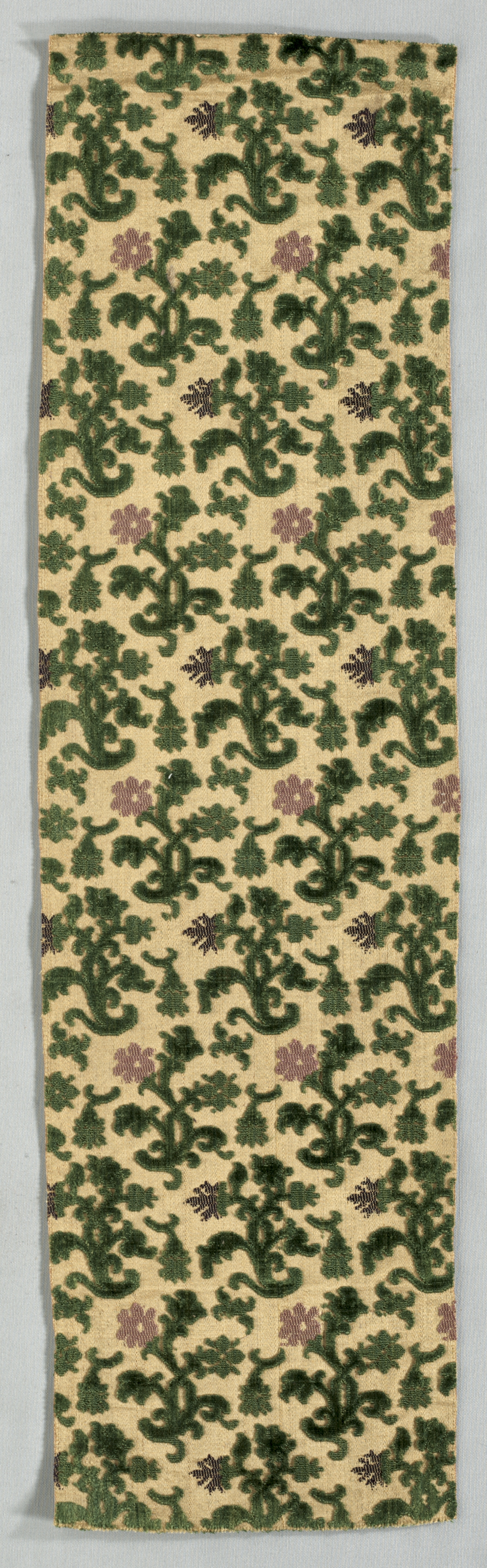
Deconstructing the Velvet Fragment: A Technical and Stylistic Analysis for Zoey Fashion Lab
This analysis, prepared for the Chief Fabric Deconstructionist at Zoey Fashion Lab, examines an Italian velvet fragment from the early 17th century. The specimen, composed of silk and featuring cut, uncut, and voided velvet techniques, is designated as a "New DNA Strand" for its potential to inform avant-garde design. The following deconstruction explores its historical foundation, technical intricacies, and stylistic reinterpretation within a contemporary, experimental framework.
Historical Context and Material Provenance
The fragment originates from Italy during the early 17th century, a period when velvet production reached extraordinary heights of artistry and technical sophistication. Italian city-states, particularly Genoa, Venice, and Florence, were epicenters of silk weaving, supplying European courts with luxurious textiles. This fragment would have been part of a larger ecclesiastical or aristocratic garment, such as a chasuble or a courtly doublet, reflecting the era’s emphasis on opulence and status. The choice of silk as the primary fiber underscores its value; silk was imported from the East and processed locally, requiring immense labor and skill. The fragment’s survival offers a rare window into the precision of early modern weaving, where each thread was manipulated to create depth and texture.
Technical Deconstruction: Cut, Uncut, and Voided Velvet
The fragment employs three distinct velvet techniques, each contributing to its tactile and visual complexity. Understanding these methods is essential for extracting design principles applicable to avant-garde fashion.
Cut Velvet: In cut velvet, loops of pile are sheared to create a dense, plush surface. This technique produces a soft, reflective texture that catches light and shadows. In the fragment, cut areas form the primary motifs—likely floral or geometric patterns—elevating them above the ground. The pile height and density indicate a high thread count, resulting in a fabric that is both resilient and luxurious. For Zoey Fashion Lab, cut velvet offers a template for creating tactile focal points in avant-garde garments, such as sculptural collars or asymmetrical panels that demand touch and visual engagement.
Uncut Velvet: Also known as terry velvet, uncut velvet retains its loops, creating a softer, less reflective surface. In this fragment, uncut areas serve as the background or secondary elements, providing contrast to the cut motifs. The loops create a subtle, rippled texture that absorbs light differently, adding dimensionality. Uncut velvet can be manipulated to create gradient effects or to suggest movement, as the loops catch and release light with shifting angles. For avant-garde design, this technique can be used to build layered, kinetic surfaces—for instance, in sleeves that seem to undulate or in draped forms that emphasize fluidity.
Voided Velvet: Voided velvet involves leaving areas without pile, exposing the woven ground fabric—often a satin or twill weave. In the fragment, voided sections create negative space, defining the contours of the patterns. This technique produces a dramatic interplay between dense pile and flat, lustrous ground. Voided velvet is particularly effective for optical illusions and high-contrast silhouettes. The ground fabric, typically silk, provides a smooth, reflective counterpoint to the velvet’s plushness. For Zoey Fashion Lab, voided velvet can inspire cut-out designs, laser-etched surfaces, or translucent overlays that reveal underlying layers.
Structural and Visual Analysis
The fragment’s weave structure is a compound weave, with a pile warp and a ground warp interlaced with a weft. The pile warps are looped over wires; for cut velvet, the wires are tipped with a blade, while uncut velvet uses blunt wires. Voided areas are achieved by weaving the pile warps flat against the ground. This precision required a skilled weaver to manage multiple warps and wefts simultaneously. The silk threads, dyed with natural pigments (likely madder for reds, woad for blues, and weld for yellows), retain their color due to the fragment’s careful preservation.
Visually, the fragment exhibits a symmetrical, repeating pattern typical of Baroque design—perhaps a pomegranate or acanthus motif. The cut velvet forms the central motif, while uncut velvet fills the background, and voided velvet outlines the shapes. This hierarchy creates a sense of depth, with the cut pile advancing toward the viewer and the voided ground receding. The interplay of light across these surfaces produces a shimmering effect, as the cut pile reflects directly and the uncut loops scatter light.
Avant-Garde Reinterpretation: The "New DNA Strand"
Designating this fragment as a New DNA Strand implies that its technical and aesthetic principles can be extracted and recombined into innovative design language. For Zoey Fashion Lab, this means moving beyond historical reproduction to create garments that challenge conventional form and function.
Texture as Narrative: The fragment’s combination of cut, uncut, and voided velvet suggests a textural grammar that can be translated into modern materials. For example, laser-cut synthetic velvets or 3D-printed textiles could replicate the pile variations, allowing for precise control over surface relief. An avant-garde dress might feature cut velvet panels that form abstract, organic shapes, while uncut areas create a soft, undulating backdrop. Voided sections could be replaced with sheer mesh or metallic laminates, introducing transparency and reflection.
Deconstruction and Reconstruction: The fragment’s structure can be deconstructed into its core components: pile height, loop density, and ground weave. Zoey Fashion Lab could experiment with asymmetrical pile distribution, where cut and uncut areas are arranged in non-repeating patterns, mimicking digital glitch aesthetics. Voided velvet could inspire cut-outs that reveal the body or underlying garments, blurring the line between fabric and form. This approach aligns with avant-garde fashion’s tendency to subvert traditional garment construction.
Material Innovation: While the original fragment uses silk, contemporary interpretations can incorporate sustainable and high-performance fibers. Recycled polyester or Tencel can be woven into velvet structures, reducing environmental impact while maintaining tactile richness. For instance, a jacket might combine cut velvet panels made from recycled silk with uncut velvet areas using biodegradable cellulose fibers. Voided sections could be filled with conductive threads for integrated technology, such as LED illumination or haptic feedback, transforming the garment into an interactive interface.
Silhouette and Movement: The fragment’s interplay of textures can inform dynamic silhouettes that change with movement. An avant-garde coat might have cut velvet shoulder panels that catch light, while uncut velvet sleeves create a fluid, rippling effect. Voided velvet along the hem could expose a contrasting lining, adding surprise and depth. The garment’s form could be inspired by Baroque draping but rendered in exaggerated, sculptural shapes—like a cape that flares asymmetrically or a bodice with cut-out voids that reveal the wearer’s skin or underlayers.
Conclusion: From Fragment to Future
This Italian velvet fragment, though centuries old, offers a rich vocabulary for avant-garde design. Its technical mastery of cut, uncut, and voided velvet demonstrates how texture, contrast, and light can be orchestrated to create profound visual and tactile impact. For Zoey Fashion Lab, this fragment serves as a New DNA Strand—a blueprint for reimagining historical techniques through a contemporary, experimental lens. By deconstructing its weave, material, and composition, we can extract principles that inform innovative garments, bridging the gap between artisanal heritage and futuristic fashion. The result is not a reproduction but a transformation, where the velvet’s legacy lives on in forms that challenge, inspire, and redefine the boundaries of fashion.