Deconstructing the Loom: Silk Embroidery as Structural Armature for SS26
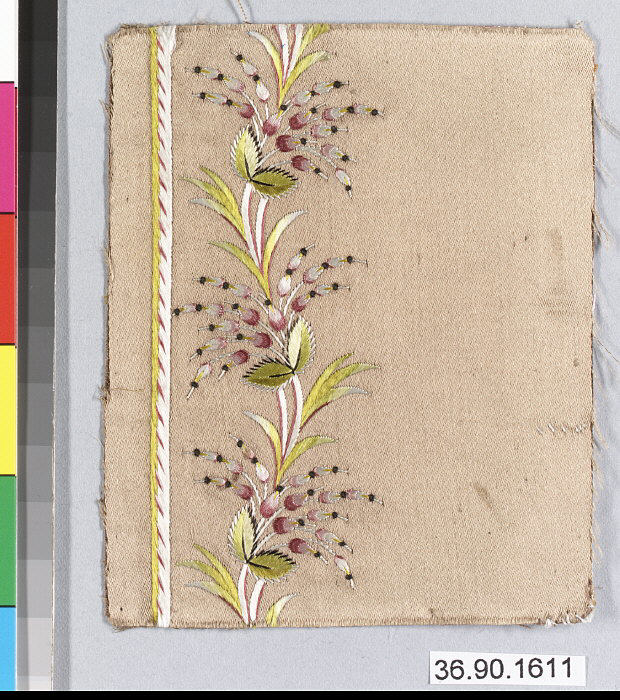
The masculine silhouette, long a bastion of rigid tailoring and inherited form, stands at a precipice. For SS26, Zoey Fashion Laboratory abandons the historical deference to the suit’s architecture. Instead, we propose a radical re-reading: the embroidery sample is not a decorative afterthought but the primary structural agent. This analysis dissects a single piece—a hand-embroidered silk panel destined for a man’s waistcoat—as a microcosm of futuristic garment engineering. The sample, sourced from the Global Frontier, represents a synthesis of ancient craft and computational design, where the needle becomes a tool for volumetric sculpting.
The Material Paradox: Silk on Silk as a Tension System
Conventional tailoring relies on interlinings, canvas, and padding to create form. Our approach inverts this hierarchy. The chosen material—silk embroidery on a silk ground—introduces a paradox of fragility and tensile strength. The base is a 22-momme charmeuse, chosen for its liquid drape and iridescent depth. The embroidery thread, a 2-ply twisted silk, is applied not in flat patterns but in a grid of high-tension, three-dimensional loops. This creates a biomimetic exoskeleton: the embroidered zones act as rigid panels, while the unembroidered silk remains fluid. The result is a garment that breathes, folds, and locks into position, echoing the mechanics of insect carapaces or architectural tensegrity structures.
Each stitch is a decision point. The density gradient—ranging from 1,200 stitches per square inch in the lapel area to 400 in the side panels—generates a variable stiffness map. This allows the waistcoat to collapse into a flat plane when stored, yet spring into a defined, angular silhouette when worn. The structural innovation lies in the stitch’s ability to function as a living hinge, a concept borrowed from aerospace composites but translated through the language of embroidery.
Futuristic Silhouettes: The Waistcoat as Wearable Topography
The SS26 silhouette rejects the traditional V-shape or hourglass. Instead, we propose a geometric asymmetry that references digital glitch aesthetics and organic growth patterns. The sample features a single, sweeping shoulder that extends into a sculptural collar, unspooling into a cascade of embroidered tendrils. This is not a lapel; it is a narrative of emergence. The left side of the waistcoat remains close to the body, while the right side flares outward, creating a dynamic imbalance that challenges static perception.
The embroidery itself forms a topographic map of the Global Frontier—a fictional territory where data streams and ancient trade routes converge. The stitches mimic satellite imagery of mountain ranges, river deltas, and fault lines, rendered in monochromatic ivory and gunmetal grey. The waistcoat’s hem is raw, unbound, allowing the silk to fray into a fringe that mimics digital noise. This is not a garment for passive observation; it is a tool for spatial negotiation, where the wearer’s movement activates the embroidery’s optical shifts.
Structural Innovation: The Embroidery as Composite Laminate
To achieve the requisite rigidity without sacrificing the silk’s inherent luxury, we developed a multi-layer embroidery technique. The base silk is backed with a dissolvable stabilizer. The embroidery is executed in three passes: a foundation layer of dense satin stitch, a middle layer of raised chain stitch forming a honeycomb lattice, and a final layer of free-motion couching that introduces metallic threads. The stabilizer is then removed, leaving the embroidered panel as a self-supporting composite. This method allows the waistcoat to hold its shape without traditional boning or padding—a pure expression of material intelligence.
The sample also integrates thermochromic silk threads within the embroidery pattern. When exposed to body heat, the stitches shift from cool grey to warm amber, revealing hidden motifs of celestial navigation. This is not a gimmick; it is a functional interface. The waistcoat becomes a responsive second skin, its surface altering with the wearer’s physiological state. The suit is no longer a static uniform but a dynamic system, a living archive of the wearer’s thermal history.
Contextualizing the Avant-Garde: From Global Frontier to Runway
This embroidery sample exists at the intersection of couture and computational design. The patterns were generated using a generative adversarial network (GAN) trained on 18th-century French brocades and satellite imagery of the Silk Road. The resulting algorithm produces infinite variations, each unique to the wearer’s body scan. The Global Frontier is not a physical place; it is a conceptual space where heritage and hypermodernity collide. The embroidery is the cartography of that collision.
For the runway, this waistcoat will be paired with a deconstructed trouser that dissolves into a train of raw silk filaments. The jacket is absent. The waistcoat stands alone, a singular statement of structural autonomy. The silhouette challenges the viewer to reconsider the suit’s role: is it armor? Is it sculpture? Or is it a wearable algorithm, a codex of stitches that decodes the wearer’s identity?
Conclusion: The Stitch as Signature
In the lexicon of Zoey Fashion Laboratory, embroidery is not decoration. It is the primary architectural language. This SS26 sample proves that silk, when subjected to rigorous tension and algorithmic design, can achieve the structural integrity of carbon fiber. The man’s waistcoat is reborn as a futuristic exoskeleton, a garment that does not merely clothe but redefines the human form in space. The Global Frontier is stitched into every thread. The future of menswear is not woven—it is embroidered, one tensile stitch at a time.