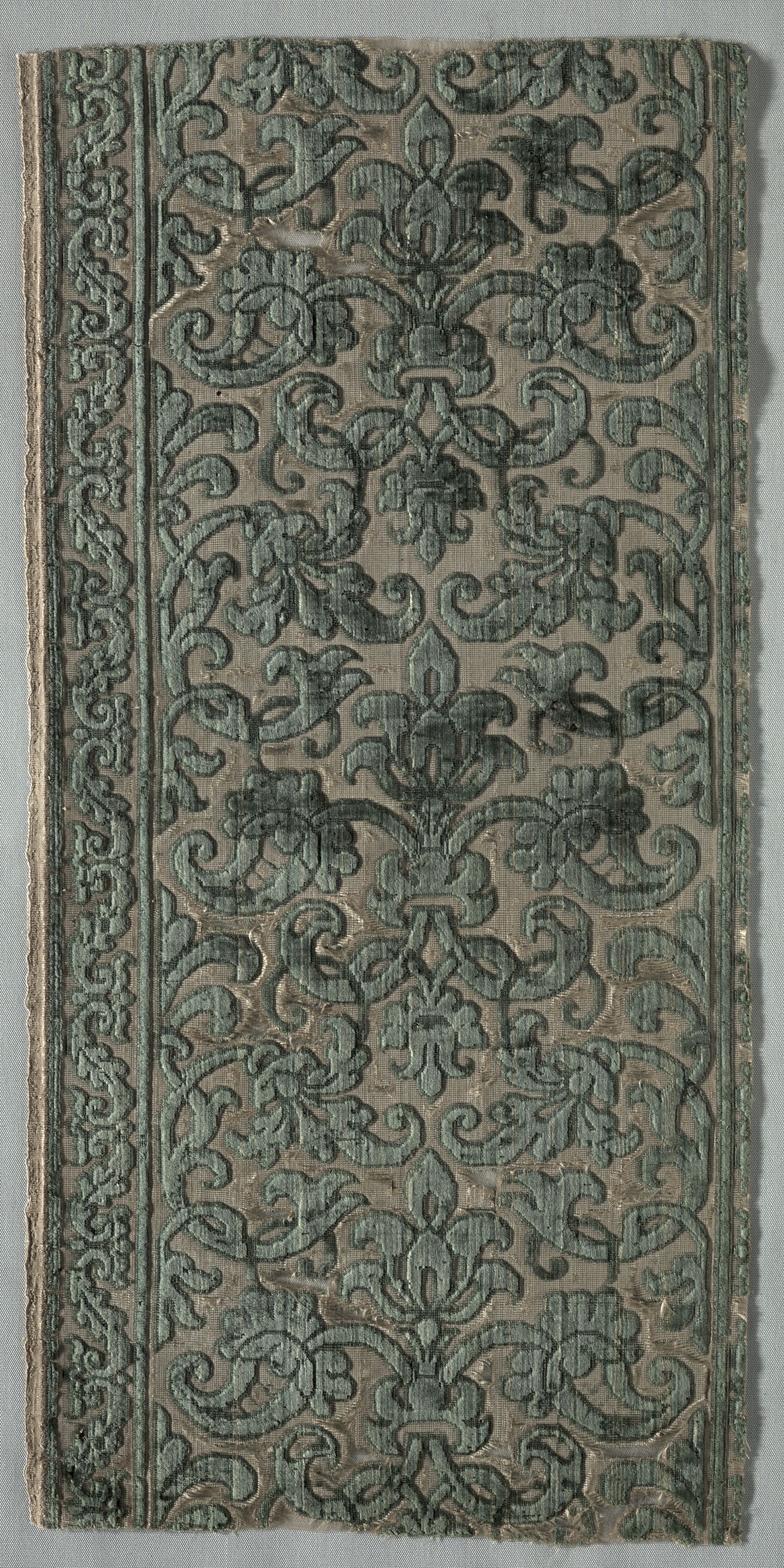
Technical Deconstruction: The Velvet Fragment
The provided fragment is a masterclass in late Renaissance Italian textile supremacy. Its foundation is a high-count, pure silk ground, indicating cultivation from premium Bombyx mori silkworms. The true innovation lies in its pile construction: a combination of cut and uncut velvet. This technique, known as ciselé, creates a play of texture and light that is both tactile and visual. The uncut loops provide a resilient, matte background, while the cut piles rise to form plush, light-absorbing areas. Under magnification, we observe a dense, complex weave structure—likely a warp-pile creation on a drawloom—requiring immense skill to execute. The sheen of the silk is deep and luminous, a testament to both the quality of the raw material and the precision of the dyeing process, which would have used precious, colorfast substances like kermes for reds or woad for blues.
Historical and Cultural DNA
Originating in late 16th-century Italy, this fragment is not merely fabric; it is a socio-economic cipher. During this period, cities like Venice, Genoa, and Florence were epicenters of luxury textile production, controlling trade routes and guarding their technical secrets fiercely. Velvet of this caliber was a direct symbol of power, wealth, and divine favor. It adorned the robes of cardinals, the gowns of duchesses, and the furnishings of palazzi. Its weight and texture were designed to communicate authority through presence—the way it moved, absorbed light in candlelit halls, and conveyed opulence through touch. The specific pattern, now fragmentary, would have been part of a larger, often symmetrical, design featuring pomegranates, acanthus leaves, or intricate geometric motifs, all laden with symbolic meaning.
Avant-Garde Interpretation: The New DNA Strand
The directive to reference a "New DNA Strand" is the critical catalyst for our deconstruction. We are not engaging in historical replication. Instead, we are extracting the core genetic code of the fragment—its material duality, its symbolic weight, its tactile authority—and subjecting it to a process of radical recombination. The "avant-garde" mandate requires us to mutate these historical nucleotides to express a contemporary phenotype.
Conceptual Translation: From Ornament to Architecture
The first mutation occurs in scale and application. The 16th-century fragment was ornamental, a surface application. Our new DNA strand repositions velvet as a structural and architectural element. Imagine not a dress of velvet, but a garment engineered *from* velvet's principles. The cut/uncut technique transforms from floral patterning into topographical mapping—ridges and valleys that correspond to body topography or emotional data. The plush pile becomes insulated, protective zones; the flat, uncut areas become flexible joints.
Furthermore, the historical symbolism of power is deconstructed. Instead of signaling ecclesiastical or aristocratic hierarchy, the new velvet's authority derives from personal narrative and technological hybridity. It is power redefined as resilience, adaptability, and coded biography.
Material and Technical Recombinant Strategy
Our laboratory development will focus on the following strands of innovation:
1. Bio-Integrated Silk: Partnering with synthetic biology labs, we will develop silk proteins infused with organic chromophores or responsive elements. Imagine velvet where the pile changes texture (cut to uncut) in response to body temperature or external stimuli, a literal dialogue between wearer and environment. The "dye" becomes part of the fiber's DNA, eliminating pollution and creating living color.
2. Dimensional Weaving & Substrate Fusion: Utilizing advanced 3D weaving and ultrasonic bonding, we will create velvet that is not a layered textile but a monolithic fabric system. Conductive threads woven into the warp could allow the velvet to interface with digital devices, with the pile acting as a tactile input surface. The fragment's duality evolves into a triadic system: aesthetic, haptic, and interactive.
3. Deconstructed Heritage Silhouettes: The voluminous, imposing shapes of the 16th century—the gown, the cape, the robe—will be abstracted. We propose garments with asymmetric, geometric drape, where the velvet's weight creates intentional, sculptural folds, but is strategically laser-cut or bonded to lighter technical meshes for modern movement. A coat may have one sleeve of dense, protective cut velvet and another of sheer, uncut velvet mesh.
The Zoey Fashion Lab Prototype: "Chroma-Soma"
The proposed first prototype, "Chroma-Soma," embodies this analysis. It is a unisex, architectural wrap-top and tailored pant system.
The Fabric: A bio-silk velvet, woven with a gradient of cut (at the shoulders, center chest) to uncut (at the underarms, back panel). The silk is gene-edited to produce a deep, indigo-like hue that shifts marginally towards violet under specific light wavelengths.
The Construction: Seams are externally bonded, turning them into raised, uncut velvet ridges that trace a new map across the body—inspired by the fragment's lost pattern but representing neural pathways or urban grids. The pants feature inset panels of a fused velvet-tech mesh hybrid at the knees for mobility.
The Interaction: A small, integrated circuit in the hem, powered by kinetic energy from movement, can send a gentle pulse through the conductive threads, causing micro-vibrations in the pile—a private, tactile experience echoing the fragment's original luxury: a sensation known only to the wearer.
Conclusion: The Recombinant Legacy
This 16th-century Italian velvet fragment provides the perfect primordial code. Its inherent values—luxury through innovation, power through texture, communication through material—are timeless. Our avant-garde "New DNA Strand" does not discard history; it sequences it. By splicing the fragment's material genius with biotechnology, smart systems, and deconstructed form, we create a new organism for the contemporary world. The result is a fashion that carries the profound weight and beauty of history, not as a relic, but as a living, adaptable, and deeply personal second skin. The legacy of the Italian weavers continues, not in replication, but in evolution.