Deconstructing the Hunting Sword: A Zoey Fashion Lab Analysis
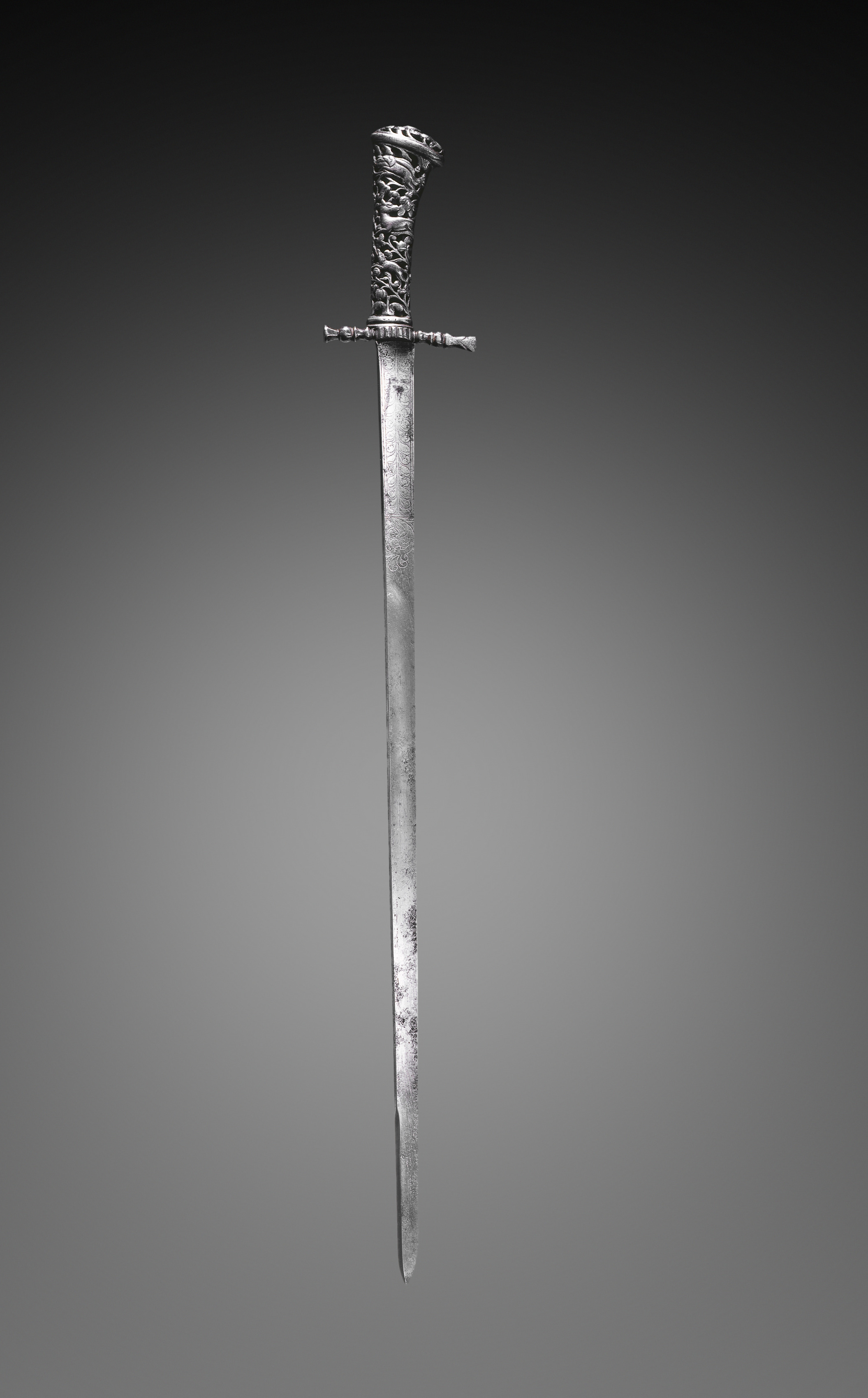
At Zoey Fashion Lab, we approach historical artifacts not as static relics, but as dynamic blueprints for future design. The subject of this analysis—a Dutch Hunting Sword from the 17th or 18th century—presents a rich paradox. Its technical specifications, specifically the pierced and chiseled cast-iron hilt and the engraved steel blade, offer a vocabulary of material tension and structural precision that is profoundly relevant to the Avant-garde aesthetic. Our methodology, the New DNA Strand, does not seek to replicate the sword’s form, but to extract its core genetic code: the dialectic between brutal function and ornamental fragility. This report deconstructs the sword’s components to propose a new language for fabric, silhouette, and construction.
Material Dialectic: The Cast-Iron Hilt and the Engraved Blade
The most striking technical feature is the pierced and chiseled cast-iron hilt. Cast iron is a material of industrial weight and rigidity, yet the artisan has subjected it to a process of delicate removal—piercing and chiseling—to create negative space. This is a direct contradiction: a dense, unyielding substance rendered as lacework. For Zoey Fashion Lab, this translates into a design principle of structural void. Imagine a garment where the primary structure is not a continuous fabric, but a network of rigid, interlocking panels (perhaps of resin-treated leather or laser-cut metalized textile) that are themselves perforated. The "hilt" of the garment—the collar, the shoulder yoke, the waist corset—becomes a cage of negative space, allowing the underlying, softer layers to breathe through it.
Conversely, the engraved steel blade represents a different kind of contradiction. Here, a surface designed for cutting and thrusting is adorned with narrative imagery. The engraving is a superficial mark, a scar that does not compromise the blade's lethal integrity. In our Avant-garde translation, this becomes a principle of surface as document. The "blade" of a garment—perhaps a long, sweeping train or a dramatic sleeve—would be constructed from a high-tensile material like a bonded neoprene or a metallic mesh. Its surface would be treated not with color, but with chemical or laser etching, creating a pattern that mimics the organic, flowing lines of Dutch decorative engraving. This pattern is not printed; it is physically removed from the material, creating a texture that is both decorative and structurally weakening—a deliberate risk that mirrors the sword's own duality of beauty and danger.
The New DNA Strand: Extracting the Genetic Code of the Avant-Garde
The New DNA Strand methodology posits that every artifact contains a set of "genes"—core principles that can be recombined to generate novel forms. For this Hunting Sword, we identify three primary genes:
Gene 1: The Negative Silhouette. The pierced hilt teaches us that form can be defined by absence. In garment construction, this manifests as a silhouette that is not a closed shape, but a series of apertures, cutouts, and transparent bridges. Think of a coat where the shoulders are connected by a single, chiseled metal or carbon-fiber strut, while the rest of the arm is exposed. The "hilt" of the garment becomes a harness of absence.
Gene 2: The Functional Ornament. The engraved blade insists that decoration is not an afterthought but an integral part of the object's function. The engraving is a record of the blade's history, its use, and its owner's status. In our Avant-garde design, ornamentation must be structural. A pattern of laser-cut perforations along a seam line would not only be decorative but also allow for ventilation, reduce weight, and create a controlled point of tearing—a conscious vulnerability. The ornament is the function.
Gene 3: The Rigid-Fluid Interface. The sword is a union of two opposing states: the rigid, cast-iron hilt and the flexible, albeit hard, steel blade. The Avant-garde garment must explore this interface. Where does the rigid structure (the hilt) end, and the fluid form (the blade) begin? Our designs would feature articulated joints—perhaps using a system of hinges, cables, or interlocking scales—that allow a stiff, corseted torso to transition into a flowing, blade-like skirt. The point of connection becomes the most expressive element of the piece.
Avant-Garde Garment Propositions
Based on this deconstruction, we propose three distinct garment concepts for the Zoey Fashion Lab collection:
1. The "Hilt" Bodice. A structural top constructed from laser-sintered nylon or cast aluminum, mimicking the pierced and chiseled ironwork. The bodice would be a cage of negative space, with the wearer's skin and a sheer, flesh-toned underlayer visible through the apertures. The "chiseling" would be expressed as sharp, angular cutouts that follow the body's anatomy, creating a second skeleton. This piece is pure structure, a wearable sculpture that rejects softness.
2. The "Engraved Blade" Skirt. A floor-length skirt made from a high-density, matte-finish technical satin or a bonded metallic jersey. The surface would be treated with a chemical etching process that selectively removes the top layer of fabric, revealing a contrasting color or texture underneath. The pattern would be a direct translation of the sword's engraved floral or hunting motifs, but rendered in an abstract, deconstructed manner. The skirt would have a sharp, asymmetrical hemline, mimicking the blade's edge. The train would be a single, long panel that trails behind the wearer, its surface a document of the etching process.
3. The "Rigid-Fluid Interface" Gown. A full-length gown that explicitly explores the tension between structure and flow. The upper portion—a high-necked, long-sleeved bodice—would be constructed from panels of rigid, resin-infused leather, connected by visible metal hinges. The lower portion would explode into a cascade of laser-cut, flexible metallic mesh, each scale a tiny, engraved blade. The transition point—the waist—would be marked by a dramatic, chiseled belt that appears to be a single piece of cast iron, but is actually a lightweight, articulated composite. The gown is a narrative of transformation: from cage to cascade, from hilt to blade.
Conclusion: The Sword as Design Manifesto
The Dutch Hunting Sword, when viewed through the lens of the New DNA Strand, is not a weapon of the past, but a manifesto for the future of Avant-garde fashion. Its core genetic code—the dialectic between rigid structure and fluid surface, between functional ornament and structural void—offers a powerful vocabulary for designers seeking to break free from conventional garment construction. At Zoey Fashion Lab, we do not replicate history; we extract its essence and recombine it into forms that challenge the very definition of clothing. This sword is not a tool for hunting, but a tool for thought. Its legacy is not in the cut of a blade, but in the cut of a silhouette.