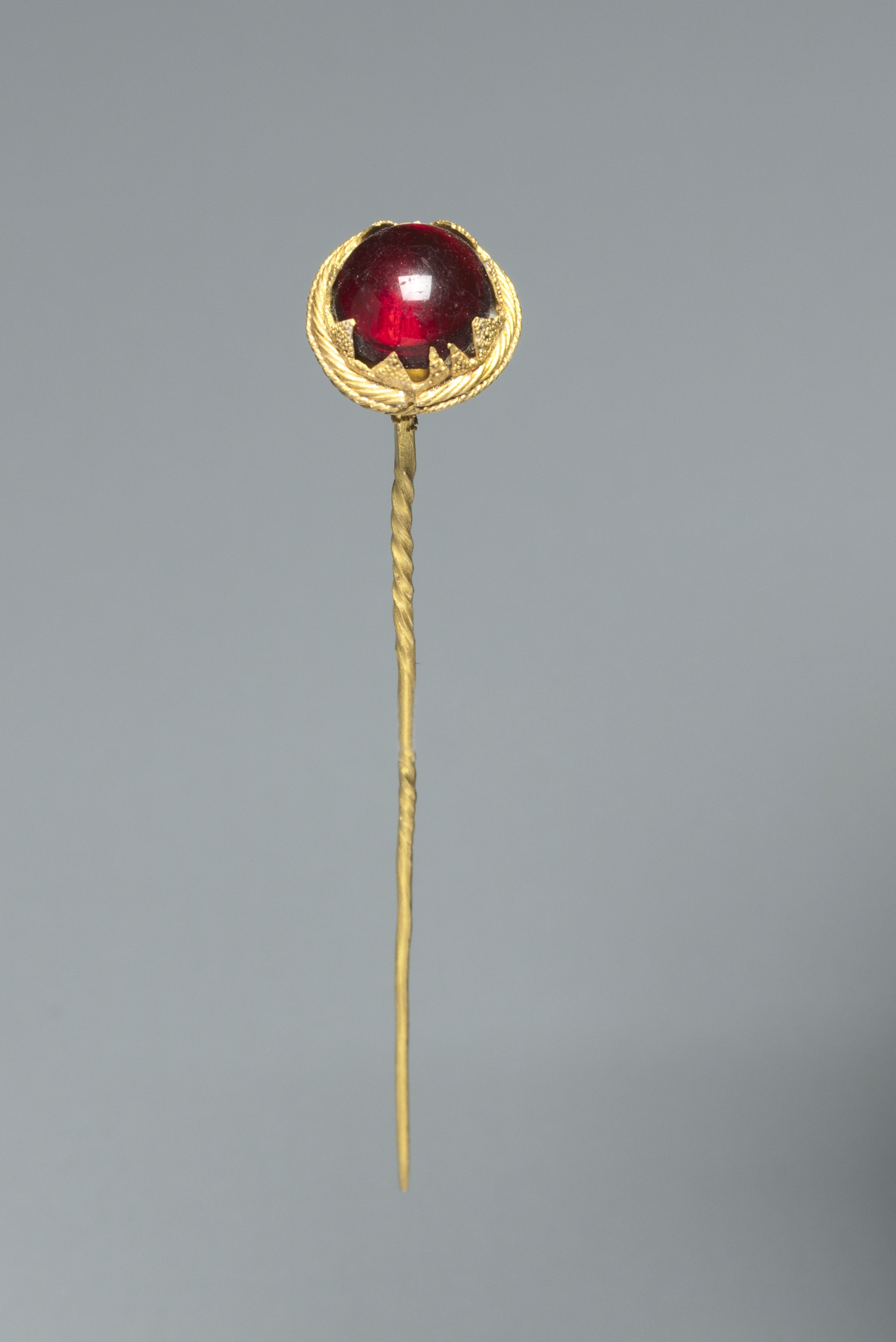
Deconstructing the Straight Pin: An Etruscan Artifact in Avant-Garde Context
At Zoey Fashion Lab, the act of deconstruction is not merely a technical process—it is a philosophical excavation. Today, we examine a singular artifact: a straight pin of Etruscan origin, crafted from gold and glass. This object, seemingly mundane in its functional purpose, becomes a vessel for profound narrative when viewed through the lens of Archive Resonance. The reference provided—Mirror with Split-Leaf—offers a dualistic tension: one side a polished silver mirror inlaid with intricate gold palm-leaf motifs, the other a cold stone sarcophagus lid where a life story is told in relief. This straight pin, therefore, is not a fastener but a threshold between vanity and mortality, between surface and depth. Our analysis will unravel its material, historical, and symbolic layers, positioning it as a catalyst for avant-garde fashion design.
Materiality: Gold and Glass as Contradictory Elements
The choice of gold and glass for a straight pin is inherently paradoxical. Gold, a metal of permanence, wealth, and divine association, suggests eternity. In Etruscan culture, gold was used extensively in funerary objects, such as wreaths and jewelry, to accompany the deceased into the afterlife. Glass, however, is fragile, transparent, and often associated with illusion or the ephemeral. When combined, these materials create a dialectic: the pin’s shaft—presumably gold—offers structural integrity, while its head, likely a glass bead or inlay, introduces vulnerability. This juxtaposition mirrors the Mirror with Split-Leaf reference: the gold palm leaves on the mirror’s surface represent the fleeting beauty of nature and vanity, while the glass element echoes the reflective, yet fragile, nature of self-perception. In an avant-garde context, this pin becomes a wearable commentary on the tension between permanence and decay. For Zoey Fashion Lab, deconstructing this pin means separating the gold from the glass, not physically but conceptually, to explore how luxury and fragility can coexist in a single garment. The gold could be reimagined as structural boning in a corset, while the glass might be crushed into a powder for textile printing, creating a shimmering, transient effect.
Historical Origin: The Etruscan Legacy of Adornment and Ritual
The Etruscans, a pre-Roman civilization in ancient Italy, were masters of metalwork and glass production. Their straight pins, known as fibulae or dress pins, were not merely utilitarian; they held symbolic weight in funerary and ceremonial contexts. A pin found in an Etruscan tomb might have secured a shroud or a priest’s garment, marking a transition between life and death. The Archive Resonance reference—the mirror and the sarcophagus—directly evokes this dual role. The mirror, with its gold palm leaves, represents the living world’s obsession with image and beauty. The sarcophagus, carved with narratives of the deceased, represents the eternal story. The straight pin, then, is the object that binds these two realms: it pierces the fabric of the living to anchor the dead. In avant-garde fashion, this historical resonance can be harnessed to create garments that speak to transience. For instance, a collection might feature dresses with detachable panels secured by such pins, where the act of removing a pin reveals a hidden narrative—a photograph, a text, or a textile layer—beneath. The pin becomes a tool for revelation, not concealment.
Technical Craft: Gold Filigree and Glass Inlay
From a technical standpoint, this Etruscan straight pin likely employs granulation or filigree techniques for the gold, where tiny beads or twisted wires are fused to create intricate patterns. The glass component may be a millefiori bead or a simple cabochon, reflecting the Etruscan mastery of glassmaking, which they inherited from Phoenician and Egyptian traditions. The pin’s shaft would be hammered and polished, while the head might be attached via a small gold collar. Deconstructing this technique for Zoey Fashion Lab involves analyzing how these methods can be translated into contemporary fabrication. For example, 3D-printed gold structures could mimic filigree, while laser-cut glass components could replace hand-formed beads. The pin’s dual-material construction also inspires hybrid fastenings: a gold clasp with a glass hinge, or a glass button with a gold shank. In an avant-garde silhouette, this pin could be scaled up to function as a structural element—a gold and glass brooch that holds together a deconstructed jacket, where the glass is backlit with LED fibers to create a glowing, ethereal effect.
Symbolic Resonance: The Mirror and the Sarcophagus
The Mirror with Split-Leaf reference is central to understanding this pin’s symbolic power. The mirror’s silver surface, inlaid with gold palm leaves, suggests a moment of arrested time—a reflection of beauty that is both real and illusory. The sarcophagus, in contrast, is a permanent record of a life lived. The straight pin, as a bridge between these two states, embodies the concept of temporal duality. In fashion, this translates to garments that oscillate between the ephemeral and the eternal. A dress might have a mirrored bodice (the vanity) that, when unpinned with a gold and glass pin, reveals a sculpted underlayer resembling a sarcophagus relief (the mortality). The act of pinning or unpinning becomes a ritual performance, echoing Etruscan funerary practices. Zoey Fashion Lab could develop a capsule collection where each garment includes a hidden pocket or panel secured by such pins, inviting the wearer to engage in a personal narrative of revelation and concealment.
Avant-Garde Application: From Artifact to Wearable Statement
To translate this straight pin into avant-garde fashion, we must first deconstruct its form and function. The pin’s linearity suggests a dart or seam, while its head offers a point of ornamentation. In a deconstructed garment, the pin could replace traditional stitching, holding together panels of raw silk or organza. The gold and glass combination could be echoed in other accessories: a belt buckle, a shoe clip, or a headpiece. The Etruscan origin also invites a color palette of oxidized gold, deep amber, and translucent glass tones, evoking the patina of ancient artifacts. For a runway presentation, models could wear garments that appear to be held together solely by these pins, with fabric edges left raw and unfinished. The pins would be placed not for utility but for visual tension, creating a sense of precariousness. This aligns with the Archive Resonance of the mirror and sarcophagus: the garment is both a reflection of the wearer’s identity and a narrative of their ephemeral existence.
Conclusion: The Pin as a Portal
In conclusion, the Etruscan straight pin of gold and glass is far more than a tool. It is a portal between the polished mirror of vanity and the carved stone of legacy. For Zoey Fashion Lab, deconstructing this object reveals a blueprint for avant-garde design: one that honors historical craftsmanship while challenging contemporary notions of materiality, temporality, and wearability. By reimagining this pin as a structural, symbolic, and narrative element, we can create fashion that does not merely clothe the body but tells the story of its own existence—a story of beauty, fragility, and the inevitable passage of time. The straight pin, in its Etruscan simplicity, becomes a radical statement: that the smallest object can hold the weight of an entire civilization, and that in deconstruction, we find the seeds of infinite creation.