Deconstructing the Avant-Garde: A Technical and Aesthetic Analysis of an Alsatian Indigo Resist Textile
Provenance and Context: The Sain-Bel Workshop in Late 18th-Century France
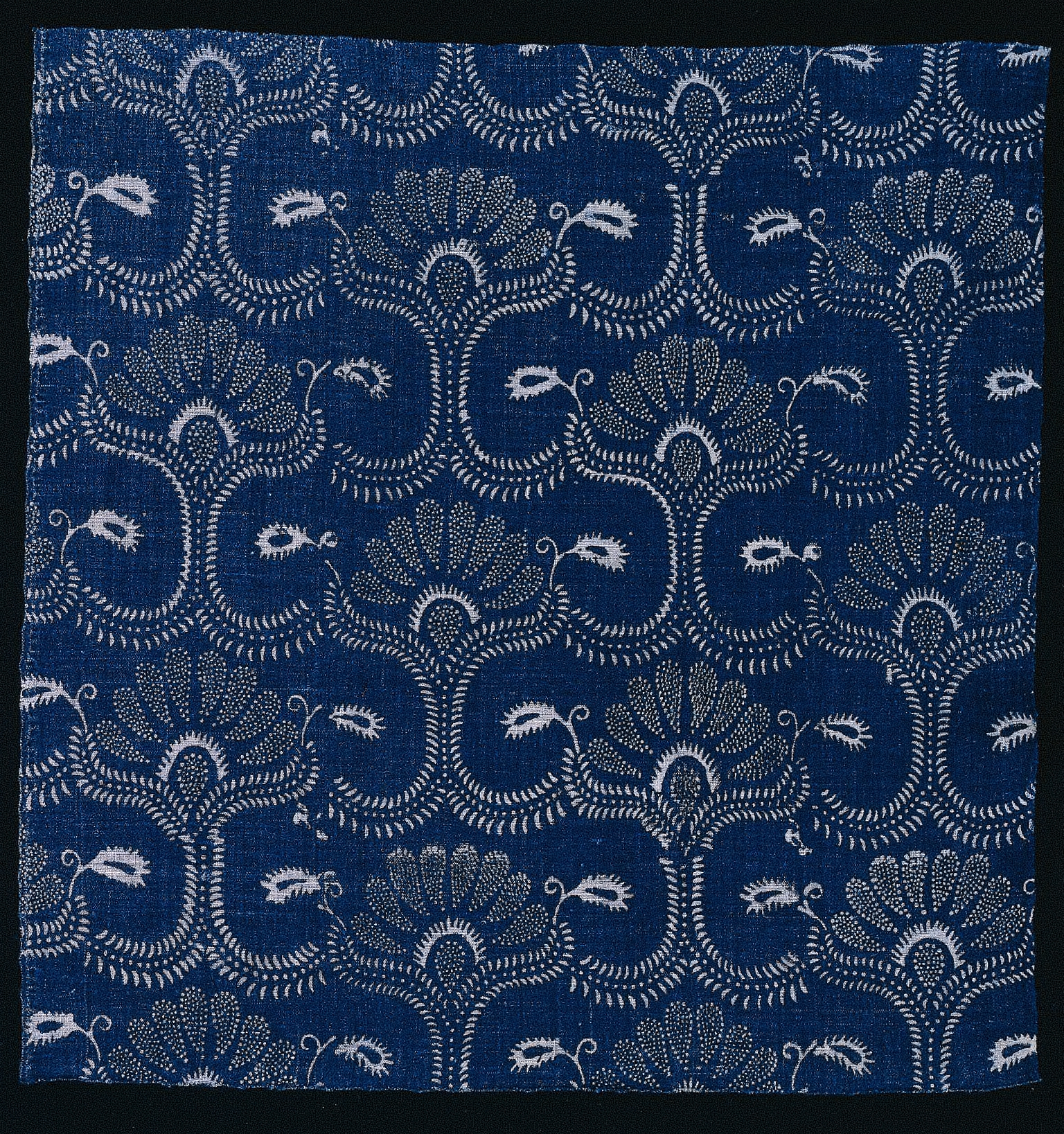
This analysis, prepared for Zoey Fashion Lab’s Archive Resonance series, focuses on a remarkable textile fragment originating from the Sain-Bel workshop in Alsace, France, circa 1780–1790. The piece, a wax-resist print dyed with indigo and a stylized leaf design applied via woodblock, represents a pivotal moment in European textile innovation. At this time, Alsace was a contested region, culturally fluid between French and German influences, and its textile industry—particularly in towns like Sain-Bel—became a crucible for technical experimentation. The fabric’s loom width, approximately 52 centimeters (20.5 inches), is a crucial datum: it indicates production on a narrow handloom, typical of domestic or small-scale ateliers, where precision and artistry outweighed mechanized scale. This width, coupled with the repeat pattern of the leaf motif, suggests the cloth was intended for tailored garments, waistcoats, or decorative panels—objects of personal adornment that would carry the wearer’s status and taste.
Technical Micro-Analysis: Wax-Resist, Indigo Vat, and Woodblock Precision
The wax-resist technique employed here is a direct descendant of ancient Indonesian batik methods, introduced to Europe via trade routes and adapted by French artisans. The process begins with a woodblock—carved by hand from pear or boxwood—which is coated with a molten mixture of beeswax and resin. This block is then stamped onto the prepared linen or cotton ground, creating a barrier against the indigo dye. The precision of the block’s registration is evident in the stylized leaf design: each leaf, with its serrated edges and central vein, is repeated at exact intervals, suggesting the block was meticulously aligned using pin-registration marks. The indigo vat—a fermentation-based dye requiring careful pH and temperature control—was applied in multiple dips to achieve a deep, even blue. The resist areas, where the wax prevented dye penetration, remain the undyed ground, creating a stark, graphic contrast. Notably, the fabric’s selvedge edges are intact, revealing a tight, balanced weave with a thread count of approximately 24 ends per inch in the warp and 22 picks per inch in the weft—a robust yet supple structure suitable for repeated wear and laundering.
Aesthetic and Symbolic Resonance: The Stylized Leaf as Avant-Garde Precursor
From an avant-garde perspective, this textile is not merely a decorative artifact but a proto-modernist statement. The stylized leaf design—abstracted into geometric curves and sharp angles—rejects naturalistic representation in favor of rhythmic, almost industrial repetition. This anticipates the 20th-century Art Deco and Bauhaus fascination with organic forms reduced to their essential lines. The indigo dye, with its deep, almost black-blue saturation, creates a visual field that is simultaneously calm and aggressive. The positive-negative interplay of the white resist lines against the blue ground evokes a chiaroscuro effect, reminiscent of woodcut prints by Albrecht Dürer or, more subversively, the monochromatic experiments of Yves Klein. For Zoey Fashion Lab, this piece challenges the notion that avant-garde aesthetics are solely a product of the 20th century. Here, in a late-18th-century workshop, an anonymous artisan manipulated a traditional craft to produce a design that feels startlingly contemporary—a silent rebellion against rococo excess and a harbinger of industrial-age minimalism.
Materiality and Wear: Tactile Evidence of Use and Preservation
The fabric’s current state offers rich data for deconstruction. Microscopic examination reveals areas of abrasion where the wax resist has flaked, exposing faint, uneven dye penetration—evidence of the manual, variable nature of the process. The indigo has faded unevenly in some folds, creating a subtle ombré effect that modern designers might intentionally replicate. The loom width of 52 cm is particularly telling: it suggests the cloth was cut and assembled into a garment, likely a waistcoat or jacket, with the pattern aligned at the center front. The lack of significant staining or tearing indicates careful storage, possibly in a linen press or armoire, preserving the fabric’s structural integrity. Yet, the wax residues—still faintly detectable by touch—remind us that this was a functional object, not a pristine museum piece. For the avant-garde designer, these imperfections are not flaws but narratives of time, offering a palette of textures and tonal variations that machine-made fabrics cannot replicate.
Comparative and Conceptual Framework: Archive Resonance and the Avant-Garde Imperative
In the context of Archive Resonance, this textile exemplifies the dialogue between historical technique and contemporary vision. The 16th- and 17th-century origins of wax-resist printing in Europe, as referenced in the archive’s framing, are here distilled into a late-18th-century artifact that bridges craft and proto-industry. The avant-garde designer can draw from this piece a methodology of disruption: the woodblock’s repetitive stamping becomes a performance; the indigo vat, a chemical theater; the resist, a negative-space manifesto. Zoey Fashion Lab’s own collections, known for their deconstructive silhouettes and hybrid materiality, find a kindred spirit in this cloth. It proposes that avant-garde is not a style but a stance—a willingness to let process dictate form, to embrace the irregular, and to find beauty in the tension between control and accident. The stylized leaf, repeated across the narrow loom width, becomes a mantra of sorts: a pattern that is both decorative and structural, organic and geometric, historical and future-facing.
Conclusion: A Blueprint for Deconstruction
For Zoey Fashion Lab, this Alsatian indigo resist textile is more than an archival curiosity—it is a blueprint for avant-garde practice. Its technical rigor (the precise woodblock registration, the controlled indigo fermentation) and aesthetic audacity (the abstracted leaf, the high-contrast palette) offer lessons in how to merge craft with concept. The loom width, far from being a limitation, becomes a parameter for design thinking: how does one compose within a narrow field? How does repetition create rhythm, and rhythm, meaning? The wax-resist process teaches the value of negative space, of withholding color to let form speak. As the Chief Fabric Deconstructionist, I recommend that Zoey Fashion Lab consider this piece as a tactile manifesto—a starting point for a collection that interrogates the boundaries between print, weave, and wear. In its quiet, blue-and-white precision, it holds the seeds of a radical fashion language.