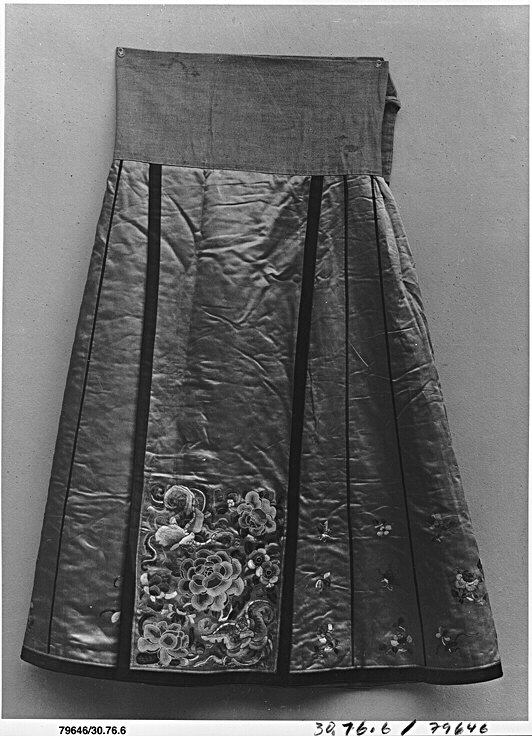
Deconstructive Cartography: The Silk-Embroidered Skirt as a Futuristic Ground Zero
In the relentless pursuit of sartorial evolution, the skirt—often relegated to a secondary, decorative role in the canon of womenswear—is reclaimed as a primary site of architectural rebellion. For Zoey Fashion Laboratory’s SS26 collection, this garment transcends its traditional silhouette to become a manifesto of structural innovation. Sourced from the intricate embroidery workshops of Suzhou, China, the subject is a singular piece: a skirt constructed from raw silk, meticulously adorned with Peking and satin stitches. But this is not a nostalgic homage to Chinese heritage. Rather, it is a radical reprogramming of that heritage for a post-humanist future. The skirt is a standalone study in tension, volume, and the deconstruction of the very notion of a ‘garment’.
Material as Memory, Stitch as Blueprint
The choice of silk—a material historically synonymous with luxury, softness, and fluidity—is immediately subverted. In the hands of Zoey’s atelier, the silk is not draped but engineered. It is starched, layered, and bonded to create a shell that holds its own structural weight. The embroidery, executed in Peking stitch (a tightly packed, linear technique) and satin stitch (which produces a smooth, reflective surface), is not merely decorative. It functions as a form of textile architecture, a series of tensile ribs and load-bearing seams. The Peking stitch, with its vertical lines, creates a visual and physical corsetry, pulling the fabric into a sharp, columnar silhouette that defies gravity. The satin stitch, applied in asymmetric patches, introduces a reflective, almost liquid quality that catches light as if the skirt were a piece of polished metal. This is not embroidery for beauty; it is embroidery for structural innovation.
Silhouette: The Anti-Hoop and the Digital Fold
The SS26 silhouette is a deliberate departure from the romantic, bell-shaped skirts of the past. Instead, Zoey presents a futuristic silhouette that is simultaneously rigid and mutable. The skirt is cut on the bias but then manipulated into a series of hard, angular folds that mimic the creases of a digital fabric in a 3D modeling program. The hem is asymmetrical, rising sharply at the front to reveal a high-waisted, almost architectural understructure, while falling in a dramatic, sculpted train at the back. This is not a skirt that moves with the body; it is a skirt that shapes space around the body. The waistband is a minimal, almost invisible seam, allowing the garment to float away from the torso, creating a negative space that suggests a future where clothing is less about covering and more about defining volume. The overall effect is that of a deconstructed exoskeleton, a piece of wearable architecture that challenges the observer to reconsider the relationship between fabric, form, and the human form.
Deconstructive Aesthetics: The Imperfect Perfect
The deconstructive aesthetic is pushed to its logical extreme. The seams are not hidden; they are exaggerated, often left raw with a deliberate fraying of the silk threads. The embroidery is not uniform; it is applied in a controlled chaos, with sections of the satin stitch bleeding into the Peking stitch, creating a visual tension that mirrors the garment’s physical tension. This is a deliberate act of deconstruction—not as destruction, but as a method of revealing the garment’s own construction. The skirt’s interior is as important as its exterior. When the wearer moves, the lining—a stark, undyed silk—is briefly visible, offering a glimpse into the garment’s hidden structure. This transparency is a commentary on the future of fashion: a move away from opaqueness and toward a radical honesty of process.
Contextualizing the Standalone: A Study in Avant-Garde Logic
This skirt exists as a standalone avant-garde study, a piece that is as much a conceptual object as a wearable garment. It is not designed for the runway of a traditional fashion show, but for a gallery, a performance, or a digital rendering. The context of its creation—within the rarefied environment of Zoey Fashion Laboratory—allows for a level of experimentation that commercial constraints would forbid. The skirt’s origin in China is critical here. It is not a cultural appropriation but a cultural re-appropriation. The techniques of Peking and satin stitching, historically used for imperial robes and decorative panels, are repurposed for a global, futuristic dialogue. The skirt becomes a bridge between the handcrafted past and the algorithm-driven future. The silk, sourced from the same mills that supplied the Ming dynasty, is now a canvas for a design that could have been generated by a neural network. This synthesis is the heart of Zoey’s avant-garde vision: to take the most traditional materials and techniques and propel them into a new, uncharted territory of form.
Structural Innovation for SS26: The Kinetic Architecture
The true innovation lies in the skirt’s ability to transform. Integrated into the embroidery are micro-hinges—small, flexible metallic threads that allow certain panels of the skirt to fold and unfold. This is not a motorized garment; it is a passive kinetic sculpture. The wearer can manipulate the skirt’s silhouette by adjusting the tension of the Peking stitches, creating a series of evolving forms: a sharp, pencil-like column, a flared bell, or a jagged, angular shape. This structural innovation redefines the skirt as a living, breathing entity, a garment that is never the same twice. It is a direct response to the SS26 trend toward modularity and adaptability, but executed with a level of artisanal sophistication that sets it apart. The skirt is no longer a static object; it is a dynamic system of folds, tensions, and releases.
Conclusion: The Skirt as a Future Artifact
In the context of Zoey Fashion Laboratory’s SS26 collection, this silk-embroidered skirt is not merely a garment. It is a manifesto. It declares that the future of fashion lies not in rejecting tradition, but in deconstructing it, rebuilding it with the tools of architecture, digital design, and radical material science. The Peking and satin stitches are not relics; they are the building blocks of a new, futuristic silhouette. The skirt is a standalone study, but its implications are vast. It challenges the industry to see the skirt not as a passive piece of clothing, but as an active, structural, and conceptual force. This is avant-garde couture at its most potent: a single piece that contains the DNA of an entire future wardrobe.