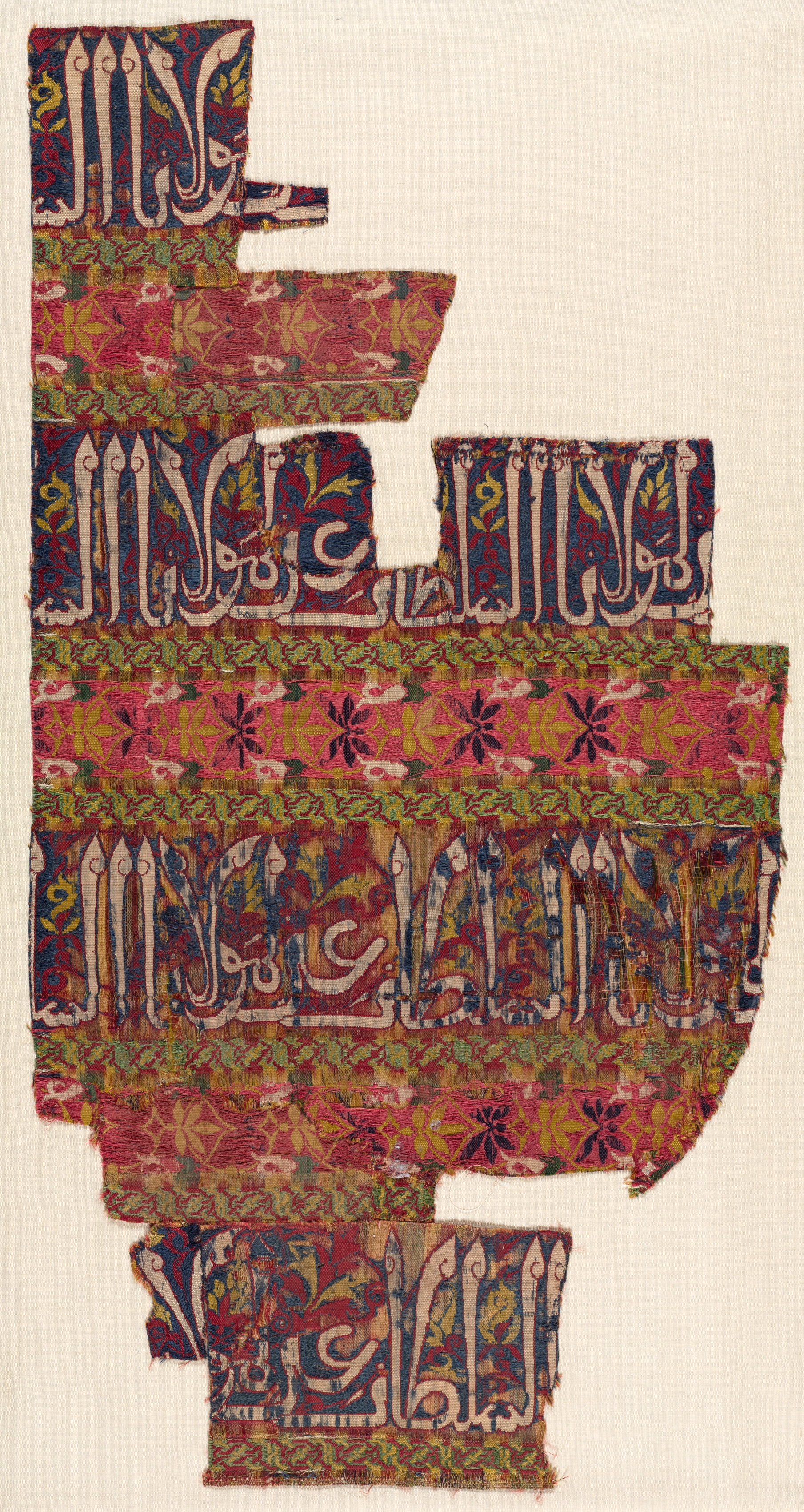
Technical Deconstruction: The Diasper Weave as a Cryptographic Text
The provided silk fragment is not merely a textile; it is a sophisticated data storage device from the 10th-12th century Andalusia. The diasper weave is the foundational code. Unlike simpler weaves, diasper—a derivative of the more complex lampas—utilizes a main warp and a secondary binding warp to create small, regularized geometric patterns. This structural duality is our first clue. The pattern, likely a diminutive stylized vegetal or Kufic-inspired motif, repeats with machinic precision. This repetition is not aesthetic monotony; it is algorithmic. Each intersection of warp and weft represents a binary decision point, a historical logic gate encoded in silk. The density of the weave, the twist of the yarn, the consistency of the pattern unit—all are parameters in an ancient program for creating light-reflective surfaces and durable, yet luxurious, cloth. Our task is to reverse-engineer this algorithm, not to replicate it, but to understand its core imperative: to impose sublime order on organic material.
Molecular Archaeology: The "New DNA Strand" Reference
The directive "Reference: New DNA Strand" is the pivotal key. It instructs us to look beyond the physical artifact to its biological and informational blueprint. Historically, the silk itself—the protein filament spun by the Bombyx mori silkworm—was a technological secret fiercely guarded by the Islamic world. Today, we can deconstruct this further. Imagine sequencing the degraded protein chains of this Spanish-Islamic silk. The resulting data, a "new DNA strand," is not genetic but structural and informational. It represents:
1. The Protein Sequence: A unique fingerprint of sericin and fibroin, potentially traceable to a specific sericulture tradition that bridged Chinese origins with Iberian ecology.
2. The Dye Molecular Signature: Spectral analysis revealing not just color (likely kermes red, saffron yellow, or indigo blue) but the complex mordanting chemistry that made Islamic textiles legendary for their chromatic permanence—a form of molecular-level color memory.
3. The Data Pathway: This biological data strand becomes our new warp thread. We treat it not as a historical footnote, but as the primary generative element. In the Avant-garde context, this "DNA" can be translated into digital code, governing parametric design software, informing 3D printing matrices, or generating non-woven textile structures through bio-assembly.
Conceptual Synthesis: From Al-Andalus to Avant-Garde
The fusion of Spain's Islamic period with an Avant-garde style mandate is not a contradiction; it is a revelation. The court workshops of Cordoba and Almeria were the original avant-garde labs of their day—fusion centers of Persian, Byzantine, Berber, and Visigothic knowledge, pushing the boundaries of dye chemistry, loom engineering, and aesthetic abstraction. Their work was inherently conceptual, using pattern to explore infinity, geometry to signify the divine, and luxury to project soft power.
Our contemporary avant-garde interpretation must channel this same spirit of radical synthesis and intellectual rigor. The goal is not to produce a "Moorish revival" print, but to create a new sartorial language born from the fragment's embedded principles.
Proposed Collection Direction: "The Al-Andalus Kernel"
This collection would manifest the deconstruction across three interconnected lines:
1. Structural Memory (Wearable Architecture): Garments based on the diasper's dual-warp system. Imagine double-layered pieces where an outer, sheer "binding warp" layer shifts to reveal fragments of a concealed, richly patterned "main warp" layer beneath—a direct translation of the weave's hidden structure into dynamic clothing. Seams and darts would follow the geometric logic of the original pattern, creating angular, architectural silhouettes that reference the tessellations of the Alhambra.
2. Molecular Chromatics (Bio-Feedback Fashion): Utilizing the "new DNA strand" data. Develop dyes through synthetic biology that replicate the exact molecular composition of the historical mordants and colorants. Further, create fabrics coated in reactive polymers whose color shifts (like the iridescence of ancient silks) in response to specific environmental data—pH levels, temperature, or digital signals—making the wearer's body a canvas for living, biochemical color fields.
3. Digital Diasper (The Woven Network): Here, the weave pattern becomes a network map. Using conductive smart threads woven in a diasper algorithm, garments become low-power sensory networks. Each pattern node (a tiny geometric motif) could be a touch-sensitive control, a micro-LED pixel, or a data-transfer point. The garment is no longer a passive object but an active interface, its beauty defined by its latent functionality, echoing how Islamic geometric patterns often mapped cosmic and philosophical order.
Conclusion: The Fragment as Future Code
The Spanish-Islamic silk fragment is a seed. Its diasper weave is the hard-coded program. Its origin story—a crossroads culture of art, science, and faith—is the operating system. The "New DNA Strand" is the command line prompt. For Zoey Fashion Lab, the avant-garde outcome is a collection that embodies techno-spiritual craftsmanship. It moves beyond pastiche to create pieces that are conceptually dense, biologically informed, and digitally integrated. We are not reviving a textile; we are compiling its code, debugging it for the 21st century, and running it on the new hardware of contemporary technology and consciousness. The final creations will stand as artifacts not of the past, but of a perpetual present where Cordoba's logic meets computational logic, weaving a future that remembers its threads.