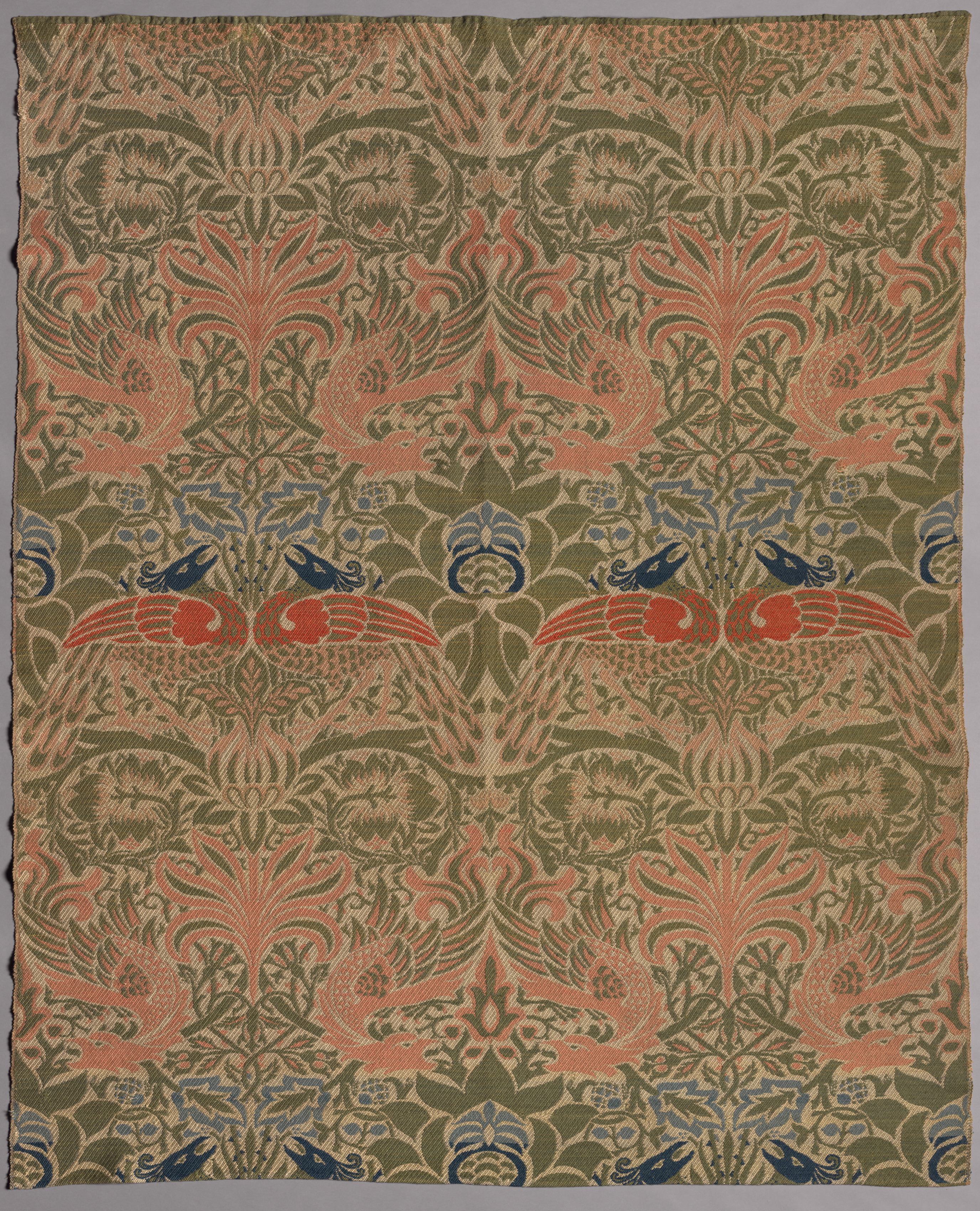
Deconstructing the Peacock and Dragon: An Avant-Garde Analysis of Merton Abbey’s Weft-Faced Compound Twill
At Zoey Fashion Lab, our mandate is to dismantle the historical and technical fabric of textiles to extract their latent avant-garde potential. The subject of this analysis—a fragment of Peacock and Dragon wool, originating from England, Surrey, Merton Abbey, and executed as a weft-faced compound twill—presents a profound paradox. It is at once a relic of the late 19th-century Arts and Crafts Movement and a prescient blueprint for deconstructive fashion. This report deconstructs its materiality, its cultural resonance as articulated in the Archive Resonance reference, and its radical implications for contemporary design.
Technical Taxonomy: The Weft-Faced Compound Twill as a Structural Allegory
The technical designation—weft-faced compound twill—is not merely a classification but a manifesto of construction. Unlike simpler weaves, this structure prioritizes the weft (horizontal threads) over the warp (vertical threads), creating a dense, almost painterly surface where the pattern is built from the interplay of multiple weft systems. In the Peacock and Dragon fragment, the woolen wefts are packed tightly, obscuring the warp entirely. The resulting fabric is heavy, pliable, and rich with a tactile depth that mimics the layering of brushstrokes.
From an avant-garde perspective, this structural choice is a deliberate subversion of textile hierarchy. The weft—traditionally the passive, filling element—becomes the dominant, expressive force. This mirrors the deconstructivist fashion ethos of challenging conventional garment logic: the hidden becomes visible, the secondary becomes primary. The compound nature of the twill, with its multiple weft systems, creates a layered narrative within the weave itself. Each weft color—indigo, verdigris, ochre, and crimson—contributes to the overall image of the peacock and dragon, but individually, they are fragments. This is a proto-digital, pixelated approach to textile design, where the whole is only perceived when the viewer steps back from the microscopic scrutiny of the threads.
The use of wool as the fiber further amplifies this tension. Wool, a protein fiber, is inherently soft, resilient, and capable of holding deep, saturated dyes. In the Merton Abbey context, it was a material of choice for William Morris and his weavers, who prized its natural origins and its ability to absorb the complex, plant-based dyes they favored. However, for the avant-garde designer, wool’s thermal and textural properties become tools of subversion. A heavy woolen compound twill, when used in a garment, contradicts expectations of lightness and fluidity. It becomes a sculptural medium, a rigid yet drapable armor that encases the body in a woven history.
Archive Resonance: The Peacock and Dragon as a Cultural Collision
The Archive Resonance reference—“在人类文明的长河中,器物与绘画不仅是时代技艺的结晶,更是文化碰撞与美学交融的无声见证。十六至十七世纪…”—positions this textile within a broader historical framework of cultural exchange. The peacock and dragon motifs are not indigenous to England. The peacock, a symbol of vanity and immortality in Byzantine and Indian art, and the dragon, a creature of power and chaos in Chinese and Japanese iconography, converge on a single loom in Surrey. This is not a mere decorative choice; it is a silent witness to the global trade routes, colonial encounters, and aesthetic appropriations that defined the 16th and 17th centuries.
William Morris, the founder of Merton Abbey, was a staunch socialist and medievalist who rejected industrial capitalism. Yet, his designs were deeply indebted to the very global flows he ostensibly opposed. The Peacock and Dragon pattern, with its sinuous, intertwined forms, borrows from Persian carpets, Indian palampores, and Chinese silks. This is the colonial unconscious of the Arts and Crafts Movement—a romanticized, handcrafted utopia built on the visual vocabulary of colonized cultures.
For the avant-garde fashion theorist, this contradiction is fertile ground. The garment constructed from this fabric becomes a site of cultural critique. It wears its influences on its sleeve—literally—but does so with a Victorian English accent. The deconstructivist designer can amplify this dissonance by cutting the fabric against the grain of its own pattern, disrupting the peacock’s tail and the dragon’s spine, or by combining it with synthetic, industrial materials that Morris would have abhorred. The result is a garment that performs its own history, acknowledging the violence and beauty of cultural exchange without resolving the tension.
Avant-Garde Application: Deconstructing the Pattern, Reconstructing the Body
To translate the Peacock and Dragon into an avant-garde collection, Zoey Fashion Lab proposes a radical intervention. The first step is to extract the warp from its weft-dominated context. In a weft-faced compound twill, the warp is a silent infrastructure. By isolating a few warp threads and leaving them exposed, we create a deconstructed grid that reveals the fabric’s hidden skeleton. This technique, known as décortiqué in couture, exposes the labor and structure that conventional fashion conceals.
Next, we apply asymmetric dyeing to the wool. Using natural indigo and madder, we can create gradients that mimic the fading of historical pigments, but we deliberately over-dye certain sections with synthetic aniline dyes—a deliberate anachronism that signals the industrial era Morris fought against. The peacock’s eye might bleed into the dragon’s scales, creating a morphing pattern that challenges the binary of nature versus myth.
The garment silhouette itself must be architectural and fragmented. A coat constructed from this fabric would feature exaggerated, asymmetric shoulders, one sleeve cut short to reveal the lining (a raw silk in a contrasting, clashing color), and the other sleeve elongated into a train. The hem would be left raw, allowing the weft threads to unravel and form a fringe—a deliberate unmaking of the fabric’s integrity. This is not decay but a statement: the garment is alive, in a state of perpetual deconstruction.
Material Memory and the Future of Textile Deconstruction
The Peacock and Dragon fragment is not a static artifact. It is a material memory that contains within its threads the labor of Merton Abbey weavers, the botanical knowledge of dyers, the global circulation of motifs, and the ideological contradictions of the Arts and Crafts Movement. To wear this fabric in an avant-garde context is to perform a historical autopsy, exposing the layers of meaning that have been woven into its surface.
Zoey Fashion Lab’s deconstructionist approach does not seek to destroy the textile but to amplify its inherent tensions. The weft-faced compound twill, with its dense, painterly quality, becomes a canvas for temporal collage. The peacock and dragon, once static symbols of luxury and power, become fluid signifiers that slide between cultures and eras. The garment is no longer a covering but a critical text, readable by those who understand the language of warp and weft.
In conclusion, the Peacock and Dragon offers a rich repository for avant-garde innovation. Its technical complexity, cultural hybridity, and historical resonance provide the raw material for a fashion that is simultaneously reverent and rebellious. By deconstructing its structure and reconstructing its narrative, we honor the legacy of Merton Abbey while pushing the boundaries of what textile can mean in the 21st century. The result is a garment that witnesses its own creation—and its own undoing.