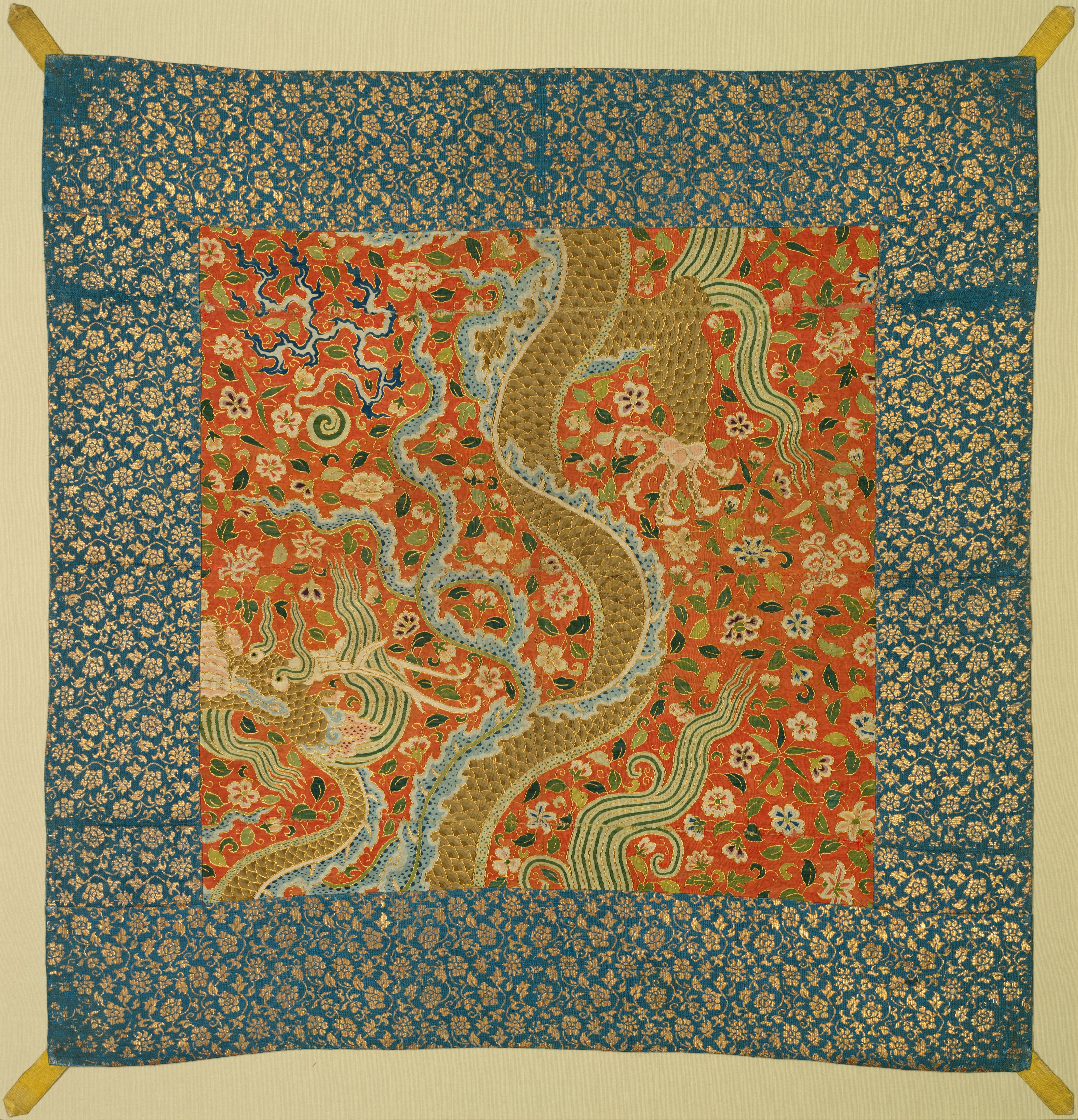
Deconstructing the Canopy: An Avant-Garde Analysis of a Southern Song and Ming Textile
As the Chief Fabric Deconstructionist for Zoey Fashion Lab, my role is to dissect historical textiles not merely as artifacts, but as radical, living documents that challenge contemporary fashion’s relationship with time, materiality, and narrative. The subject of this analysis—a canopy featuring a dragon among flowers, with a silk and gold tapestry weave (kesi) center from the Southern Song dynasty (1127-1270) and a silk and gold lampas weave border from the Ming dynasty (1368-1644)—is a profound example of temporal dissonance. It is not a unified object but a composite of two distinct imperial epochs, stitched together by history. This analysis will deconstruct its technical, symbolic, and archival resonance, proposing how its avant-garde potential can be reanimated for Zoey Fashion Lab’s collections.
Technical Dissonance: Kesi vs. Lampas
The first layer of deconstruction lies in the radical technical juxtaposition between the center and the border. The Southern Song center is executed in kesi, or “cut silk,” a tapestry weave where the weft threads are discontinuous. This technique creates sharp, independent color blocks, allowing for painterly, almost calligraphic detail. The dragon and flowers are not woven into a continuous grid but are built from individual, meticulously chosen silk and gold threads that are “slit” between color areas. This results in a fabric that is both structurally fragile and visually explosive—a paradox of strength and delicacy.
In stark contrast, the Ming border employs lampas weave, a compound structure where a pattern weft (often gold) floats over a ground weave. Unlike kesi’s discrete color zones, lampas creates a continuous, shimmering field. The gold threads are not cut but float across the fabric’s surface, producing a reflective, almost metallic surface that catches light uniformly. The technical dissonance here is the conflict between fragmentation and continuity. The kesi center is a series of isolated, precious moments, while the lampas border is an unbroken, imperial statement. For Zoey Fashion Lab, this duality can be translated into garment construction: a garment’s core could be composed of deconstructed, slit-like panels (referencing kesi), while its edges or structural seams are rendered in continuous, reflective materials (referencing lampas). This creates a visual and tactile tension—a conversation between the ephemeral and the eternal.
Symbolic Subversion: The Dragon in a Garden of Time
The iconography of the dragon among flowers is a classic symbol of imperial power and natural harmony. However, in this composite object, the symbolism becomes subversive. The Southern Song dragon, rendered in kesi, is likely more fluid, almost ethereal—a reflection of the dynasty’s refined, scholarly aesthetic. The flowers, perhaps peonies or lotuses, are delicate and stylized. When this center is framed by a Ming border, the dragon is no longer a solo act. It is imprisoned by a later, more assertive imperial gaze. The Ming dynasty’s aesthetic was bold, structured, and expansive. The lampas border’s repetitive, geometric patterns or secondary floral motifs act as a rigid frame, containing the earlier, more organic dragon.
This creates an avant-garde narrative of colonization and resistance. The Southern Song center represents a lost, fragile world, while the Ming border is the dominant, surviving power. The dragon, a symbol of authority, is now trapped within a later authority’s definition of beauty. For Zoey Fashion Lab, this can inspire a collection that explores temporal layering and power dynamics. Imagine a dress where a central, fluid print of a dragon (digitally rendered from the kesi) is “framed” by rigid, metallic embroidery or laser-cut appliqués that mimic the lampas border. The garment becomes a wearable critique of how history is framed, edited, and controlled. The wearer is not just adorned; she is a curator of conflicting timelines.
Archive Resonance: A Dialogue with the 16th-17th Century
The reference provided—Archive Resonance: 在人类文明的长河中,器物与绘画不仅是时代技艺的结晶,更是文化碰撞与美学交融的无声见证。十六至十七世纪....—positions this canopy within a global context of cultural collision. The 16th and 17th centuries were a period of intense cross-cultural exchange, particularly between China and Europe via the Silk Road and maritime trade. This canopy, with its Southern Song core and Ming border, is not just a Chinese object; it is a microcosm of global aesthetic hybridization. The gold threads, the motifs, and the techniques themselves were influenced by Central Asian, Persian, and even nascent European tastes. The “silent witness” of this object is a testament to how cultures absorb, reinterpret, and recontextualize each other’s art.
For Zoey Fashion Lab, this archive resonance demands a decolonial approach to design. We must not simply “appropriate” the dragon or the kesi technique. Instead, we must deconstruct the power structures embedded in the object. The canopy was likely made for a Buddhist or imperial context, yet it now exists in a museum or private collection. Its journey from sacred canopy to aesthetic object is a story of commodification and recontextualization. An avant-garde collection could explore this by using the canopy’s motifs in ways that disrupt their original hierarchy. For example, the dragon could be fragmented and recombined with non-Chinese motifs (e.g., Baroque scrollwork or African mudcloth patterns), creating a new, hybrid visual language that acknowledges the 16th-17th century’s global exchanges without falling into Orientalist clichés. The gold threads could be replaced with recycled metallic fibers or even conductive threads, transforming the garment into a commentary on how value is assigned and contested across cultures.
Material Alchemy: Gold, Silk, and the Avant-Garde Body
Finally, we must consider the materiality of gold and silk. In both the kesi and lampas, gold is not merely decorative; it is a materialization of power, divinity, and permanence. Silk, too, is a signifier of luxury and imperial status. For an avant-garde fashion lab, these materials must be alchemized—transformed into something new that critiques their original meanings. Imagine a garment where the silk is deconstructed into raw, frayed edges, mimicking the “cut” nature of kesi, while the gold is applied as a volatile, temporary surface—perhaps as a gold leaf that flakes off, or as a gold pigment that fades with wear. This would create a garment that is deliberately impermanent, challenging the traditional association of gold with eternal value.
Alternatively, the gold could be translated into sound or light. Using conductive gold threads, a garment could light up or emit a subtle hum when the wearer moves, referencing the shimmer and “voice” of the original lampas weave. The body becomes the loom, and movement becomes the weft. This is not mere technology for technology’s sake; it is a way to reanimate the silent witness of the canopy, giving it a new, interactive life in the 21st century.
Conclusion: The Canopy as a Time Machine
The Southern Song and Ming canopy is not a static artifact. It is a time machine made of silk and gold, carrying within it the technical, symbolic, and cultural collisions of centuries. For Zoey Fashion Lab, the task is not to replicate its beauty but to deconstruct its power. By embracing the technical dissonance between kesi and lampas, subverting the dragon’s imperial symbolism, acknowledging the archive’s global resonance, and alchemizing its precious materials, we can create a collection that is truly avant-garde—a collection that does not just wear history but questions it, fragments it, and reweaves it into a new, critical future. The canopy becomes a blueprint for a fashion that is intellectually rigorous, materially innovative, and culturally aware. This is the work of a Chief Fabric Deconstructionist: to see the threads that bind time, and to cut them, deliberately, to create something unprecedented.