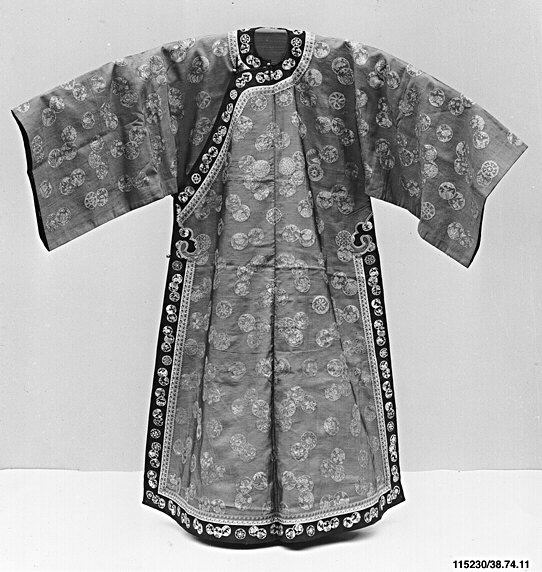
Deconstructing the Loom: The Tapestry-Woven Kesi Robe as a Blueprint for SS26 Avant-Garde Silhouettes
The Zoey Fashion Laboratory dissects the Women's Tapestry-Woven (Kesi) Robe with Roundels not as a relic of dynastic opulence, but as a radical, pre-digital algorithm for volumetric construction. This artifact, forged from silk and metallic thread, represents a paradox: it is both impossibly labor-intensive and structurally liberated. For SS26, we propose a deconstructive reanimation—a futuristic silhouette that weaponizes the robe’s inherent tensile strength and modular roundel architecture against the body’s static form. This is not homage; it is a surgical extraction of principles.
Material Dialectics: Silk as Structural Code
The Kesi technique—literally “cut silk”—creates a tapestry where warp and weft are not woven continuously but interrupted, leaving slits that define shape. In our avant-garde analysis, these slits are not flaws but intentional negative-space seams. For SS26, we reimagine this as a parametric lattice: the metallic thread (gold or silver) becomes a conductive, rigid exoskeleton, while the silk acts as a fluid, semi-transparent membrane. The robe’s original function—to drape—is inverted. We propose a floating, cantilevered silhouette where the metallic threads are woven into a self-supporting scaffold. The silk becomes a kinetic skin, billowing in response to movement, while the metallic threads hold the structure in a state of permanent tension. This creates a soft-hard dichotomy that defies gravity, echoing the robe’s original interplay of weight and air.
Roundels as Volumetric Nodes
The roundels—circular medallions of intricate pattern—are the robe’s most potent architectural element. Traditionally, they serve as decorative foci. In our SS26 reinterpretation, they are structural anchors and modular hubs. Each roundel is re-engineered as a 3D-printed composite disk using silk-infused biopolymer and metallic thread. These disks are not sewn onto the garment; they are magnetic or snap-fit connectors that allow the robe to be reconfigured into multiple silhouettes. Imagine a single garment that can transform from a cocoon-like wrap to a deconstructed, asymmetrical cape, with roundels acting as pivot points. The metallic thread is woven into the roundels’ edges to create conductive circuits, enabling the garment to respond to temperature or light—a living textile that shifts opacity or emits a subtle glow. This is wearable architecture where the roundels are not decoration but functional nodes in a dynamic, biomimetic system.
Silhouette Innovation: The Floating Envelope
The Kesi robe’s original silhouette—a broad, rectangular envelope—is a masterclass in negative space. For SS26, we amplify this into a futuristic, aerodynamic form. The robe’s sleeves, traditionally wide and flowing, are reimagined as detachable, inflatable panels using a silk-membrane and air-channel system. The metallic thread is woven into the seams to create structural ribs that inflate upon activation, transforming the garment from a flat plane into a volumetric, almost architectural shell. This silhouette is not about draping the body but encasing it in a controlled environment. The robe becomes a mobile pavilion, with the roundels serving as pressure valves that release or retain air, allowing the wearer to modulate their presence—from a sleek, body-hugging second skin to a dramatic, sculptural cocoon. The asymmetrical hemline is retained but re-engineered as a laser-cut, fractal edge that mirrors the Kesi’s cut-silk slits, creating a digital filigree that catches light and motion.
Deconstructive Methodology: The Unwoven Robe
Our avant-garde approach requires a deconstructive surgery on the original garment. We remove the roundels and re-weave them into a modular, grid-based system that can be attached to any base layer. The silk panels are laser-cut into geometric fragments—triangles, hexagons, and crescents—and reassembled using magnetic closures inspired by the Kesi’s slit seams. This creates a patchwork of tension and release, where the garment’s integrity is constantly negotiated. The metallic thread is extracted and re-spun into a conductive yarn, woven into the fragment edges to create smart seams that can detect pressure or movement. The result is a living, responsive garment that is never finished—it evolves with each wear. This is radical sustainability: the robe is not preserved but reprogrammed for a future where clothing is infinitely configurable.
Futuristic Silhouette: The SS26 Manifesto
The SS26 silhouette derived from the Kesi robe is a hybrid of the ancient and the post-human. The body is not the center; it is a node within a larger textile system. The robe’s original horizontal and vertical lines are broken into diagonal, aerodynamic sweeps that suggest motion even at rest. The roundels are raised off the surface using micro-pneumatic actuators, creating a 3D topography that shifts with the wearer’s breath. The metallic thread is woven into a Faraday cage that shields or amplifies electromagnetic signals, making the garment a wearable antenna. The silk is treated with a thermochromic finish that changes color in response to body heat, creating a living palette. The final silhouette is anti-gravitational: it floats, folds, and expands in ways that defy traditional tailoring. This is not a robe; it is a prototype for a new kind of existence—one where the garment is not worn but inhabited.
Conclusion: The Loom as Laboratory
The Women's Tapestry-Woven Kesi Robe with Roundels is not a historical artifact to be replicated; it is a generative matrix for SS26. By extracting its structural principles—tensile strength, modular roundels, negative-space seams, and metallic conductivity—we forge a new avant-garde vocabulary. The future of couture lies not in preserving the past but in deconstructing its DNA to create self-evolving, responsive, and volumetric forms. Zoey Fashion Laboratory presents this analysis as a blueprint for a radical tomorrow, where the loom is the laboratory and the robe is the prototype for a post-gravity, post-material fashion. This is the SS26 manifesto: We do not wear history; we reweave it into the future.