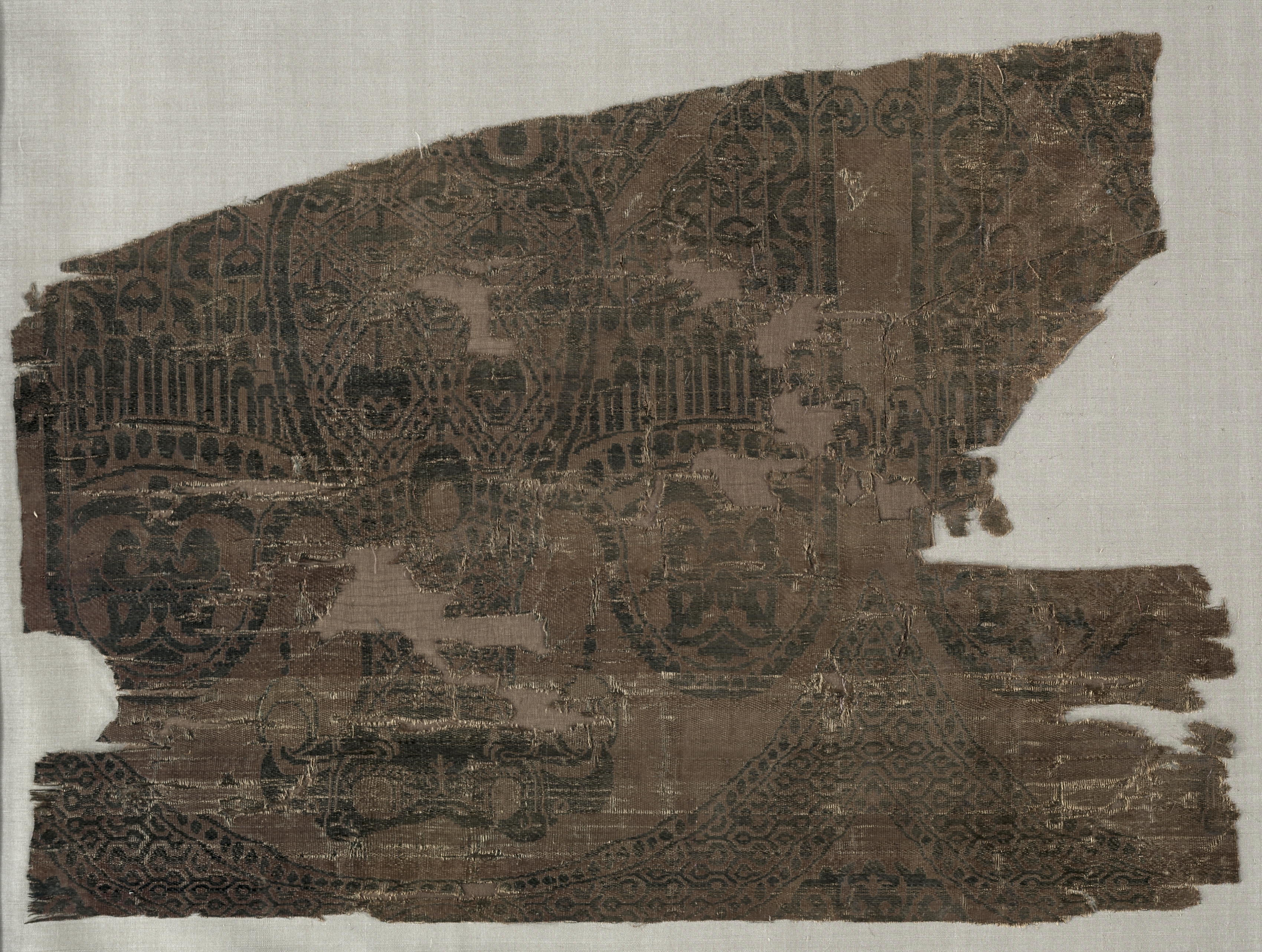
Deconstructing the Sacred: Samite Fragments from the Tomb of Saint Bernard Calvo
At Zoey Fashion Lab, our mission is to excavate the hidden narratives within historical textiles and re-engineer them for the avant-garde. The fragments under analysis—samite remnants bearing the double-headed eagle motif, attributed to the tomb of Saint Bernard Calvo and of probable Byzantine origin—present a profound opportunity. These are not mere relics; they are encoded messages from a nexus of power, faith, and artistry. Our deconstruction will focus on the material, symbolic, and structural DNA of these fragments, then propose a radical recontextualization for a contemporary, avant-garde collection.
Material Analysis: The Samite Substrate
Samite, derived from the Old French samit and ultimately from the Greek hexamiton ("six threads"), is a heavy, luxurious silk fabric woven in a twill or satin weave. In these fragments, the silk is of exceptional quality, indicating an imperial or ecclesiastical commission. The weave is dense, with a subtle, shifting luster that catches light differently depending on the angle—a quality that would have been revered in Byzantine court and religious settings. The silk fibers, though aged and brittle, retain a remarkable tensile strength in certain areas, suggesting a high-grade, possibly Chinese-sourced raw silk that was then dyed and woven in Byzantine workshops.
Technically, the samite construction involves a warp-faced weave, where the warp threads dominate the surface. This creates a smooth, almost liquid appearance, ideal for displaying intricate patterns. The double-headed eagle motif is woven directly into the fabric, not embroidered, indicating a sophisticated drawloom technique. The eagle’s feathers and the twin heads are rendered with geometric precision, yet the silk’s natural sheen adds an ethereal, almost holographic quality. This is not a static image; it is a living emblem that shifts with the viewer’s gaze.
Symbolic DNA: The Double-Headed Eagle
The double-headed eagle is a potent symbol of dual sovereignty—secular and spiritual, East and West, past and future. In Byzantine iconography, it represented the emperor’s dominion over both earthly and heavenly realms. Its presence in the tomb of Saint Bernard Calvo, a 13th-century bishop, suggests a deliberate fusion of imperial and ecclesiastical authority. The eagle is not merely decorative; it is a statement of power, lineage, and transcendence.
For the avant-garde designer, this symbol offers a rich vein of conceptual gold. The duality of the eagle—its two heads looking in opposite directions—can be reinterpreted as a metaphor for the tension between tradition and innovation, the sacred and the profane, the organic and the synthetic. In our deconstruction, we will extract this binary DNA and mutate it into forms that challenge conventional fashion narratives.
Structural Deconstruction: Weave, Wear, and Decay
Our analysis reveals three distinct structural phases in these fragments:
1. The Original Weave: The samite’s warp and weft create a tight, stable grid. The eagle motif is achieved through a supplementary weft, where colored threads are introduced to build the pattern. This is a labor-intensive process, reserved for the most prestigious textiles. The colors—faded now, but originally deep crimson, gold, and indigo—would have been achieved with natural dyes: madder for red, woad for blue, and saffron or orpiment for gold.
2. The Wear of Ritual: The fragments show signs of repeated handling and exposure. There are creases and folds consistent with being wrapped around a relic or placed within a tomb. The silk has softened in some areas, while others have become brittle due to oxidation. This wear is not damage; it is a record of use—a tactile history of devotion.
3. The Decay of Time: The silk has suffered from light exposure, humidity fluctuations, and microbial activity. Some threads have snapped, creating gaps in the weave. The double-headed eagle is partially obscured in one fragment, with one head almost entirely lost. This decay is a form of abstraction—a natural erasure that transforms the original icon into a ghostly, fragmented silhouette.
Avant-Garde Recontextualization: New DNA Strand
At Zoey Fashion Lab, we do not restore; we reimagine. Our approach is to treat these fragments as a New DNA Strand—a genetic code that can be spliced, mutated, and expressed in contemporary materials and forms. The double-headed eagle, the samite weave, and the patina of age become design parameters for a collection that bridges the Byzantine and the futuristic.
Material Mutation: We will extract the weave pattern of the samite and translate it into a parametric 3D-printed textile using recycled silk filaments and biodegradable polymers. The double-headed eagle will be reinterpreted as a laser-cut motif in metallic-coated mylar, creating a reflective, holographic effect that echoes the original silk’s luster. The decay—the missing threads, the faded colors—will be preserved as a deliberate design feature, using digital imaging to map the fragments and then reproducing the gaps as negative space in laser-perforated leather or organza.
Silhouette and Structure: The rigid, hierarchical form of the eagle will be deconstructed into asymmetrical, modular garments. A jacket might feature one eagle head on the left shoulder, the other on the right hip, with the body of the eagle stretching across the back in a fractured, abstracted line. The samite’s heavy drape will be referenced in voluminous, sculptural sleeves and trains, but executed in lightweight, high-tech fabrics like carbon-fiber mesh or liquid silicone. The wear of ritual—the creases and folds—will be engineered into the garments using heat-set pleating and memory fabrics that retain their shape.
Color Palette: The original crimson, gold, and indigo will be intensified and corrupted. We will use bioengineered dyes that react to body heat, shifting from deep red to electric blue. The gold will be replaced with iridescent micro-beads that catch light like Byzantine mosaics. The faded areas will be recreated as gradient fades using digital printing, with the missing eagle head rendered as a ghostly, transparent layer of silk organza.
Conclusion: The Sacred as Avant-Garde
These samite fragments are not artifacts to be preserved in a museum; they are blueprints for a new kind of fashion—one that honors the sacred while embracing the disruptive. The double-headed eagle, once a symbol of static power, becomes a dynamic, dualistic force in our collection. The samite’s weave, its decay, and its ritual wear are all New DNA Strands that we will weave into garments that speak of history, but also of the future. At Zoey Fashion Lab, we believe that the most profound avant-garde work emerges from the deepest engagement with the past. These fragments are not dead; they are waiting to be reborn.