Deconstructing the Vellum: A Textile Analysis of the Saint James Leaf
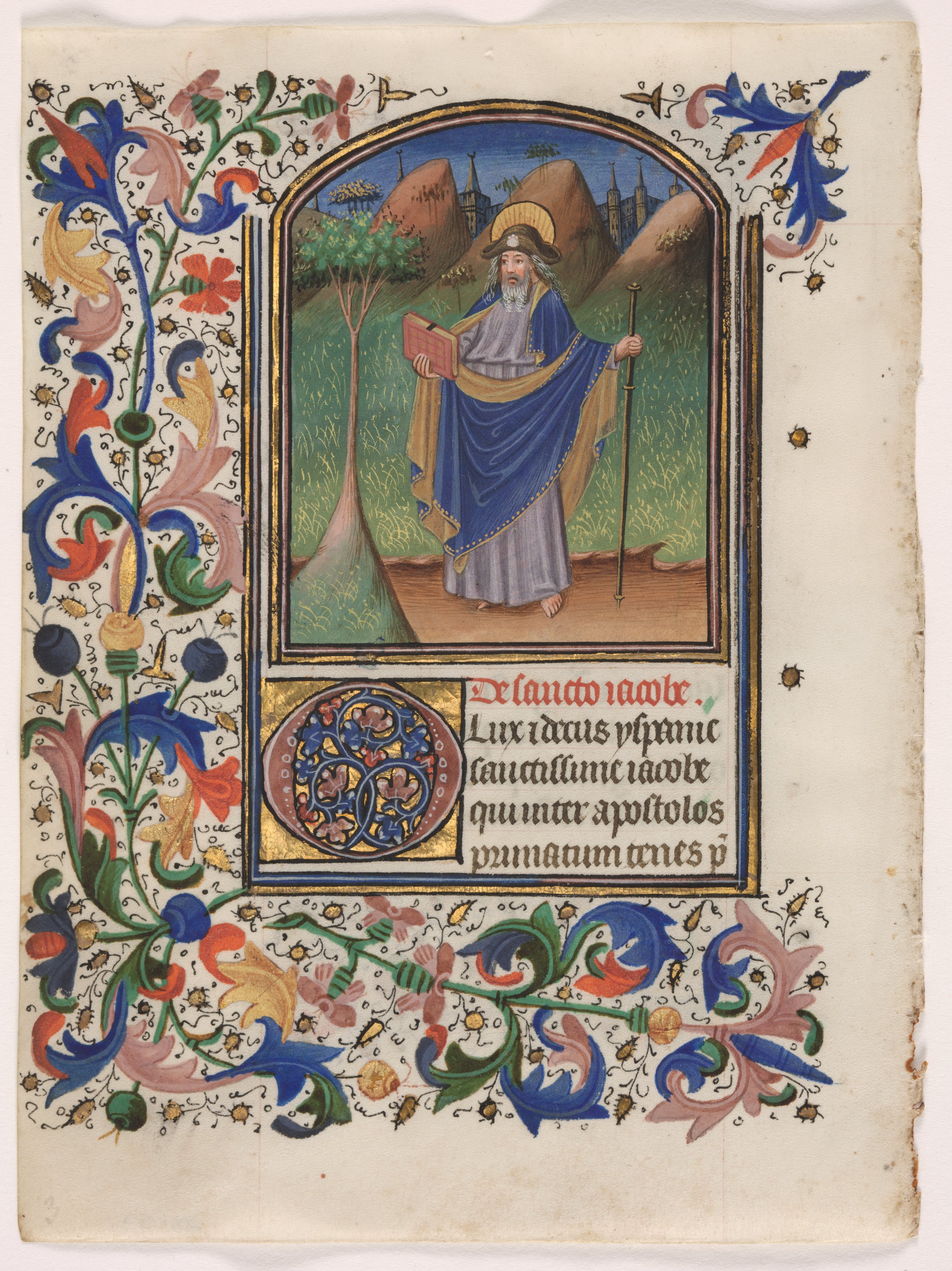
At Zoey Fashion Lab, we approach historical artifacts not as static relics but as living blueprints for textile innovation. The Leaf from a Book of Hours: Saint James the Greater, originating in 15th-century Bruges, Flanders, presents a profound opportunity for deconstruction. Crafted with ink, tempera, and gold on vellum, this illuminated manuscript page is more than a devotional image—it is a complex textural and narrative matrix. Our analysis, guided by the avant-garde sensibility of the Archive Resonance reference—which juxtaposes a mirror’s polished, gold-inlaid surface with a sarcophagus’s carved life story—seeks to translate the leaf’s material and symbolic elements into radical fashion language.
Materiality as a Dualistic Canvas
The vellum itself is the foundational fabric. Its preparation—stretched, scraped, and smoothed—mirrors the tension between structure and fluidity in haute couture. The gold leaf applied to Saint James’s halo and the architectural details is not mere decoration; it is a structural statement. In our deconstruction, this gold becomes a metallic thread woven into a base of raw silk or a laser-cut mylar overlay on a matte wool base. The tempera—an egg-based pigment—offers a lesson in color saturation and opacity. We interpret this as a palette of deep, mineral-rich dyes (lapis lazuli, cinnabar, ochre) applied in irregular, brushstroke-like patterns on sheer organza, creating a play of light and shadow that mimics the manuscript’s luminous quality.
The ink lines, both delicate and assertive, serve as our pattern drafts. They define the saint’s pilgrim hat, the scallop shell emblem, and the folds of his robe. For Zoey Fashion Lab, these lines become topstitching on a deconstructed pilgrim’s cape, or etched into leather using laser engraving. The split-leaf palmettes mentioned in the Archive Resonance reference are not just decorative motifs; they are structural elements. We reimagine them as three-dimensional, sculptural appliqués that rise from a garment’s surface, much like the gold inlay on a mirror. The contrast between the mirror’s polished silver and the gold inlay is echoed in our textile choice: a high-shine, liquid-like metallic fabric (the mirror) juxtaposed with matte, hand-embroidered golden vines (the inlay).
Narrative Embroidery: The Saint’s Journey as a Garment’s Story
The second side of the Archive Resonance reference—the stone sarcophagus with relief-carved life narrative—informs our approach to the leaf’s iconography. Saint James the Greater is depicted as a pilgrim, his staff, scrip, and scallop shell symbols of a journey. In avant-garde fashion, this journey is not linear but fragmented. We propose a modular garment that deconstructs the saint’s narrative into separate, reconfigurable panels. Each panel contains a portion of the story: the scallop shell becomes a pocket, the pilgrim staff a structural boning element, the halo a detachable collar or headpiece.
The tempera’s flat, matte finish on the vellum contrasts with the gold’s reflective surface. We translate this into a fabric with a dual finish: a base of matte, unbleached linen (the vellum) with burnished, high-relief embroidery in gold and silver thread (the tempera and gold). The ink outlines become visible seam lines, intentionally left raw and exposed, celebrating the construction process. This is not a garment that hides its making; it is a garment that reveals its narrative construction, much like the stone sarcophagus’s carved reliefs are meant to be read.
Avant-Garde Silhouette and Structural Innovation
The leaf’s composition—a figure within an architectural niche, surrounded by floral borders—inspires a silhouette that is both enclosed and expansive. We envision a cape or mantle with a rigid, architectural collar that frames the face like a niche. The body of the garment flows in soft, asymmetrical folds, mimicking the vellum’s natural buckling and the tempera’s uneven application. The gold leaf is not applied uniformly; it is concentrated at the shoulders and hem, creating points of light that draw the eye upward, much like the saint’s halo.
The split-leaf palmette motif from the Archive Resonance reference is translated into a cutwork technique on the fabric. Using laser cutting, we create intricate, branching patterns that are then backed with a contrasting color (a deep burgundy or midnight blue) visible through the voids. This technique echoes the mirror’s inlaid gold while also referencing the stone relief’s depth. The garment’s lining, visible through these cutouts, becomes the “sarcophagus” side—a darker, more somber narrative layer that contrasts with the bright, reflective exterior.
Color Palette and Surface Treatment
The manuscript’s limited but potent palette—ultramarine, vermilion, gold, and black—is our starting point. We propose a monochromatic base of deep, charcoal-black wool crepe (the vellum’s dark ink lines), overlaid with panels of hand-painted silk in tempera-like hues. The paint is applied in irregular, gestural strokes, mimicking the manuscript’s brushwork. Gold is not used as a color but as a structural element: gold metallic threads are woven into the fabric’s warp, creating a subtle, shimmering grid that catches light only at certain angles. This is the “mirror” side—polished, reflective, and elusive.
For the “sarcophagus” side, we use a textured, stone-like fabric—a heavy, felted wool or a crinkled, metallic-coated linen that resembles carved stone. The narrative relief is achieved through embroidery and appliqué using corded threads and leather pieces, creating a low-relief effect. The scallop shell is rendered in hand-stitched silver bullion, while the pilgrim staff is a sinuous, boned channel running from shoulder to hem. The garment’s interior is lined with a raw, unbleached silk that references the vellum’s natural animal origin, its slight unevenness a reminder of the artifact’s handmade nature.
Conclusion: A Garment as a Living Archive
The Leaf from a Book of Hours: Saint James the Greater is not a static image; it is a dynamic text of material and symbolic codes. At Zoey Fashion Lab, we deconstruct these codes to create garments that are themselves archives—textiles that hold memory, narrative, and ritual. The avant-garde approach, inspired by the Archive Resonance’s dualism of mirror and sarcophagus, allows us to produce a collection that is both luminous and somber, polished and raw, reflective and narrative. The resulting fashion is not wearable history but wearable interpretation—a dialogue between the 15th-century Flemish artisan and the 21st-century textile innovator. Each stitch, each gold thread, each cutout is a leaf turned, a page read, a story worn.