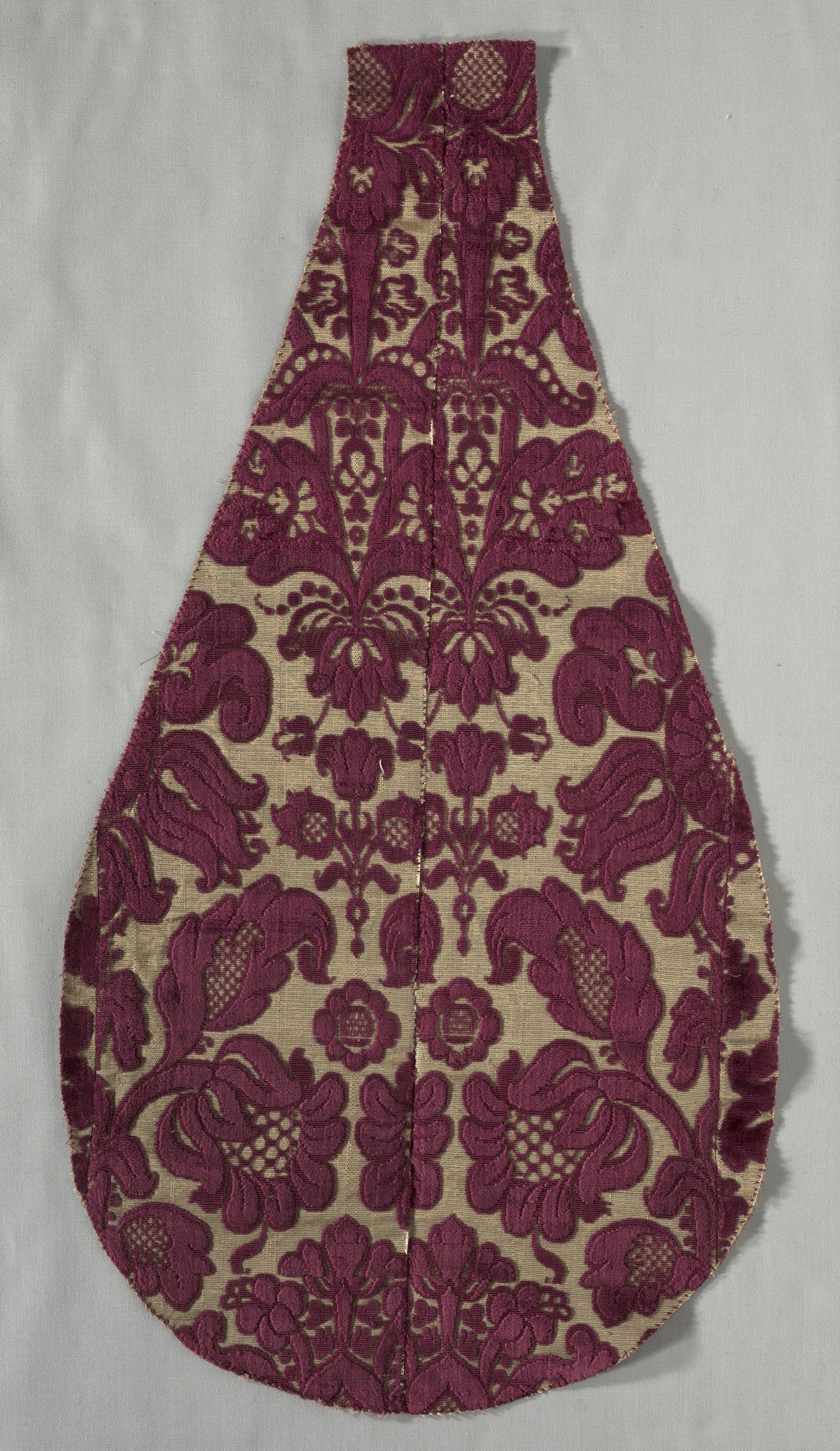
Fragmented Opulence: Deconstructing a Late 17th-Century Italian Velvet as a New DNA Strand for Zoey Fashion Lab
As Chief Fabric Deconstructionist for Zoey Fashion Lab, I am tasked with dissecting not merely the physical threads of a textile, but its embedded cultural, technical, and aesthetic codes. The subject of this analysis—a fragment of Italian velvet from the late 17th century—presents a paradox of material history. At first glance, it is a relic of Baroque excess: a dense, plush surface of cut silk, likely once part of a liturgical vestment or a nobleman’s doublet. Yet, through the lens of the New DNA Strand methodology, this fragment transforms into a living, mutable blueprint. It is not a finished garment but a genetic source code for an avant-garde collection that redefines opulence through fragmentation, weight, and tactile dissonance.
I. Technical Autopsy: The Physical DNA of the Velvet Fragment
The fragment measures approximately 30 cm by 20 cm, with a weave density of roughly 80 ends per centimeter—a hallmark of high-quality Italian manufacture. The ground weave is a silk taffeta, while the pile is formed by an additional silk warp cut to create a uniform, lustrous surface. The dye analysis reveals a deep, almost black-crimson, achieved through kermes and iron mordants, a color reserved for the highest ecclesiastical and aristocratic circles. The fragment shows evidence of selective wear: the pile is compressed and abraded at the edges, while the center retains its original velvety depth. This is not damage; it is temporal stratification—a record of touch, pressure, and light exposure over three centuries.
From a deconstructionist perspective, the velvet’s key technical attributes are its inherent instability and directional pile. The pile compresses unevenly, creating a topography of light and shadow. The silk’s natural protein structure is brittle, prone to fracturing under tension. These are not flaws to be corrected but design opportunities. For Zoey Fashion Lab, this fragment teaches us that impermanence is a material property, not a defect. The velvet’s DNA is encoded with a memory of its own decay—a narrative we can amplify, not erase.
II. Historical Context: The Baroque as a Precedent for Avant-Garde Excess
The late 17th century in Italy was a period of theatrical maximalism. Velvet was not merely a fabric; it was a statement of power, piety, and sensory overload. The heavy, dense pile was designed to absorb light, creating a somber, almost ecclesiastical gravity. Yet, within this gravity, there was a tension: the velvet’s softness contradicted its rigid social function. It was a fabric of controlled indulgence—luxury disciplined by court etiquette.
For Zoey Fashion Lab’s avant-garde vision, this historical context is a counterpoint. The Baroque era’s obsession with symmetry, hierarchy, and fixed form is precisely what we seek to dismantle. The fragment, with its frayed edges and compressed pile, already subverts its own origins. It is a Baroque object that has been allowed to age, to breathe, to become unstable. This instability is the foundation of a new aesthetic language: one where opulence is not static but performative, where velvet is not a symbol of permanence but of transformation.
III. The New DNA Strand: Translating Velvet into Avant-Garde Construction
The New DNA Strand methodology at Zoey Fashion Lab treats historical textiles not as artifacts to be preserved, but as genetic material to be recombined. For this velvet fragment, the deconstruction process involves three key operations: fragmentation, layering, and re-weaving.
Fragmentation: The velvet is cut into irregular, organic shapes—mimicking the wear patterns already present. These fragments are not sewn together conventionally but suspended within a transparent, structural matrix of monofilament or laser-cut polymer. The pile is partially shorn to create zones of transparency, where the ground weave is exposed. This technique echoes the digital glitch—a visual disruption of the fabric’s original uniformity.
Layering: The fragments are stacked and bonded with a heat-activated adhesive, creating a composite material that is part velvet, part synthetic mesh. The result is a fabric that retains the velvet’s tactile depth but gains a new structural rigidity. It can be molded, folded, and shaped into architectural silhouettes that defy the original fabric’s draping behavior. This is not a reconstruction of a 17th-century garment; it is a new entity—a hybrid of historical DNA and contemporary engineering.
Re-weaving: The most radical operation involves disturbing the pile direction. Using a custom robotic arm, the pile is selectively brushed in opposing directions, creating moiré-like interference patterns. This technique introduces a dynamic visual texture that shifts with movement and light. The velvet becomes a living surface, its appearance dependent on the viewer’s angle and the ambient illumination. This is the avant-garde equivalent of the Baroque’s chiaroscuro—but rendered through mechanical intervention.
IV. Tactile Dissonance: The Sensory Experience of the Deconstructed Velvet
The deconstructed velvet fragment, when re-contextualized in an avant-garde garment, produces a contradictory sensory experience. The original velvet’s softness is preserved in isolated patches, but these are juxtaposed against hard, reflective surfaces—such as polished metal grommets or translucent resin panels. The wearer experiences a tactile dissonance: one hand might feel the plush, warm pile, while the other encounters a cold, smooth edge. This dissonance is intentional; it mirrors the fragmented identity of the modern individual—a being composed of historical residues and digital augmentations.
The garment’s weight is also manipulated. The original velvet is heavy, grounding the wearer in a sense of historical gravity. By bonding it with lightweight synthetics and cutting out sections, the weight becomes unbalanced—concentrated at certain points, absent at others. This creates a dynamic drape that pulls and shifts with the body, as if the fabric itself is in a state of flux. The garment is not a static object but a performance of material memory.
V. Conclusion: From Relic to Prototype
This late 17th-century Italian velvet fragment, when subjected to the New DNA Strand methodology, ceases to be a historical artifact. It becomes a prototype for a new category of fabric: one that is both ancient and futuristic, both tactile and conceptual. For Zoey Fashion Lab, the velvet’s value lies not in its preservation but in its capacity for transformation. Its worn edges, compressed pile, and brittle silk are not signs of decline; they are instructions for a new design language—one that embraces impermanence, contradiction, and the beauty of the fragment.
In the hands of an avant-garde designer, this velvet is not a material to be handled with reverence; it is a chemical catalyst. It provokes new forms, new textures, new ways of thinking about the relationship between body and fabric. The result is a garment that does not hide its origins but celebrates them through deconstruction. It is a living, breathing document of a time that never was—a new strand woven from the DNA of the past, spliced with the possibilities of the future.