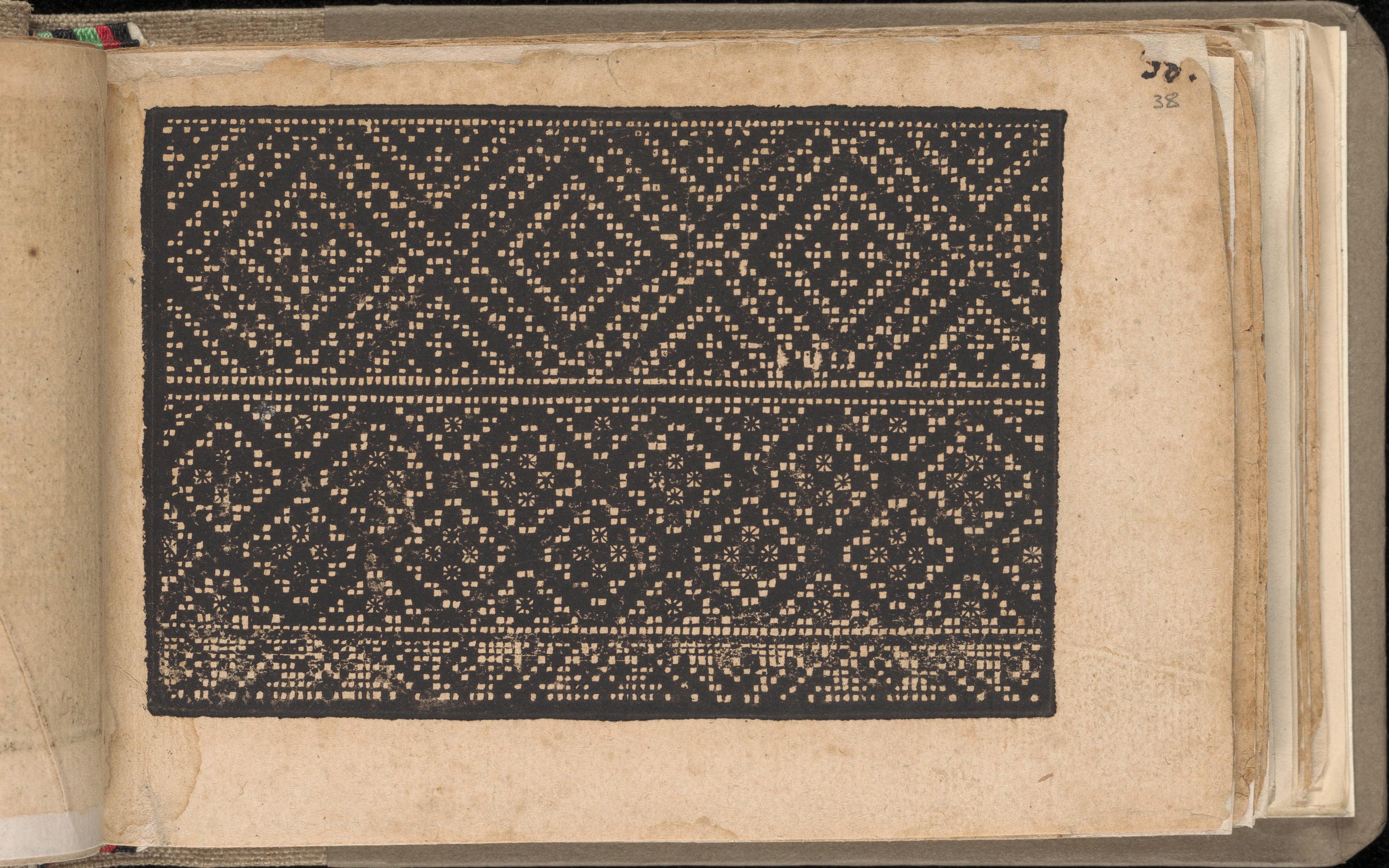
Deconstructing the Woodcut: Schön newes Modelbuch (Page 38r) as a Blueprint for SS26
The Zoey Fashion Laboratory’s avant-garde analysis of the Schön newes Modelbuch—specifically Page 38r—transcends mere historical costume study. This 16th-century woodcut, a relic of pattern-making and sartorial instruction, becomes a radical manifesto for SS26. The medium itself—woodcut—is not a passive illustration but a tectonic force. The incised lines, the negative space carved from the block, and the stark ink-on-paper contrast speak directly to our laboratory’s ethos: fashion as structural architecture, where absence defines presence and the garment’s silhouette is a deliberate scar on the fabric of time. This analysis deconstructs the woodcut’s formal vocabulary to reimagine futuristic silhouettes, focusing on structural innovation as the cornerstone of the season.
The Woodcut as Material: From Print to Prosthesis
Page 38r’s woodcut is not a soft sketch; it is a rigorous, almost brutalist, carving. The lines are rigid, the forms angular, and the human figure is subjugated to the geometric logic of the block. For SS26, we translate this into garment architecture that rejects draping in favor of cut-and-assembly methodologies. The woodcut’s unyielding lines become seams that do not follow the body but instead create new, alien contours. Consider the shoulder construction: the woodcut’s sharp, almost serrated edge where the sleeve meets the bodice is not a seam but a structural dislocation. In our collection, this manifests as a cantilevered shoulder piece—a sculptural extension that floats away from the torso, secured by a single, exposed metal bracket. The material itself must echo this rigidity. We propose a bio-composite linen infused with a thermoset resin, allowing for permanent, sharp folds that mimic the woodcut’s carved indentations. The garment is no longer worn; it is worn upon, a prosthetic shell that redefines the wearer’s silhouette as a series of negative spaces and protruding lines.
Futuristic Silhouettes: The Geometry of Absence
The most avant-garde revelation of Page 38r is the handling of negative space. The woodcut’s white areas—where the block was cut away—are as active as the black lines. They create voids that define the garment’s perimeter. For SS26, we invert this principle: the silhouette is not a continuous line but a series of interrupted planes. The traditional bodice is replaced by a torque-like structure—a single, continuous band of material that wraps the torso in a non-Euclidean spiral, leaving large, deliberate gaps that expose the body in a calculated, architectural manner. This is not eroticism; it is structural transparency. The gaps are cut with laser precision, following the woodcut’s sharp angles, so the skin becomes a negative space within the garment’s geometry. The skirt morphology follows suit: a crinoline of carbon fiber that fans out in a series of asymmetrical, trapezoidal panels, each one slightly rotated from the previous. The overall silhouette is that of a deconstructed bell—fragmented, angular, and perpetually in motion, as if the woodcut’s lines were animated by a digital algorithm. The hemline is not even; it is a broken horizon, with sharp points that extend to the floor and abrupt cutouts that lift the garment’s edge, creating a dynamic, almost glitch-like profile.
Structural Innovation: The Garment as a Load-Bearing System
Page 38r’s woodcut reveals a hidden structural logic: the seams are not decorative but load-bearing. They are the lines that hold the garment together, much like the ribs of a ship’s hull. For SS26, we reimagine these seams as exoskeletal joints. The garment becomes a system of interlocking components, each piece designed to bear weight and distribute tension. The primary innovation is the articulated spine—a central seam that runs from the nape of the neck to the base of the spine, constructed from a series of 3D-printed, interlocking vertebrae made from recycled titanium. This spine is not hidden; it is exposed, running along the back of a sheer, bio-engineered silk tunic. The sleeves are attached not by a traditional armhole but by a ball-and-socket joint at the shoulder, allowing for 360-degree rotation and a new range of motion. The woodcut’s rigid lines are thus translated into kinetic architecture. The garment breathes, but not with the wearer’s lungs—it moves with the wearer’s skeleton, becoming a second, mechanical skin. The fastening system is equally radical: no zippers or buttons. Instead, magnetic latches are embedded within the seams, allowing for instant, silent assembly. The garment is modular—a single piece can be disassembled into its constituent panels and reconfigured into a new silhouette, echoing the woodcut’s potential for infinite reprinting.
Materiality and the Woodcut’s Texture: A New Tactile Language
The woodcut’s physical texture—the raised ink, the grain of the wood, the pressure marks from the press—demands a haptic innovation. For SS26, we develop a laminated fabric that mimics this three-dimensional surface. A base layer of micro-perforated neoprene is overlaid with a laser-engraved film that reproduces the woodcut’s lines as raised ridges and recessed grooves. The result is a fabric that feels like a braille of the future—each ridge corresponds to a seam or a structural element of the garment. When touched, the wearer can trace the garment’s architecture. The color palette is monochromatic: carbon black for the base, with silver-gray for the raised lines, echoing the ink-and-paper contrast. But there is a subversive element: thermochromic pigments are embedded in the raised lines. When the garment is exposed to body heat or ambient temperature shifts, the lines change from silver to a deep, iridescent blue, revealing a hidden layer of the woodcut’s design. The garment is not static; it is a living document, reprinting itself with every movement.
Conclusion: The Woodcut as a Portal to Post-Human Couture
Page 38r of the Schön newes Modelbuch is not a historical artifact; it is a prophecy. Its woodcut lines are not just patterns—they are blueprints for a new anatomy. For Zoey Fashion Laboratory’s SS26, we do not interpret the woodcut; we reconstruct it as a living, breathing, mechanical organism. The silhouette is a fractured geometry, the structure is an exoskeletal system, and the material is a tactile archive. This is not fashion as adornment; it is fashion as infrastructure. The wearer becomes a cyborg, not through electronics but through architectural integration. The garment does not follow the body; it redefines it, carving new lines of force and new voids of possibility. The woodcut’s permanence is subverted by the garment’s mutability, and the past is weaponized to create a future where the line between garment and architecture, between wearer and machine, is permanently erased. This is the definitive avant-garde statement for SS26: a collection that does not dress the body but builds it anew.