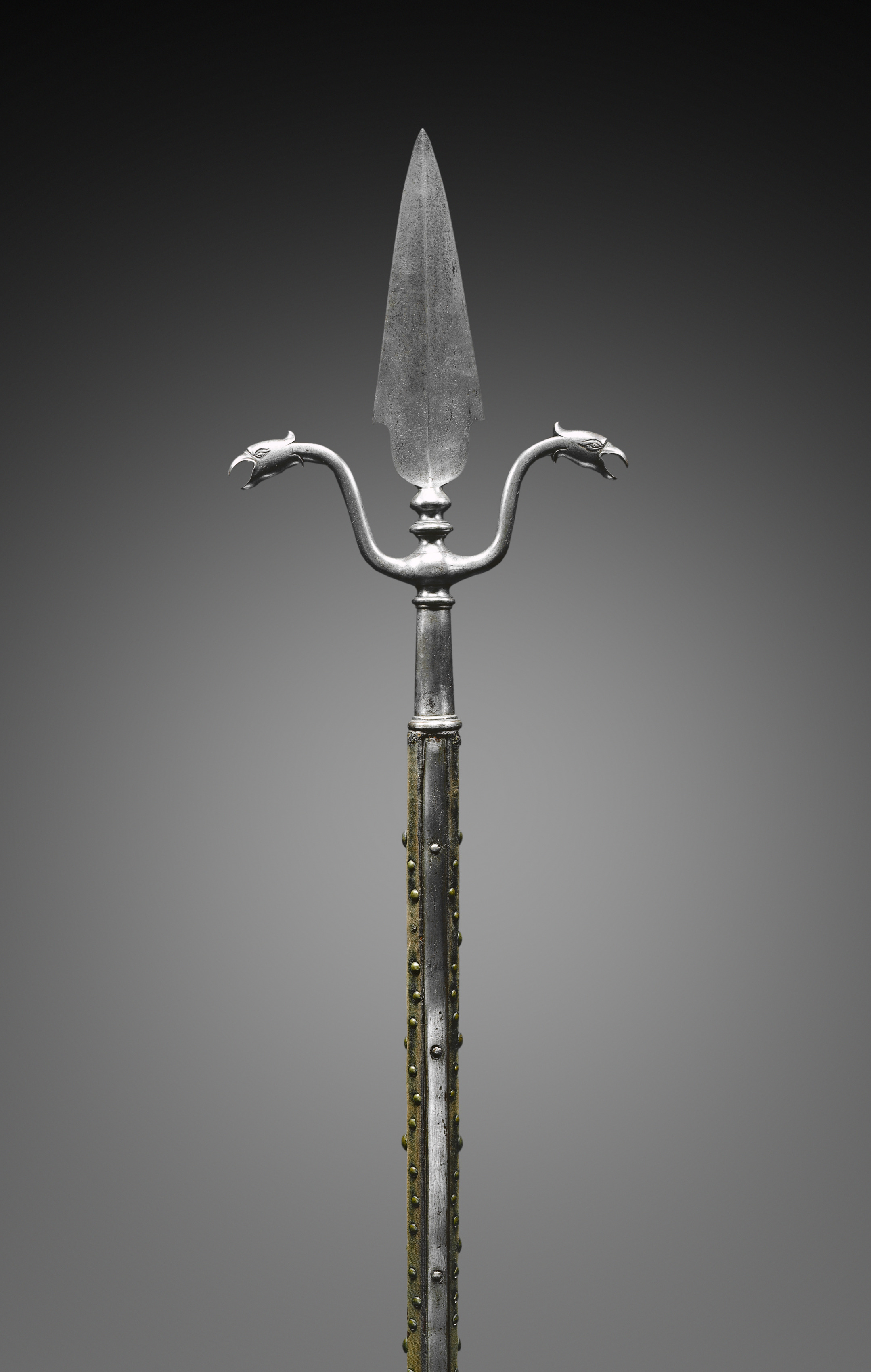
Deconstructing Linstock: A Technical and Avant-Garde Analysis
At Zoey Fashion Lab, the role of the Chief Fabric Deconstructionist is to dissect historical artifacts not merely as relics, but as proto-fashion technologies. The Linstock, a 17th-century French implement of artillery and pyrotechnics, presents a unique challenge. Typically a tool for igniting cannon fuses, its material composition—steel, octagonal wood haft, green velvet, and brass studs—suggests a ceremonial or officer-grade piece, far removed from purely utilitarian battlefield equipment. This analysis will deconstruct the Linstock through the lens of our New DNA Strand methodology, which treats each material and structural element as a genetic marker for avant-garde reinterpretation. We will examine its technical DNA, its historical context, and propose how these components can be re-coded into a contemporary, disruptive fashion narrative.
1. Technical DNA: The Material Lexicon
The Linstock’s physicality is a study in contrasting tensions. The steel component, typically a forked or pointed head, represents industrial precision and danger. It is cold, hard, and unforgiving—a symbol of controlled firepower. In the context of fashion, steel translates to structural armatures, metallic mesh, or rigid exoskeletons that challenge the softness of traditional textiles. The octagonal wood haft, a geometric departure from the common round handle, introduces a prismatic, faceted quality. This is not a passive support; its eight sides suggest multiplication of perspective, a core tenet of avant-garde design. For Zoey Fashion Lab, this haft could inspire geometric tailoring—sharp, angular shoulder pads, asymmetrical paneling, or corsetry that fractures the silhouette into multiple planes.
The most intriguing element is the green velvet covering. Velvet, a fabric historically associated with luxury, royalty, and ecclesiastical vestments, is here applied to a tool of war. This juxtaposition of opulence and violence is a rich seam for deconstruction. The velvet’s pile catches light and shadow, creating a tactile, almost liquid surface. In our lab, this could be reimagined as deconstructed velvet—unraveled edges, burnished finishes, or layered with transparent materials to expose the underlying “wood” of the human form. The brass studs serve as both functional fasteners and decorative accents. They are points of tension, anchoring the velvet to the wood. In avant-garde fashion, brass studs become hardware punctuation—rivets, grommets, or exposed zippers that disrupt the fabric’s flow, creating a dialogue between the organic (velvet) and the mechanical (brass).
2. Historical Context: The Ceremonial Firebrand
To fully deconstruct the Linstock, we must understand its role in 17th-century France. This was an era of absolutism under Louis XIV, where even military tools were imbued with courtly aesthetics. The Linstock, while functional, was often carried by artillery officers as a badge of rank. The green velvet and brass studs indicate a piece intended for parade or ceremonial use, not just the smoke and chaos of battle. This duality—utility versus ornament—is a foundational concept for our New DNA Strand. The Linstock is a transitional object, bridging the gap between the battlefield and the ballroom. For Zoey Fashion Lab, this translates to garments that serve dual purposes: a coat that can be worn as armor or as eveningwear; a dress that conceals structural harnesses beneath silk.
The octagonal shape also carries symbolic weight. In esoteric and heraldic traditions, the octagon represents regeneration and rebirth, often used in baptismal fonts and architectural transitions. The Linstock, as a tool of ignition, literally sparks new beginnings—the firing of a cannon, the launch of a signal. This aligns with avant-garde fashion’s obsession with transformation and metamorphosis. A garment inspired by the Linstock might feature detachable elements that “ignite” a new silhouette, or fabrics that change color or texture when activated by heat or movement.
3. New DNA Strand: Re-coding the Linstock for Avant-Garde Fashion
The New DNA Strand methodology at Zoey Fashion Lab involves extracting core genetic markers from an artifact and splicing them into contemporary fashion DNA. For the Linstock, we identify four key strands:
Strand 1: The Combustible Silhouette. The Linstock’s steel head is a forked instrument, suggesting a Y-shaped or bifurcated form. This can be translated into avant-garde garments with split hems, double collars, or branching sleeves that mimic the action of holding a burning match. The silhouette should feel precarious and dynamic, as if about to ignite.
Strand 2: The Velvet-Panoply. The green velvet is not merely a covering; it is a skin of status. In our re-coding, velvet is treated as a mutable substrate. We can laser-cut it to reveal the “wood” (or a metallic underlay) beneath, or apply heat-pressed brass studs that create a three-dimensional topography. The color green, historically associated with alchemy and transformation, becomes a signature hue—perhaps a chlorophyll-infused dye that shifts under light.
Strand 3: The Octagonal Frame. The eight-sided haft inspires structural innovation. Imagine a corset or bodice built from eight interlocking panels, each angled to create a faceted, almost crystalline torso. This could be executed in carbon fiber or resin, echoing the wood’s rigidity but with modern lightness. Alternatively, an octagonal train or cape that unfolds like a fan, referencing the Linstock’s ceremonial unfurling.
Strand 4: The Brass Nexus. Brass studs are points of convergence. In fashion, they can be reimagined as connective joints—articulated metal links that allow fabric to flex and lock into place. Think of a jacket that can be reconfigured by snapping brass studs into different positions, or a skirt that transforms from a pencil to a full A-line through a system of brass-powered tensioners.
4. Avant-Garde Manifestation: The Zoey Fashion Lab Collection
Drawing from this deconstruction, a potential avant-garde collection would be titled “Fuse & Velvet.” Key pieces might include:
- The Ignition Coat: A long, velvet-trimmed coat with steel-tipped, forked lapels that can be raised to frame the face like a Linstock’s head. The back is octagonal in cut, with brass studs tracing the seams.
- The Ceremonial Corset: A structural piece made from eight panels of green velvet over a wood-like resin base. Brass grommets allow for lacing that can be adjusted to tighten or release the silhouette, mimicking the Linstock’s dual function of holding and releasing fire.
- The Pyrotechnic Dress: A gown with a dissolvable velvet overlay that, when exposed to heat or friction, reveals a steel-mesh underlayer. Brass studs act as ignition points, creating a visual “spark” along the hem.
In conclusion, the Linstock is not merely a historical oddity; it is a blueprint for tension—between luxury and violence, geometry and fluidity, past and future. At Zoey Fashion Lab, we deconstruct to reconstruct, and this 17th-century firebrand offers a rich, combustible DNA for the avant-garde wardrobe of tomorrow.