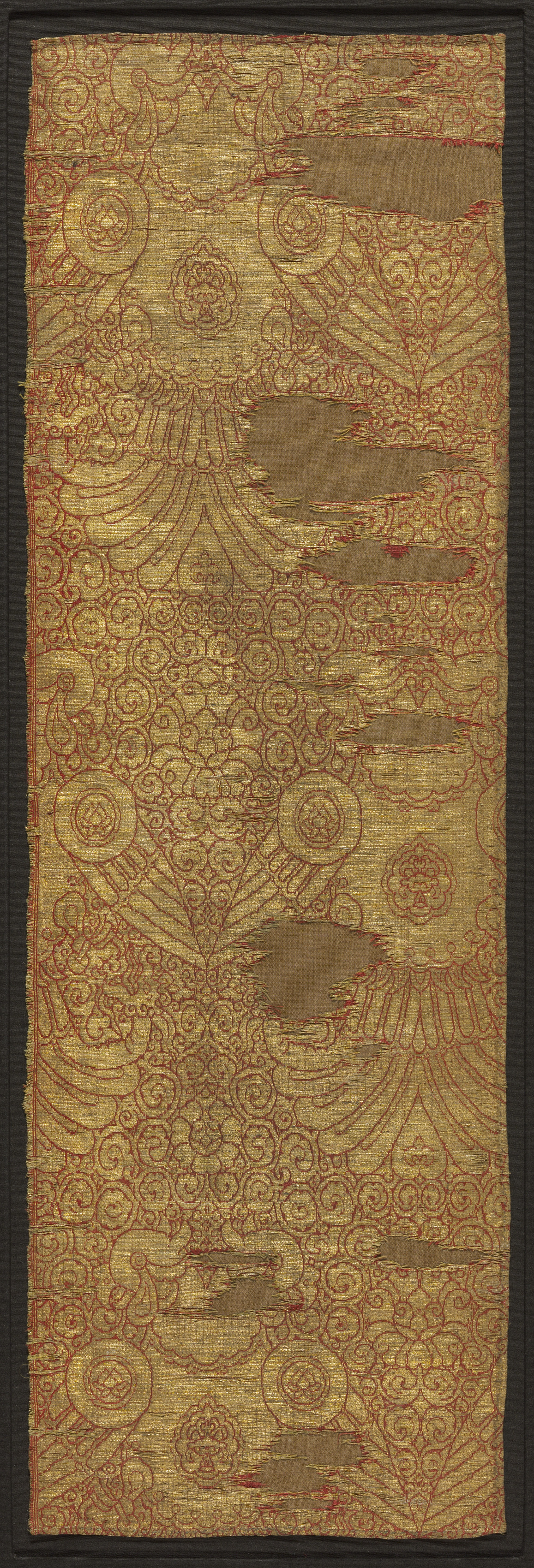
Deconstructing the Gilded Gaze: An Avant-Garde Analysis of the Cloth of Gold with Displayed Falcons
Introduction: The Archive as a Catalyst for Deconstruction
At Zoey Fashion Lab, we operate on the premise that historical textiles are not relics to be preserved in amber, but rather volatile archives of suppressed narratives and latent design potentials. The Cloth of Gold: Displayed Falcons, a Central Asian lampas weave from the 16th-17th century, is a case study in this philosophy. Its technical composition—silk and gold thread—immediately signals a convergence of nomadic power and sedentary luxury. The lampas structure, with its complex binding systems, creates a surface where the metallic weft floats freely, catching light as a symbol of imperial authority. Yet, for the avant-garde designer, this gilded surface is not a statement of opulence, but a fractured mirror reflecting the violent aesthetics of cultural synthesis. The “displayed falcons,” rendered in symmetrical, heraldic poses, are not mere decorative motifs; they are semiotic anchors that lock the textile into a specific geopolitical context. Our task is to deconstruct this anchor, to liberate the falcon from its historical cage and reimagine it as a vector for future fashion systems.
Technical Anatomy: The Lampas as a System of Tension
The lampas weave, a compound structure where a pattern weft (here, gold thread) is bound by a secondary warp, creates a layered topography of texture and reflectivity. This is not a flat surface; it is a dynamic field where the silk ground—often in deep indigo or crimson—acts as a recessive void, while the gold falcons emerge as assertive, almost sculptural presences. From an avant-garde perspective, this technical duality is a prototype for deconstructive layering. The gold thread is not simply decorative; it is a material interrogation of value. Its fragility—tarnishing over time, breaking under stress—mirrors the ephemeral nature of power. In our deconstruction, we would isolate this tension: the gold becomes a scar on the silk, a mark of historical violence rather than a badge of honor. The lampas structure, with its floating wefts, can be disrupted—cut, frayed, or rewoven—to expose the underlying threads of silk, revealing the fabric of empire as a fragile, contingent construction.
Semiotic Deconstruction: The Falcon as a Collapsing Symbol
The displayed falcon, a common motif in Central Asian and Persian textiles, is typically interpreted as a symbol of sovereignty, hunting prowess, and divine favor. However, in the context of the 16th-17th centuries, this motif also carries the weight of cultural appropriation and imperial exchange. The falcon, as a heraldic device, was adopted by Safavid, Mughal, and Ottoman courts, each reinterpreting it through their own aesthetic lenses. For Zoey Fashion Lab, this multiplicity is not a harmonious fusion but a site of conflict. The symmetrical, rigid posture of the falcon—wings displayed, talons outstretched—is a trap of representation. It freezes the bird in a moment of eternal dominance, erasing its natural fluidity and predatory grace. An avant-garde analysis would unfold this symmetry, distorting the falcon’s wings into asymmetrical, fragmented forms. The gold thread, once used to outline the bird’s precise contours, could be re-embroidered as chaotic, scar-like lines, suggesting a falcon in the process of breaking free from its heraldic prison. This is not a rejection of the motif, but a critical re-engagement that exposes the violence inherent in its stylization.
Archive Resonance: The Textile as a Time-Bomb
The phrase “Archive Resonance” from the reference material is crucial here. It suggests that the textile is not a static object but a resonant chamber that vibrates with the echoes of its creation. The 16th-17th century was a period of intense cultural collision: the Silk Road was a conduit for not only goods but also ideas, religions, and aesthetic systems. The Cloth of Gold, with its fusion of Chinese silk, Persian gold, and Central Asian weaving techniques, is a product of this collision. Yet, this fusion is often romanticized as a harmonious “dialogue.” Our avant-garde lens demands a more skeptical reading. The gold thread, extracted from mines in the Caucasus or Africa, carries the blood of labor. The silk, cultivated in China under imperial monopolies, embodies state control. The lampas weave, perfected in Byzantine and Islamic workshops, is a technology of domination. The archive resonates not with harmonious music, but with the cacophony of exploitation. For Zoey Fashion Lab, this resonance is a design brief: we will not replicate the textile’s beauty, but rather amplify its dissonance. This could involve using digital weaving to create “glitch” versions of the falcon pattern, where the gold thread is replaced with conductive fibers that short-circuit the viewer’s gaze, or by integrating sound-responsive materials that hum with the frequencies of historical trauma.
Avant-Garde Application: From Displayed to Displaced
How does this analysis translate into a fashion collection? The Cloth of Gold becomes a template for deconstruction, not a source of inspiration. The “displayed” falcon is displaced from its symmetrical throne. We propose a series of garments that fragment the falcon’s body: a coat where the left wing is rendered in gold lamé, the right wing in raw, unraveling silk, and the body in a void of negative space. The lampas structure is inverted: the silk ground becomes the foreground, while the gold falcon is buried beneath layers of organza, only visible under specific lighting conditions. This creates a ghostly presence, a falcon that haunts rather than dominates. The gold thread is not polished but oxidized, treated with chemicals to create a patina of decay. The garments are designed to be worn in motion, allowing the falcon to disintegrate with each gesture, shedding gold flecks like historical debris. This is not a nostalgic revival; it is a critical intervention that uses the textile’s own materiality to critique its original function.
Conclusion: The Future of the Gilded Gaze
The Cloth of Gold with Displayed Falcons is not a masterpiece to be revered, but a problem to be solved. Its gilded surface conceals a history of power, labor, and cultural violence. For Zoey Fashion Lab, the avant-garde is not about novelty for its own sake, but about unearthing these buried narratives and giving them form. By deconstructing the lampas weave, fragmenting the falcon motif, and amplifying the archive’s dissonant resonance, we transform a static relic into a dynamic critique. The result is fashion that does not merely adorn the body, but challenges it to confront the complexities of its own cultural inheritance. The gilded gaze is no longer a symbol of imperial control; it becomes a mirror of self-reflection, fractured and unsettling, but ultimately more honest than the polished surface of history.