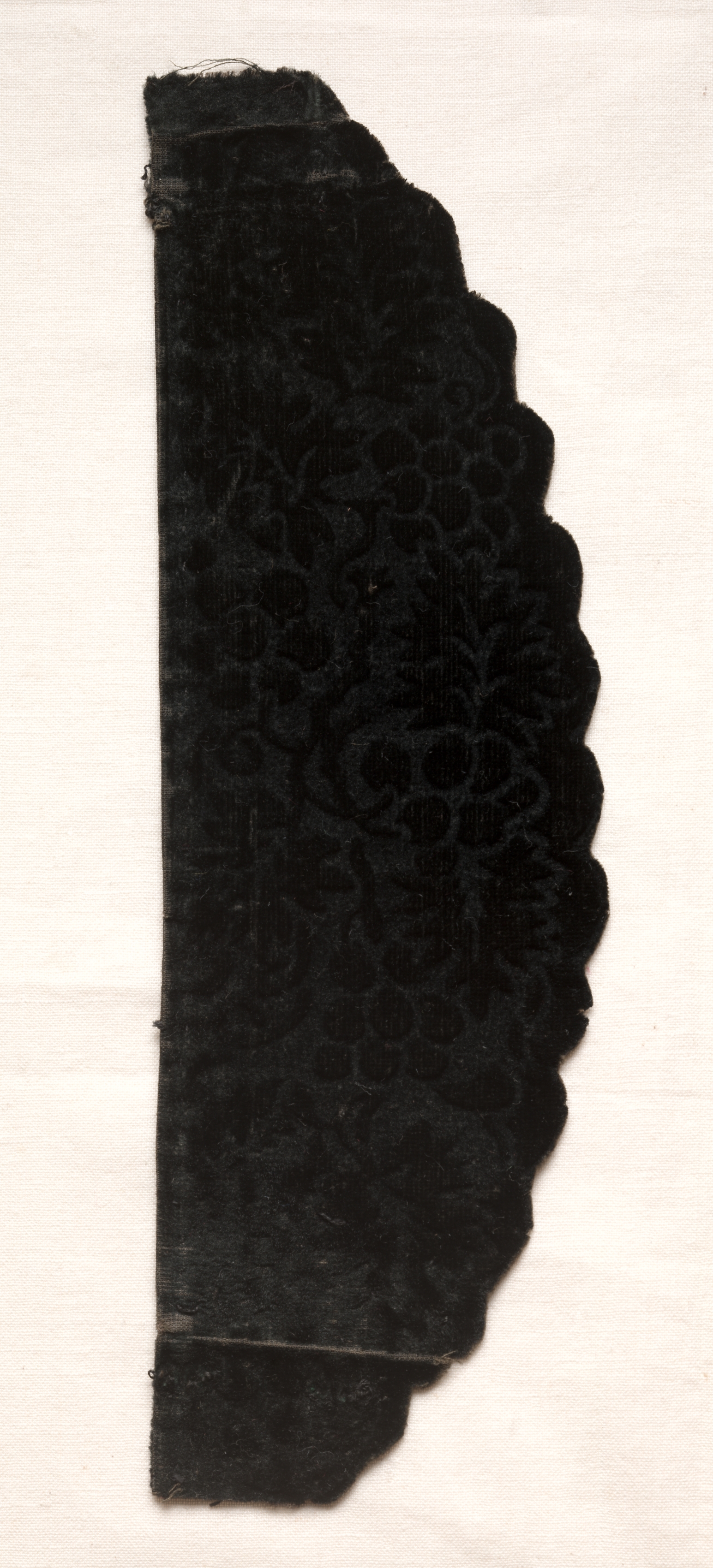
Deconstructing the Velvet Cuff: A 19th-Century French Artifact Reimagined for the Avant-Garde
At Zoey Fashion Lab, our mission is to unravel the historical and material DNA of garments, then re-splice those strands into something unprecedented. The subject before us—a pair of velvet cuffs from 19th-century France—presents a particularly rich case study. These are not mere accessories; they are a condensed archive of aristocratic power, textile craftsmanship, and the tactile language of luxury. To deconstruct them is to understand how velvet, a fabric of profound material complexity, encoded social status, and how that encoding can be broken, mutated, and reborn through an avant-garde lens. This analysis will proceed through three phases: Historical DNA Extraction, Material Deconstruction, and Avant-Garde Re-splicing.
Phase One: Historical DNA Extraction – The 19th-Century French Context
The velvet cuff of 19th-century France was not a casual adornment. It was a marker of the haute bourgeoisie and the fading aristocracy, a detail that signaled leisure, wealth, and a deep familiarity with the codes of high fashion. In an era before machine-washable fabrics, velvet—with its delicate pile and demanding care requirements—was a statement of non-productivity. The cuff itself, often detachable, served both practical and symbolic functions: it protected the sleeves of fine coats from soiling while simultaneously framing the hand, drawing the eye to gestures of refinement.
The DNA strand we extract here is one of controlled opulence. The velvet of this period was typically silk, woven on a drawloom or, later, a Jacquard loom, with a dense, erect pile that caught and scattered light. Colors were deep and saturated—burgundy, midnight blue, emerald green—often achieved with expensive natural dyes like cochineal or indigo. The cuffs were frequently embroidered with metallic threads, beads, or even semi-precious stones, turning them into miniature canvases of status. This historical DNA encodes a language of hierarchy, restraint, and the performative nature of luxury. The cuff is a boundary—between body and garment, between public and private, between the wearer and the world.
Phase Two: Material Deconstruction – The Velvet Paradox
To deconstruct velvet is to confront its inherent paradoxes. Velvet is both soft and rigid, opaque and reflective, fragile and durable. The pile—the cut loops of silk that form its plush surface—is the source of its allure and its vulnerability. Under a microscope, each filament acts as a tiny light trap, absorbing and re-emitting color in a way that flat weaves cannot. This is the New DNA Strand we must isolate: the velvet’s volumetric surface and its temporal instability.
Our deconstruction process begins with a meticulous physical analysis. We examine the cuff’s construction: the backing weave (typically a plain or twill weave), the pile height (often 1-2mm for 19th-century examples), and the direction of the nap (the way the pile leans, affecting light reflection). We then subject a small sample to mechanical stress—rubbing, crushing, and abrasion—to observe how the pile distorts. This reveals the memory of the fabric: velvet “remembers” pressure, creating permanent shadows and highlights that tell the story of its wear. The historical DNA of status is thus overwritten by the DNA of use—the creases from a bent elbow, the faded patches from a hand resting on a carriage door.
Next, we perform a chemical deconstruction. Using a controlled solvent process, we separate the silk filaments from any metallic threads or dyes. This is not destruction for its own sake; it is a way to isolate the material essence of the velvet. The silk, once freed, becomes a raw, fibrous material—a new biological substrate that can be re-spun, re-woven, or even grown into new forms. The metallic threads, often tarnished, are cataloged as residues of economic exchange—silver or gold beaten into wire, representing a transfer of value from mines to looms to wrists.
Phase Three: Avant-Garde Re-splicing – From Artifact to Incarnation
Having extracted and deconstructed the historical and material DNA, we now enter the avant-garde laboratory. The goal is not to replicate the 19th-century cuff, but to use its genetic code as a catalyst for a new form. Our reference to a New DNA Strand is literal: we propose to re-splice the velvet’s material properties with digital and bio-fabricated elements.
Proposal: The “Volumetric Cuff”
We reimagine the cuff not as a wearable accessory, but as a sculptural, interactive interface. The historical velvet’s pile is re-created using programmable, micro-actuated filaments—a kind of “smart velvet” that can change its texture, color, and shape in response to environmental stimuli or the wearer’s biometrics. The deep burgundy of the original is replaced by a chromatic shift: the fabric appears black in repose, but when the wearer’s heart rate increases (detected via a wrist sensor), the pile lifts and reveals a hidden pattern of iridescent, bio-luminescent threads—a living DNA sequence of light.
The form is no longer a simple band. Instead, it is a fractal, branching structure that extends from the wrist up the forearm, mimicking the growth patterns of coral or mycelium. This references the 19th-century cuff’s function as a boundary, but now the boundary is permeable and dynamic. The cuff grows with the wearer’s movement, its pile rippling like a field of grass in wind. The metallic embroidery is replaced by conductive threads that transmit data, turning the cuff into a wearable antenna—a device that receives and transmits digital signals, connecting the body to the internet of things.
Material Ethics and the New DNA
This avant-garde re-splicing is not a rejection of history, but a translation. The 19th-century velvet cuff encoded exclusivity; our version encodes interconnection. The original relied on exploited silk production; ours uses lab-grown, bio-engineered silk proteins, produced without harming silkworms. The original was static; ours is adaptive. The original was a marker of class; ours is a marker of consciousness—a wearable that responds to the wearer’s inner state and outer environment.
Conclusion: The Cuff as a Living Archive
The velvet cuff from 19th-century France is not a relic; it is a strand of genetic material waiting to be re-expressed. By deconstructing its historical DNA of status and its material DNA of pile and weave, we have isolated the core properties: volumetric surface, temporal memory, and tactile richness. The avant-garde re-splicing—into a programmable, bio-luminescent, fractal form—does not erase the original. Instead, it amplifies its latent potential. The cuff becomes a living archive, one that remembers its aristocratic past while speaking a new language of digital fluidity and ecological ethics. At Zoey Fashion Lab, we do not preserve the past; we mutate it, ensuring that the DNA of fashion continues to evolve, adapt, and surprise.