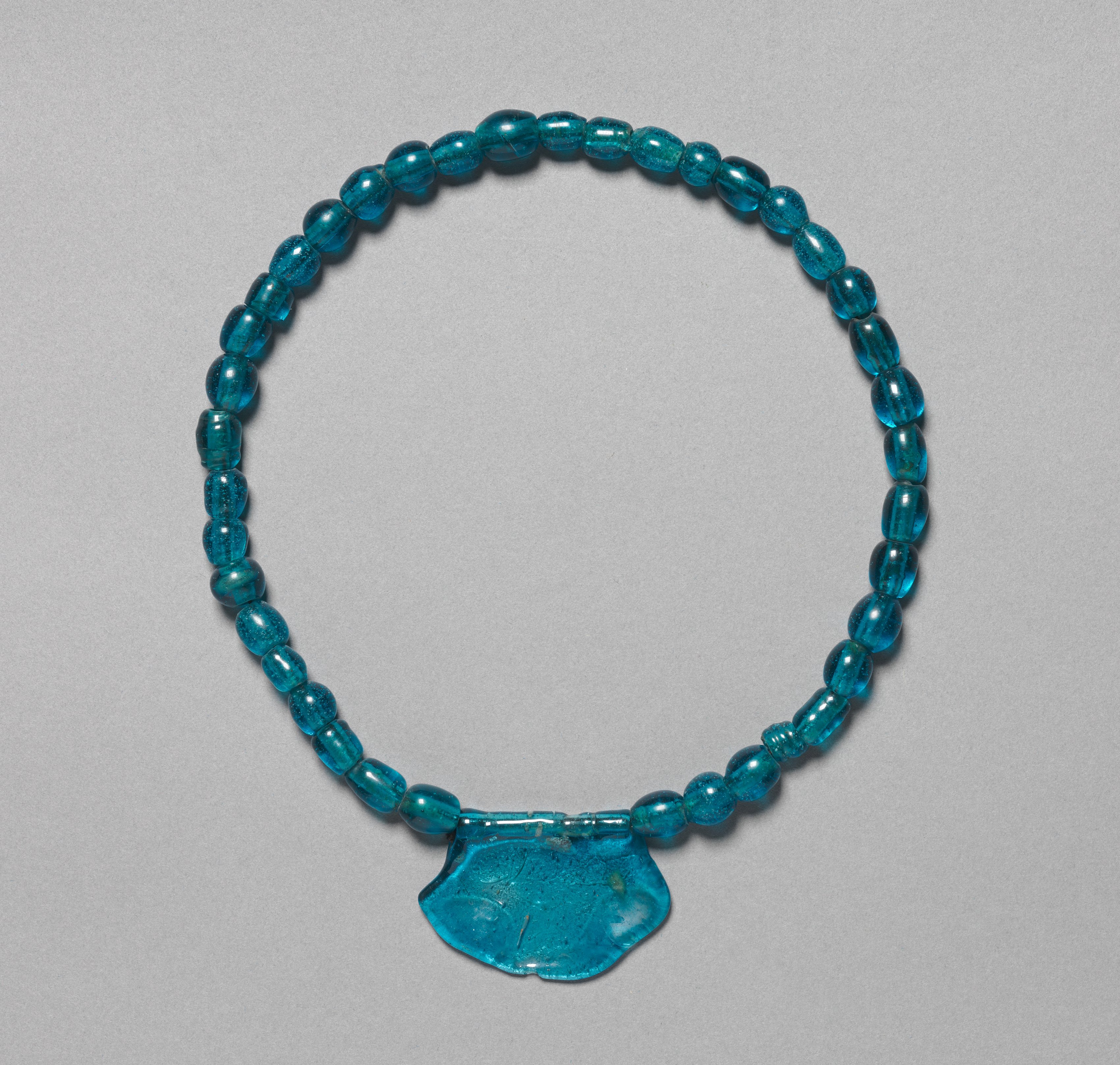
Deconstructing the Avant-Garde: Glass Beads with Pendant from the Three Kingdoms Period
At Zoey Fashion Lab, our mission is to excavate the raw, untold narratives embedded within historical artifacts and re-engineer them into avant-garde fashion statements. The subject of this analysis—a glass bead with pendant from Korea’s Three Kingdoms period (57 BCE–668 CE)—presents a profound opportunity for deconstruction. This piece is not merely an ornament; it is a coded fragment of ancient identity, a technological marvel of its time, and a precursor to modern minimalist luxury. By applying our New DNA Strand methodology—which treats each artifact as a genetic sequence of cultural, material, and symbolic markers—we will unravel its potential to disrupt contemporary fashion paradigms.
Material and Technical Analysis: The Glass as a Medium of Power
The core material—glass—is the first point of departure. In the Three Kingdoms period, glass beads were imported luxuries, often originating from trade routes linking Korea to the Roman Empire, Central Asia, and China. This glass was not native; it was a foreign substance imbued with prestige and magical properties. The pendant’s glass composition, likely soda-lime or lead-based, demonstrates advanced crafting techniques such as winding or molding. The bead’s translucent or opaque quality, possibly with iridescent patina from millennia of burial, creates a visual tension between fragility and endurance.
For the avant-garde, glass as a material challenges the traditional hierarchy of fashion textiles. It is rigid yet fluid, cold yet luminous. In our deconstruction, we reimagine this glass not as a solitary object but as a structural element for wearable architecture. Imagine a garment where laser-cut glass beads are fused onto a bio-engineered silk lattice, creating a second skin that catches light like ancient fire. The pendant’s loop—a simple hole for threading—becomes a design principle: negative space as a connector. This echoes the New DNA Strand concept of “void-as-interface,” where absence is as meaningful as presence.
Cultural and Symbolic Deconstruction: The Bead as a Social Code
In the Three Kingdoms context, glass beads were markers of elite status, shamanistic protection, and interregional connectivity. They were often buried with the dead to accompany the soul into the afterlife. The pendant form—suspended, dangling—implies motion, breath, and the threshold between worlds. This duality—life and death, ornament and talisman—is a rich vein for avant-garde exploration.
Our analysis identifies three symbolic layers:
- Status and Trade: The bead signifies access to global networks. In fashion, this translates to supply chain transparency as a design feature. A garment could incorporate visible seams or tags that map the provenance of each bead, turning the wearer into a living archive of trade routes.
- Protection and Ritual: Beads were believed to ward off evil. For our lab, this inspires interactive wearables where the pendant’s weight triggers haptic feedback or light pulses when the wearer is in danger—a modern amulet.
- Transience and Memory: The bead’s fragility mirrors the fleeting nature of life. Avant-garde fashion often grapples with ephemerality. We propose a collection where glass beads are embedded in dissolvable fabrics, leaving only the pendant after a single wear—a commentary on disposable luxury and eternal essence.
Form and Structure: The Pendant as a Disruptor of Silhouette
The pendant’s form—typically a teardrop, disc, or cylinder—creates a focal point that disrupts the linear flow of a necklace. In avant-garde terms, this is a centrifugal design element. It pulls the eye downward, challenging the vertical axis of the body. Our deconstruction repositions this pendant not as an accessory but as a primary structural node. Imagine a jacket where the pendant acts as a counterweight, altering the drape and balance of the fabric. Or a dress where multiple pendants are sewn into the hem, creating a kinetic fringe that sways with each step, echoing the bead’s original motion on a string.
We also analyze the bead’s repetition in ancient contexts—often strung in multiples. This rhythm is a pattern language for the avant-garde. Instead of uniform spacing, we propose algorithmic arrangements: beads clustered densely at the shoulders, thinning toward the waist, then exploding in a cascade of pendants at the hem. This mimics the organic growth of a DNA strand, where information is both repeated and mutated.
Color and Light: The Iridescence of Time
Archaeological glass beads often exhibit a rainbow-like patina from chemical weathering. This iridescence is not a flaw but a temporal signature. In our lab, we treat this as a color palette: ghostly greens, amber golds, and deep blues that shift under different lighting. For an avant-garde collection, we would develop photochromic or thermochromic dyes that mimic this effect, allowing garments to change color based on temperature or UV exposure. The pendant itself could be a prism, casting spectral light onto the wearer’s skin—a literal illumination of the body as a canvas.
New DNA Strand: A Blueprint for Future Collections
The New DNA Strand methodology requires us to extract a genetic code from the artifact and splice it with contemporary fashion DNA. For this glass bead, the code is: Fragility + Connectivity + Ritual + Light. We propose a capsule collection titled “Silla’s Echo,” referencing the Silla kingdom (one of the Three Kingdoms). Key pieces include:
- The Amulet Gown: A floor-length gown with a single, oversized glass pendant at the sternum, suspended by a titanium chain. The gown’s fabric is a hand-loomed silk with embedded fiber optics that pulse like a heartbeat.
- The Trade Route Coat: A deconstructed trench coat with pockets made from hand-blown glass bubbles, each containing a single bead. The coat’s interior is lined with a digital map of ancient Silk Road routes, printed in conductive ink that glows when touched.
- The Transience Dress: A dress made from biodegradable cellulose film, with beads sewn in a spiral pattern. After one wearing, the film dissolves in water, leaving only the beads—a wearable memento mori.
Conclusion: The Bead as a Portal
This glass bead with pendant from the Three Kingdoms period is not a relic; it is a portal. It connects us to a time when fashion was not just adornment but a technology of identity, protection, and global exchange. At Zoey Fashion Lab, we deconstruct this portal to build new ones—garments that are simultaneously ancient and futuristic, fragile and powerful. By treating the bead as a New DNA Strand, we honor its past while mutating it into a form that challenges the very definition of fashion. The avant-garde is not about novelty; it is about seeing the future in the fragments of the past. This glass bead is such a fragment—and its light will guide us forward.